


Ahead of Xi’s meeting with Trump, China holds back rare earth shipments.
Geopolitical Worries
Reuters reports China Rare Earth Firms Halt Some US Shipments Over Geopolitical Worries.
Some Chinese rare earth suppliers are declining to ship to the U.S. for fear of repercussions from Beijing, three sources said, underscoring how access to the materials remains an issue for the U.S. weeks before President Xi Jinping visits Washington.
U.S. officials have repeatedly asked China to stick to commitments made in Busan and Beijing over the past year to ensure the smooth flow of rare earth export licences. The persistence of the problem has put it on the U.S. planning agenda ahead of Xi’s September 24 visit, a source familiar with the work said.
A handful of Chinese suppliers have refused to ship rare earths to U.S. companies since early August when China imposed sanctions on the Responsible Business Alliance (RBA), a U.S. supply chain monitor, a separate source with direct knowledge of the situation said.
With China deploying its own trade compliance weapons, the companies were wary of punishment from Beijing for complying with the due diligence framework of the Responsible Minerals Initiative (RMI), a global mineral supply chain audit programme connected with the RBA, the source said.
Other Chinese rare earths companies had already stopped shipments to the U.S. to avoid entanglement in geopolitics in recent months, two other sources familiar with the trade said. One cited four instances where Chinese firms declined to send material for fear it could be resold to banned users.
Tight Supply
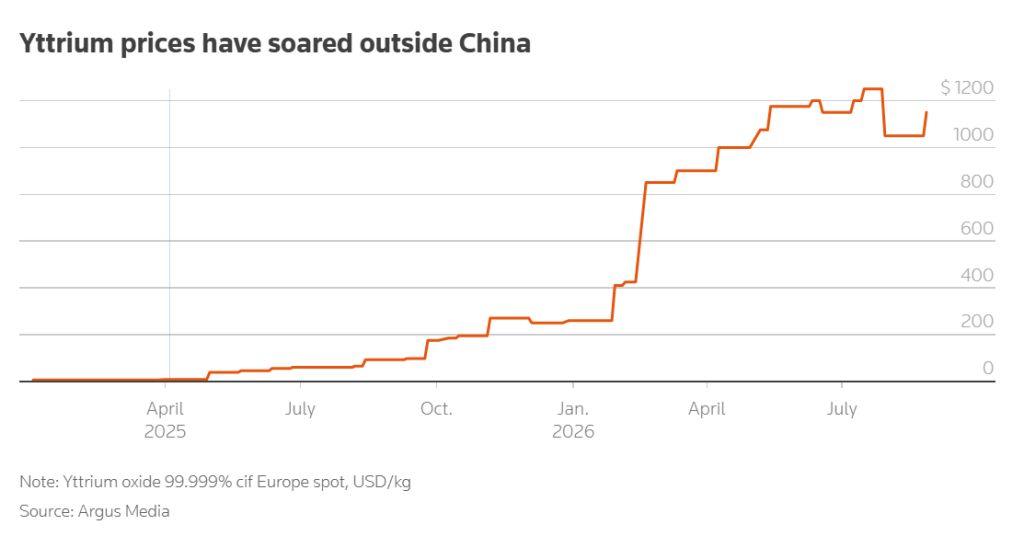
While exports of many rare earths or related magnets have rebounded since China imposed restrictions in April 2025, the prices of certain rare earths and critical materials like yttrium, indium phosphide and tungsten that have military applications or are used in sensitive industries including aerospace or chipmaking remain near record highs with tight supply.
Other industries affected by licence delays include medical devices and energy.
Exports to the U.S. of yttrium have risen this year but are still only about half 2024 levels despite large shipments to other countries, Chinese customs data shows. Some U.S. companies have been waiting more than six months for mineral licences, said two of the sources, declining to identify them.“China has been very effective in using rare earth export controls to impose restraint on the Commerce Department’s Bureau of Industry and Security,” said Reva Goujon, a geopolitical strategist at Rhodium Group, referring to the U.S. agency responsible for various restrictions targeting China.
“Supply chain chokepoints will come into focus, but I would expect Beijing to loosen up critical raw material controls a bit around the summit to deflate U.S. allegations that Beijing is not upholding the Busan truce,” Goujon added.
Beijing said its August decision to sanction the RBA and other U.S. auditing firms was a response to a series of FCC restrictions since December targeting Chinese electronics testing labs, drones, consumer routers, submarine cables, advanced robotics equipment and power inverters.
When U.S. officials have raised the rare earths issue in meetings, Chinese officials countered by saying the FCC actions were a violation of the Busan truce, said one of the sources who was briefed on the interaction.
Japan’s Trade Minister Ryosei Akazawa has previously said Japanese companies have faced delays in permits and prolonged customs inspections for critical minerals including rare earths. His ministry did not immediately respond to a request for comment on Friday.
China exported no terbium to Japan between January and August of this year, from 20 tons over the same months last year. Gallium shipments were 65% down in the same period, while yttrium was down 98%, Chinese customs data showed. Gallium and terbium are used in small amounts to make high performance rare earth magnets.
Economic Noose on Whom?
Stories like the above put a spotlight on which countries have a genuine economic noose.
Trump announced Economic D-Day on Iran, including sanctions on any country trading with Iran.
However, China said it would not honor Trump’s demand.
What’s Trump going to do about that besides nothing?
The U.S. Pressure Campaign
Economic D-Day: U.S. Treasury Secretary Scott Bessent announced a severe financial push against Iran in August 2026.
Secondary Sanctions: The U.S. threatened economic punishments for any nation, bank, or business that continues to trade with Iran.
The Goal: Washington wants to completely cut off Iranian oil money and force Tehran to surrender.
China’s Official Response
Rejection: Beijing condemned the American actions as illegal unilateral sanctions that lack support from international law.
Vow to Fight Back: Chinese foreign ministry officials stated that trade with Iran is normal and lawful, warning that China will take all necessary steps to protect its rights.
Call for Diplomacy: China urged the U.S. to stop economic pressure and solve the crisis through political talks instead. Detailed coverage of Beijing’s pushback can be found via the
China Isn’t Scared of Trump’s Squeeze on Iran
The Washington Institute reports China Isn’t Scared of Trump’s Squeeze on Iran
here’s a fatal flaw to the Trump administration’s recently announced “economic D-Day” against Iran. U.S. Treasury Secretary Scott Bessent declared that the new U.S. sanctions and pressure campaign was designed to “sever every economic lifeline that sustains the tyrannical regime” in Iran. But Iran’s single greatest lifeline, China, went unnamed.
China has long been the largest buyer of Iranian oil, with some estimates claiming that about 90 percent of Iran’s oil is shipped there through a network of “shadow fleets.” China also offers access to the Cross-Border Interbank Payment System (CIPS) that facilitates bank transfers outside of the U.S. dollar system, and through which volumes have gone up from 680 billion renminbi (RMB) per day to 790 billion RMB since the Iran war was launched. Thus, if the United States actually wanted to seriously harm Iran economically, it would have to go after China.
And yet, Beijing is hardly quivering in its boots. When the secretary was asked repeatedly at a press conference if “Operation Economic Outcast” would target Beijing, he demurred, without mentioning China directly: “No one is above the reach of U.S. sanctions.” And when pressed on why the Treasury Department is issuing a threat rather than just imposing the sanctions, Bessent simply said, “Why would I want to blow up the global financial system?”
Judging by the lackluster Chinese response, Beijing doesn’t seem too concerned by the new U.S. steps. China’s foreign ministry spokesperson condemned the announcement as “illegal” but went little further. One Chinese analyst writing on the China Internet Information Center, a State Council news outlet, described Bessent’s announcement as an “act of helplessness” that has more to do with addressing American frustration at home than with pressuring Iran. One private Chinese media outlet also pointed out how vague and slow-moving the new U.S. sanctions are.
Nevertheless, China has already said publicly that it would retaliate if the U.S. goes after its companies, and Chinese leader Xi Jinping knows it has the power to do so. So do at least some people in the Trump administration.
Beijing has recently armed itself with a legal framework for retaliation. In May, China invoked its new policy of “blocking rules” for the first time in response to U.S. sanctions against several of its biggest independent oil refineries. These rules effectively constitute a legal prohibition on any companies inside or outside China complying with the U.S. sanctions on Iran. So far, China has chosen not to enforce this rule, but it continues to signal to the United States that it is ready to do so if needed.
Most importantly, China knows it has an ace in the hole. Beyond its ability to take simple retaliatory measures, Beijing can also escalate its competition with Washington. Among its most powerful tools is a ban on the export of rare earths, which China knows that it can impose again. Freezing exports of rare earths to the U.S. last year brought some sectors of U.S. manufacturing to a standstill, particularly in the defense sector, and forced a rapid climbdown by Trump on Chinese tariffs.
This dynamic may ultimately benefit Iran. If the U.S. is unwilling or unable to bring to bear serious, concerted economic pressure on Iran’s chief economic lifeline, it will have to hope that its continued blockade of Iranian ports and military pressure is enough—despite decades of Iranian resilience to this kind of pressure. The U.S. seems to recognize that squeezing Iran depends on squeezing China. But so long as the Trump administration would rather avoid another trade war and another rare earths embargo, that squeeze will remain at best a half-hearted one.
Iran’s Primary Goal
The pressure on Iran is real, but China provides a bit of a lifeline. Regardless sanctions have never forced a country into political surrender.
I said in March that Iran’s primary goal is to inflict as much pain as possible on Trump.
By that measure, Iran has been more successful than Trump.
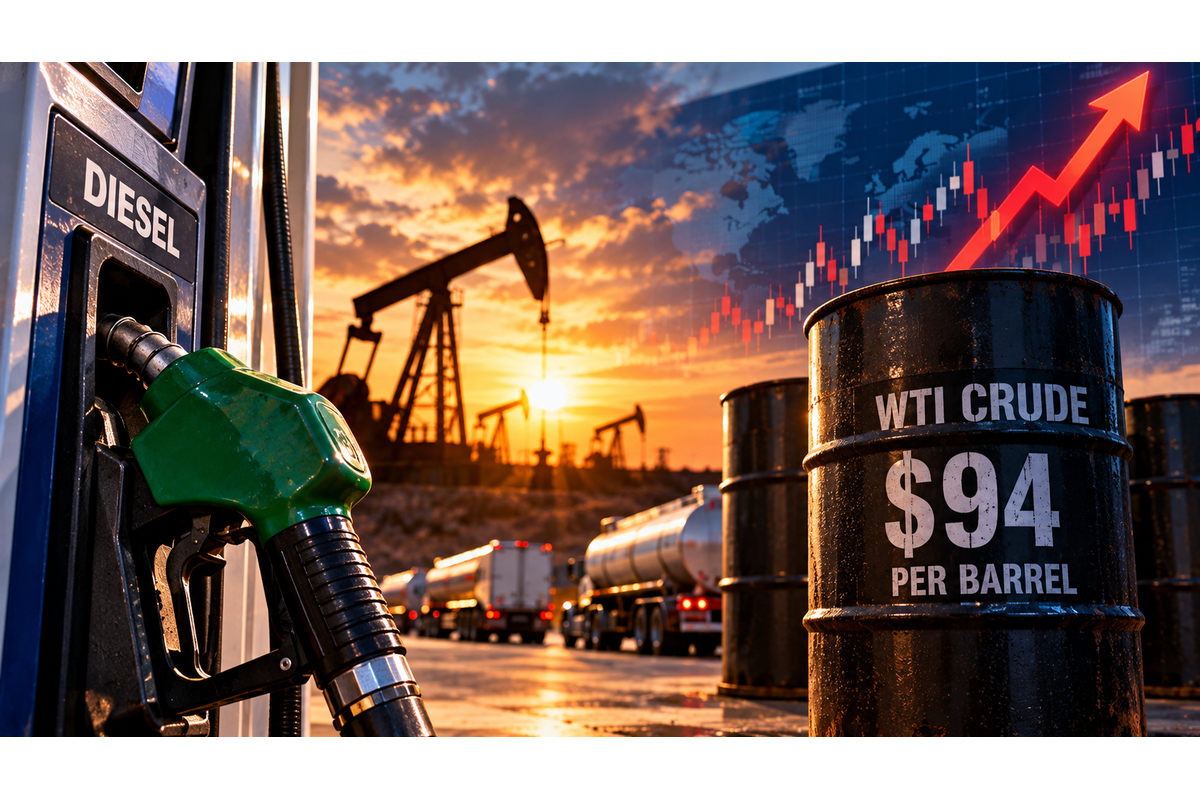
Diesel New Record High
On September 3, I commented The Price of Diesel Hit a New Record on Gas Buddy, AAA Tomorrow
Diesel jumped nearly 10 cents today after 5 cents yesterday.
Sure enough, AAA reported a new record high a day later. This move is not over. See above link for reasons why.
Classified Document Leak
Note that a Classified Document Leak Shows US Is Militarily Overextended in Iran
The truth is out. Hegseth has seriously messed up the war in Iran.
Is it Idiotic to Fight a War Over Something Worthless in Two Years?
Finally, please consider Is it Idiotic to Fight a War Over Something Worthless in Two Years?
My vote is yes, but that’s what Bessent says we are doing.

Comments
Log in or sign up to join the conversation.