


There’s a strange divide opening up in the AI economy.
As I wrote about in our last issue, it seems that every major company is at least experimenting with artificial intelligence. But some companies are using a lot more of it than others.
They might be using the same models, the same AI agents and many of the same tools. But somehow, this small group has found enough helpful things for AI to do that its spending has pulled far ahead of everyone else’s.
This week’s chart shows just how wide that gap has become.
AI’s Power Users
Our chart this week comes from Andreessen Horowitz’s latest State of the Markets report.
It looks at how much companies are spending on AI and separates them based on how heavily they’re using it.
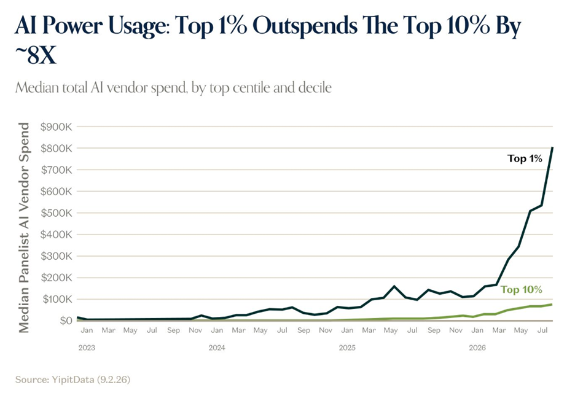
And as you can see, the companies in the top 1% of AI spending are now spending roughly 8X more than those in the top 10%.
That’s a massive difference. Especially when you consider that we’re comparing companies that are already among the heaviest users of AI.
And the gap has widened dramatically over the past year.
So what are the top 1% doing differently?
According to Andreessen Horowitz, they’ve simply found more ways to put AI to work. Instead of limiting AI to a few specific uses, they’re building it deeper into the way they operate.
For example, an employee might use AI to write an email or summarize a document. But a company can also use AI to write software, analyze data, answer customer questions, process invoices, detect fraud or even automate parts of its business.
And some of those applications can use far more AI than you’d expect.
As I’ve noted before, an AI agent might perform dozens of individual tasks while completing a single assignment. It can search for information, analyze what it finds, use another piece of software and check its own work.
That means one employee using an AI agent throughout the day could consume far more computing power than someone occasionally asking ChatGPT a question.
Multiply that across an entire company, and you can see how quickly AI usage can grow.
Andreessen Horowitz says it sees an even more extreme version of this among some of the AI companies it has invested in. Typical customers might spend $200 to $400 a month. But their biggest customers could spend $7,500 to $9,000 a month.
In some cases, the difference isn’t 2X or 3X.
It’s more than 20X.
And remember, these customers aren’t necessarily getting access to some dramatically better version of AI.
The difference is in how much they’ve found for it to do.
Here’s My Take
To me, this week’s chart changes the way we should think about AI adoption.
We tend to measure new technologies by how many people are using them. Like how many businesses adopted PCs in the 1980s, or how many people started using smartphones after Apple (AAPL) introduced the iPhone.
But is that the right way to think about AI?
After all, two companies can both legitimately say they use artificial intelligence. But if one uses it a few times a day and the other has AI working around the clock across all aspects of its business, what does that really mean?
Technically, they’ve both adopted AI. But economically, they’re not even close.
And I think we’re already starting to see that same divide among individual users.
Some people will only use AI occasionally to write an email or answer a question. Others will have AI agents handling work for them throughout the day.
That means AI won’t need billions of new users to have a much bigger impact on the economy.
It just needs the people and companies already using it to find more things for it to do.

Comments
Log in or sign up to join the conversation.