


One of the hardest things about covering emerging technologies is recognizing when they transition from promising to practical.
It doesn’t usually happen with a single announcement or breakthrough.
What’s much more common is that the emerging technology simply becomes a part of our everyday lives without us noticing.
This week’s chart hints that autonomous driving may soon be approaching this inflection point.
From Experimental to Practical
One of the biggest questions regarding robotaxis is whether they can safely navigate the real world.
Can they handle busy intersections? Construction zones? Pedestrians? Unpredictable drivers?
That question hasn’t disappeared completely. But this week’s chart from Our World In Data suggests we’re getting much closer to the answer.
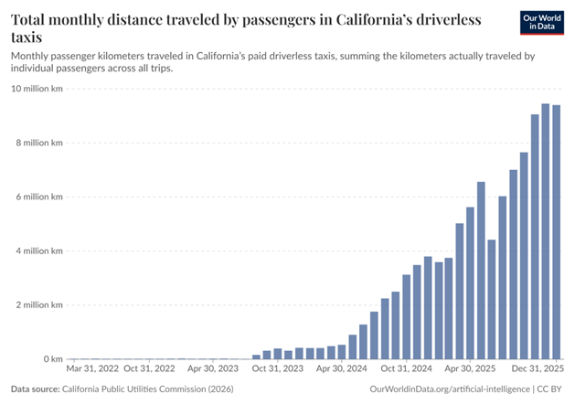
Rather than tracking engineering milestones or test miles, this chart measures the total distance traveled by paying passengers in California’s driverless taxis.
That distinction is important. Because the chart doesn’t show you how often robotaxis are driving around by themselves.
It’s a measure of how often people are choosing to ride in them.
And the increase over the past two years has been astonishing.
Just a few years ago, passenger travel in California’s robotaxis barely registered. Today, riders are logging nearly 10 million passenger kilometers every month, according to data compiled from the California Public Utilities Commission.
That doesn’t mean robotaxis have gone mainstream. Outside a handful of cities, most Americans still haven’t ridden in one.
But in the places where they’re available, they’re becoming increasingly routine.
And that’s largely because of one company.
Waymo (GOOGL).
When I wrote about robotaxis earlier this year, I argued that Waymo’s cautious approach was starting to look more practical than Tesla (TSLA)’s promise of rapid autonomy.
Since then, the company has only widened its lead.
According to California DMV data, Waymo logged nearly 7.2 million autonomous test miles in California during 2025. That accounts for almost 80% of all autonomous vehicle miles recorded in the state.
More importantly, it recorded nearly 3.9 million fully driverless miles, representing roughly 92% of all driverless miles logged in California last year.
Just as telling is what’s happened to its competition.
Cruise (GM), once Waymo’s biggest rival, effectively disappeared after suspending operations. And Zoox (AMZN) continues expanding, but it remains well behind Waymo in both testing and deployment.
Tesla told investors it expects to spend around $25 billion in capex this year largely on its robotaxi and Optimus robot initiatives. But as of today, its robotaxi service is limited to four U.S. cities, with only a small number of fully autonomous vehicles on the road.
Meanwhile, Waymo isn’t simply participating in California’s robotaxi industry.
It’s defining it.
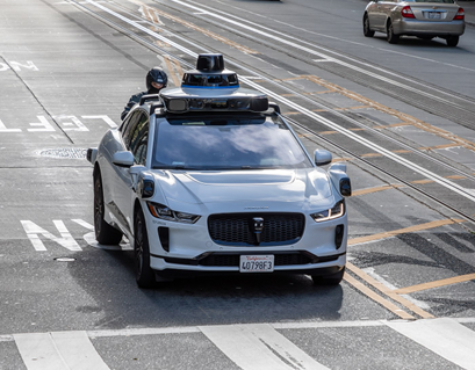
And the company’s growth isn’t limited to California.
Waymo now gives about 500,000 paid rides every week across the cities where it operates. That’s more than twice as many rides as it was giving less than a year ago.
It’s pretty easy to measure technological progress by counting software updates, sensor improvements or autonomous miles. Those are hard numbers.
But trust is much more difficult to quantify.
Even so, this chart gives us one of the best ways to measure it. Because every one of those passenger kilometers represents someone who chose to let an AI drive them across town.
And many of these passengers are doing it again and again.
That’s how an emerging technology becomes part of everyday life.
Here’s My Take
I’ve written about plenty of technologies that work but haven’t become part of our everyday lives.
Virtual reality and Google Glass immediately come to mind.
Robotaxis still have a long way to go before they’re everywhere. But this chart suggests they’re starting to clear one of the biggest hurdles every new technology faces.
They’re beginning to become routine.


Comments
Log in or sign up to join the conversation.