

Another month brings another spate of data on job growth, wages and inflation which then feed into speculation of when the central banks will raise rates again. In July, the U.S. economy generated just over 200,000 new jobs and recorded an unemployment rate of 4.3%. Canada created 11,000 additional jobs and the unemployment rate fell slightly to 6.3%. On both sides of the border, analysts immediately started to lay their bets on the timing and extent of future rate hikes from their respective central banks. The game of how fast and far rates will rise now is afoot.
Yet what continuously gnaws at the back of the minds of bankers is that the real conditions that would justify rate increases are conspicuously absent. For nearly 18 months, we have witnessed economic growth in the 2% range, modest wage increases and inflation running well-below target. Inflation in the OECD countries is at the slowest pace in nearly eight years.Yet, the Fed seems bent on pushing forward with its plans to shrink its balance sheet, “very soon”, according to the latest FMOC minutes. The Bank of Canada just raised its overnight rate and now speculation is rife that we can expect another rate hike as early as October. The European Central Bank has sent somewhat mixed signals that QE will cease shortly but has introduced the notion that monetary tightening may be on the way.
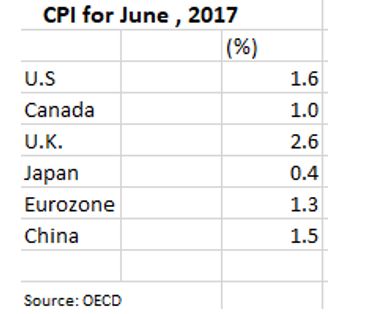
As the accompanying table demonstrates, the large economies have provided little in the way of support for such tightening measures. Inflation is running well below the 2% mark in June for most of the major industrialized nations. The one exception is the U.K. which has been hit by a major drop in the value of the pound in response to unsettled conditions regarding Brexit.
Cardiff Garcia of the FT offers a very interesting interpretation why central banks seem to ignore the lack of inflation when he states that:
A central bank’s willingness to tighten policy despite meager inflation is sometimes considered optimistic because policymakers expect the economy to return to full employment and target inflation despite less support from policy…. Rather than greeting this development {i.e. low inflation} as a gift that allows them to keep bolstering their economies, central banks are cautious, as though they do not quite believe what is plainly manifest in the data.[1]
In other words, the bankers should not look a “gift horse in the mouth”. Yet, they do just that. They still do not believe their good fortune. If the economy is growing without inflation, then why the need to tighten policy?
Certainly, we have heard on several occasions optimistic statements from Janet Yellen that inflation will reach 2% in the “medium term” and that implies that the Fed needs to jack up rates to meet that eventuality. Governor Poloz of the Bank of Canada speaks about the closing of the “output gap” in the very near future as a sign that the economy is operating a full capacity. Only the ECB and the BoJ continue to harbor very cautious concerns about the rate of expansion in their regions.
Yet, to many observers, this optimism is not supported by any concrete data. While hope springs eternal, hope should not be the basis of policy making. More to the point, tightening when conditions are non-inflationary may sow the seeds of an early downturn which would force the central banks to reverse policy. This kind of ‘go-stop’ way of making policy will do little to instill confidence in central bankers.
[1] Central banks’ abiding pessimism may yet become self-fulfilling, FT, August 5,2017



Comments
Log in or sign up to join the conversation.