

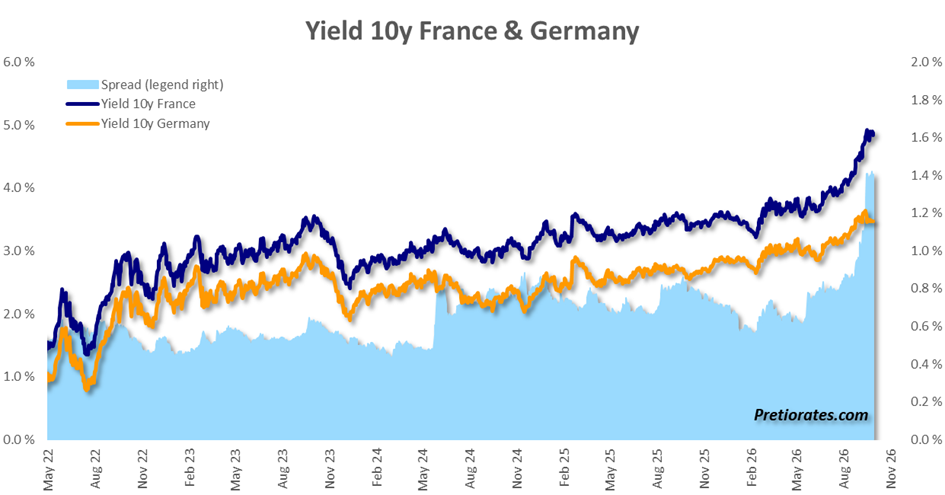
Last week, we speculated that ECB President Christine Lagarde would likely comment very soon on the situation surrounding rising market yields on French government bonds. We didn’t have to wait long. Just a few days later, confirmation came from the highest level: The central bank has sufficient tools at its disposal to combat “unfounded” and disorderly market dynamics. As expected, this statement initially brought some calm to the bond markets. The spread between German and French government bonds did not widen further—though it hasn’t narrowed yet either…
Elsewhere, in an interview with CNN, Lagarde confirmed a second expectation we had described last week: One of the tools in the ECB’s toolkit, the so-called “Transmission Protection Instrument” (TPI), is unlikely to be deployed. She called on the French government to take responsibility: The country must get its debt problems under control on its own through fiscal consolidation. In doing so, she indirectly confirmed our assessment that France does not currently qualify for this.
The ECB does not yet intend to deploy the rescue umbrella at a spread of 140 basis points, or 1.4%. Nevertheless, we’re willing to make a bet today: Should the spread widen to over 200 basis points, today’s “no” is likely to turn into “we’re monitoring the situation very closely” rather quickly—and, as is well known, that is often just the prelude to action on the part of central banks.
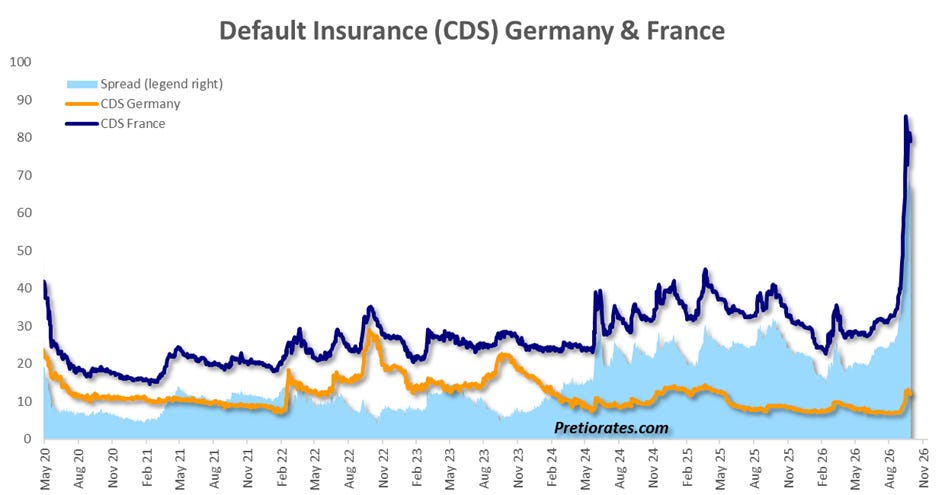
It is therefore not surprising that the insurance premiums against a French default—known as credit default swaps (CDS)—remain significantly higher than those for neighboring Germany—and have not yet declined even after this verbal reassurance.
For the moment, however, some calm has returned to the bond markets. In contrast, the stock markets—just as one would expect in October—are becoming increasingly nervous. We’ve already mentioned the arguments for a correction several times in recent Thoughts. What’s interesting, however, is this: Anyone looking only at the major indices might think everything is still fine. Only upon closer inspection does one realize that the correction began long ago: While the good old Dow Jones Industrial Average has been in reverse since early August…
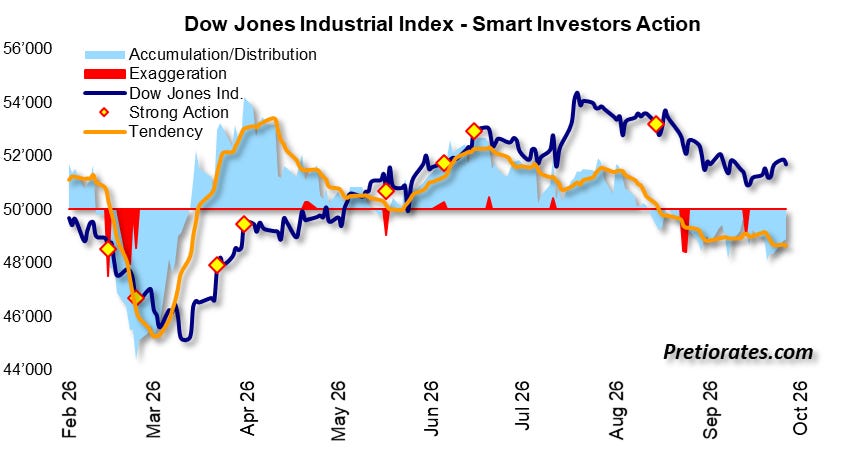
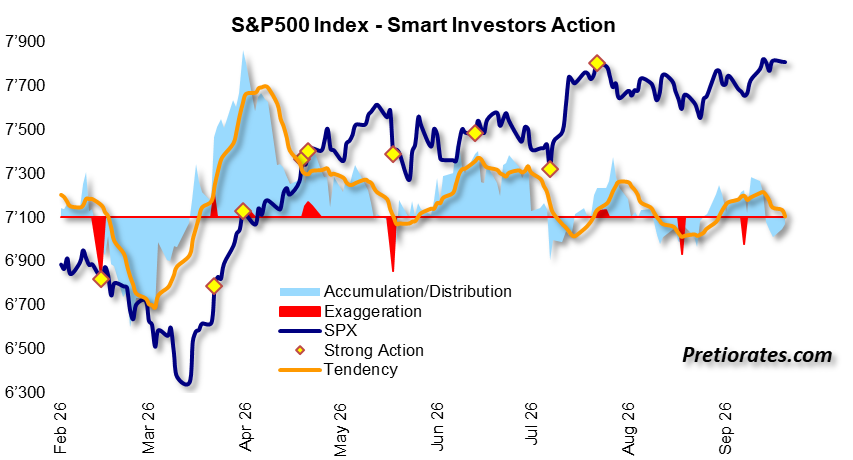
…the S&P 500 is still trading very close to its all-time high. There’s a simple explanation for this: While the Dow Jones—comprising 30 companies—does include some of the “Magnificent Seven” or “Hyperscalers”, the S&P 500 is now much more heavily weighted toward IT, AI, and related companies. AI and data center equipment providers, in particular, have performed exceptionally well recently, helping the S&P 500 set new records time and again. At the same time, however, stocks in the financial, banking, utilities, and other traditional sectors have long been in a correction phase. It’s just that these companies now carry significantly less weight in the S&P 500.
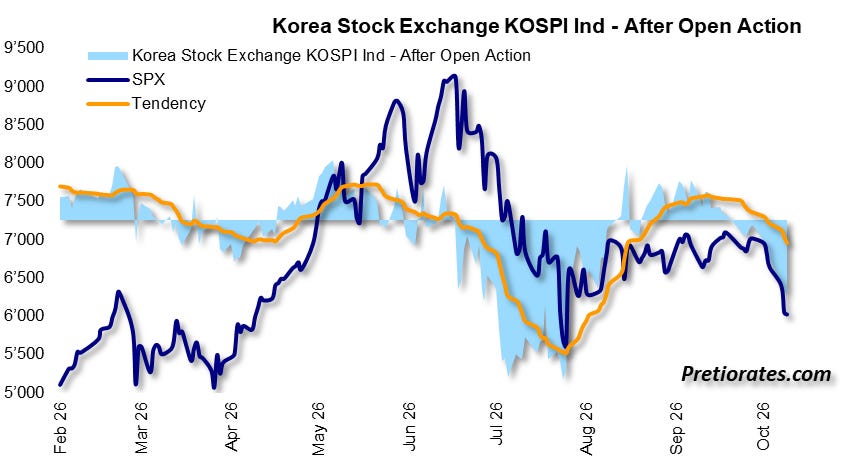
The real test for AI companies, however, likely lies ahead. In recent months, the Korean stock market has almost become a pioneer of the AI movement. And after the KOSPI triggered a minor global AI earthquake back in the summer, the index now appears to be taking a significant hit once again. Distribution by professional traders has recently increased sharply once more. Should the Korean KOSPI index fall below its late-July low in the coming days, the pulse of AI stocks on Wall Street is also likely to quicken noticeably.
Another concern for the stock market is the upcoming midterm elections. The polls aren’t going the way Wall Street would like.
Precious metals—gold and silver—are also behaving almost as if following a script. The inflation figures released today triggered a wave of selling.
It would be more accurate to say, however, that the inflation figures—which came in barely higher than expected—provided traders with a welcome excuse to sell. If they had actually been the trigger for the sell-off in precious metals, bonds would also have come under greater pressure—which was not the case.
But as is so often the case at the start of major corrections in the stock markets, precious metals are the first to take a hit. We recall 2009, 2015, 2020, and 2022: In the early stages, gold and silver were among the biggest losers—only to subsequently be among the first assets to post the strongest gains. But precious metals are, after all, the assets with the greatest market liquidity. That’s why investors usually hit the “sell” button on them first when cash becomes king again.
But… as you’ve read here before: Should the stock markets come under greater pressure, today’s expectations of further interest rate hikes could turn into fantasies of lower interest rates surprisingly quickly—including QE as a possible additional option. That’s exactly what could then trigger the next rally in precious metals and likely in cryptocurrencies as well. Until then, however, the rule remains: Cash is King…



Comments
Log in or sign up to join the conversation.