

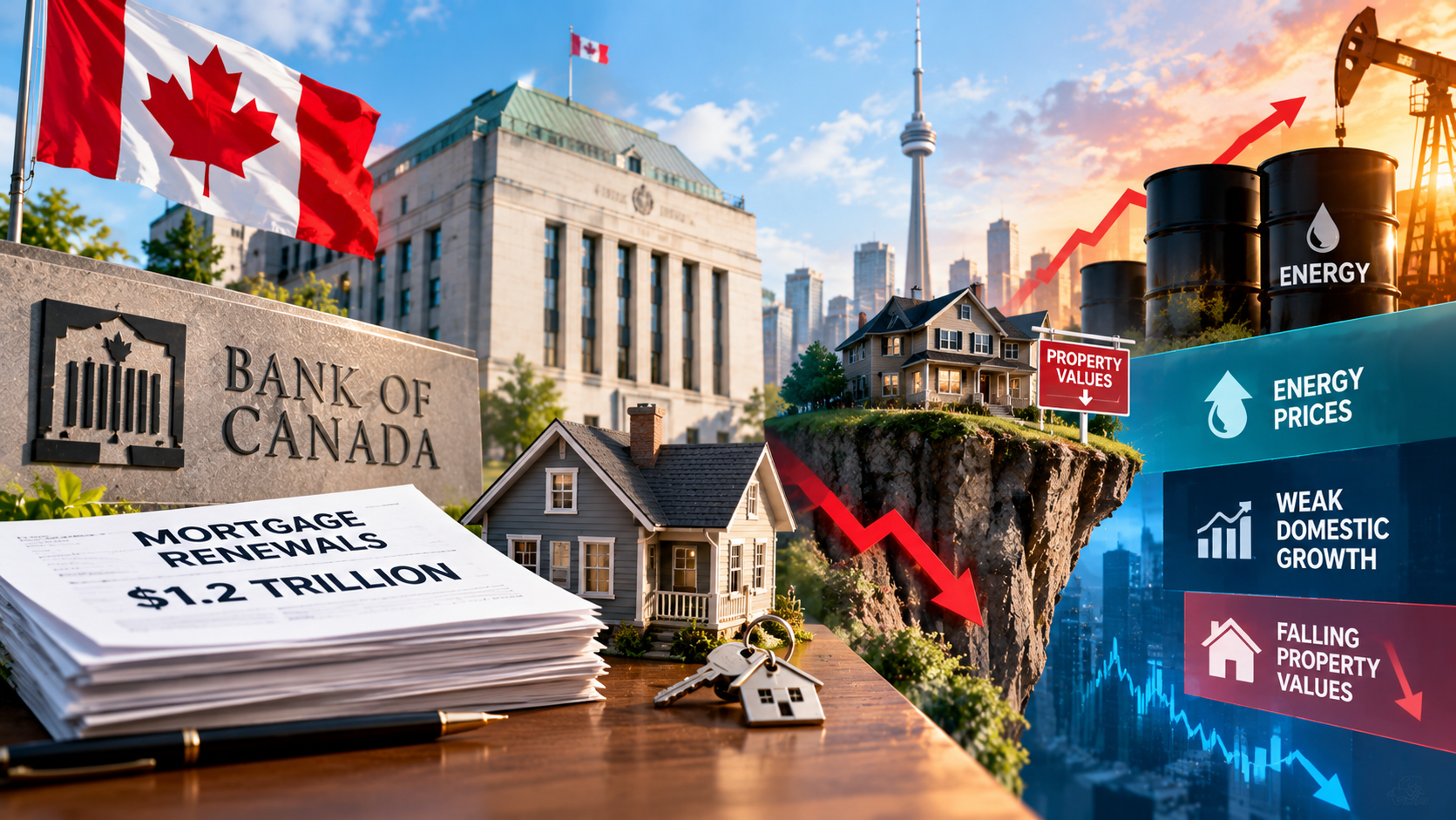
When the Bank of Canada (BoC) meets on October 28th to decide whether a rate hike is warranted, the state of the Canadian real estate market will figure prominently in that deliberation. Unlike the U.S. market, where 30-year fixed mortgages are the industry’s standard, Canada’s mortgages are either 5-year fixed or vary with the changes in the commercial prime rate. Often referred to as the “renewal cliff”, millions of Canadian homeowners must renew their 5-year fixed rates, which will impact household debt-servicing ratios.
Housing authorities in Canada estimate that 60% of all outstanding residential mortgages—approximately C$1.2 trillion in debt—are scheduled for renewal during the current 2025–26 cycle and the remaining 40% in 2027. Considering that 5-year mortgages were issued in 2021 at less than 2%—compared to renewal rates at 4.60%—homeowners are in for a rude awakening. Housing prices have fallen in Toronto by as much as 10% from their peak in 2021; worse yet, sales volume in 2025 was 48% lower than in 2021. This combination only contributes to further downward price pressure at a time when financing costs are rising.
Canadian mortgage rates are determined by adding about 1.20% to 1.75% to the yield on 5-year Government of Canada bonds. Today, the government's 5-year bond is trading at 3.6%, putting the conventional mortgage rate around 5%.
Economists are divided on whether the BoC should begin to increase its policy rate from its current level of 2.25%. Arguments for standing pat rest on the fact that domestic economic activity is weak; job losses are expected in important industries affected by the bilateral trade war; the unemployment rate is stubbornly above 6%; and the housing market is in a serious slump.
A more hawkish position calls for an immediate rate hike of 25 bps and an upward bias going forward. At the time of writing, Brent oil prices hit US$110, as hostilities between Saudi Arabia and Yemen continue, threatening global supply disruptions. While Canada’s inflation rate remains below that of the U.S., a case can be made that some rate tightening is needed now as a preemptive measure before it is too late.
The BoC Dilemma: The BoC's dilemma is whether to raise rates to deal with future domestic inflation and, by doing so, add more salt to the wound in the Canadian housing market. To the extent that Canada’s inflation rate is heavily influenced by energy supply shocks, the BoC would do well to hold back on any rate hike in the interest of supporting domestic economic growth.


Comments
Log in or sign up to join the conversation.