


The USD/CAD pair declines to around 1.4025 during the early European session on Tuesday. Nonetheless, the potential downside for the pair might be limited amid a hawkish stance of the US Federal Reserve (Fed). Fed officials are scheduled to speak later on Tuesday, including John Williams, Philip Jefferson and Thomas Barkin.
Traders are contending with hawkish signals from the US central bank, reinforcing expectations of further tightening later this year. This, in turn, could underpin the US Dollar (USD) against the Canadian Dollar (CAD).
St. Louis Fed President Alberto Musalem said on Monday that the central bank will likely need to hike interest rates further to lower inflation resulting from strong demand as well as a commodity price shock that has moved beyond oil.
Last week, the Fed raised interest rates by a quarter of a percentage point and penciled in an additional hike later this year, steps aimed at containing inflation.
Meanwhile, a rise in crude oil prices could support the commodity-linked Loonie. Iran and the US exchanged threats on Sunday, though US President Donald Trump said he would be open to meeting Iranian President Masoud Pezeshkian, who is expected to be in New York this week for the UN General Assembly, per CNBC.
Uncertainty in the Middle East remains high after Yemen’s Iran-backed Houthis said they attacked Riyadh and a Saudi Aramco facility in Yanbu and stepped up efforts to cut off Saudi-backed forces from the Red Sea coast. It is worth noting that Canada is a major oil-exporting country, and high crude oil prices generally have a positive impact on the CAD.
USD strength and wider US-Canada spreads keep CAD on the back foot
Strategists at Scotiabank note that the Canadian Dollar remains under pressure, with “crude oil prices lower on the day also but wider US/Canada front-end spreads are the biggest drag on the currency.” They add that “spot does remain somewhat overvalued relative to our fair value estimate (1.3910),” and caution that, “at the margin, the weaker CAD is unhelpful for the BoC as it considers building inflation risks.”
On the technical side, Scotiabank describes the backdrop as “bullish”—highlighting that “the USD continues to pressure the 50% retracement resistance of the June/August slide in the USD at 1.3990.” They point out that “USD bullish trend momentum on the intraday and daily oscillators supports the positive USD undertone and a sustained push through 1.40 would bolster the outlook for additional gains towards 1.4050/1.4125.” In this context, “support has shifted higher to 1.3940/50,” underscoring the firm tone in USD/CAD.
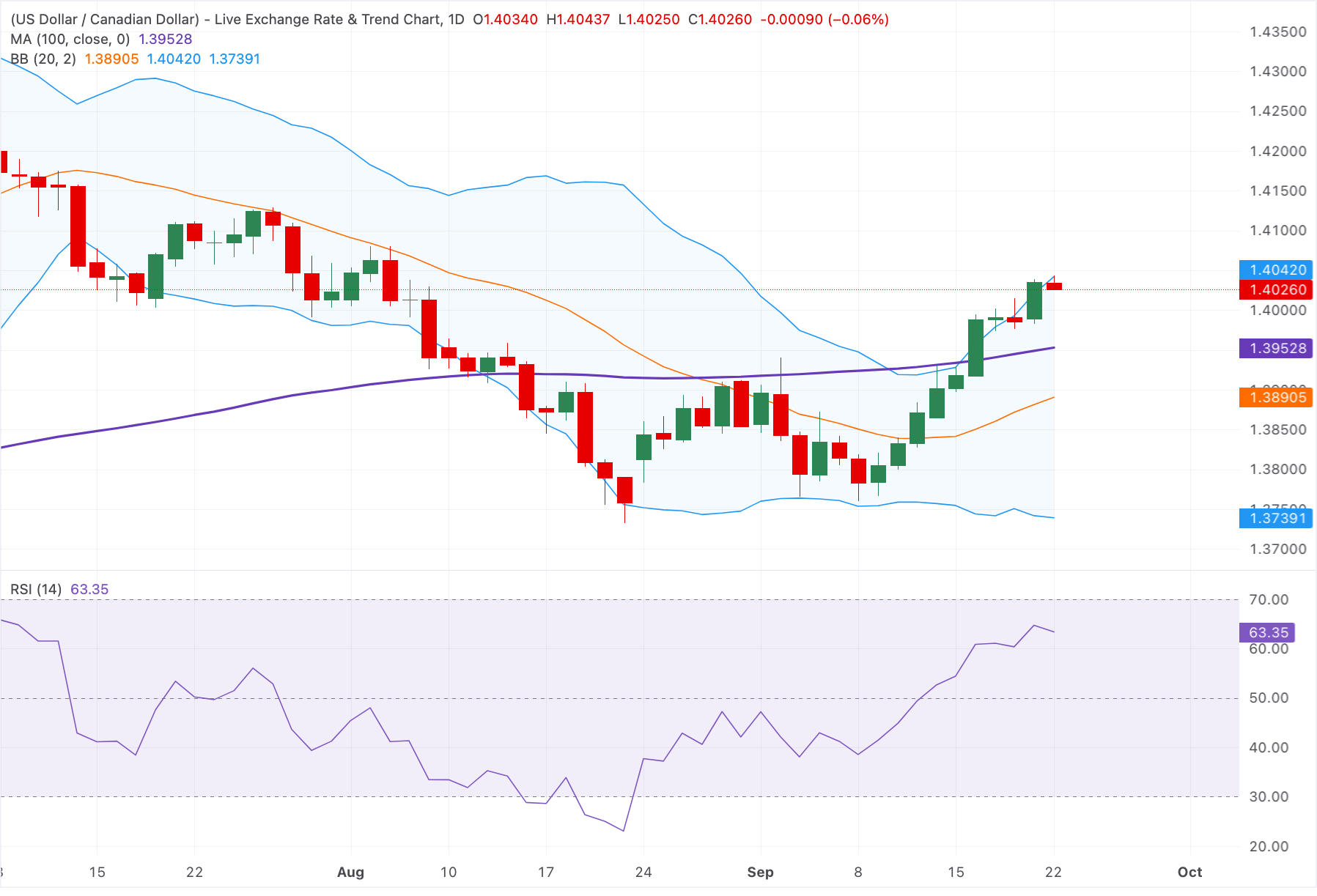
Technical Analysis: USD/CAD retains a positive bias above the 100-day SMA
In the daily chart, USD/CAD keeps a bullish near-term bias as spot holds above the 100-day moving average (MA) and the Bollinger middle band. The pair is pressing into the upper half of the recent volatility envelope, with the Bollinger upper band just ahead, while the Relative Strength Index (RSI) at 63 suggests firm but not yet overbought upside momentum.
On the topside, initial resistance is located at the Bollinger upper band near 1.4040, where a clear break would open the way for further gains in the short term. On the downside, support is seen first at the 100-day MA around 1.3955, followed by the Bollinger middle band at 1.3891, with the lower band near 1.3740 acting as a deeper structural floor should a broader pullback unfold.



Comments
Log in or sign up to join the conversation.