

Canada’s Finance Minister, Bill Morneau, released a long awaited ‘snapshot’ of the federal government support during the economic crisis. The deficit will reach C$343 billion deficit (US$ 255 billion) for this coming year, more than ten times the deficit forecasted in the last budget, pre-COVID-19 pandemic. For the Finance Minster the most important immediate issue is: how does the government finance this deficit and at what cost?
To begin with, Canada started out with lowest net debt/GDP of any of the G7 countries. Canada in 2020 will record a debt ratio of just under 50%, compared to an average debt ratio for the G7 of 100%.
(Click on image to enlarge)
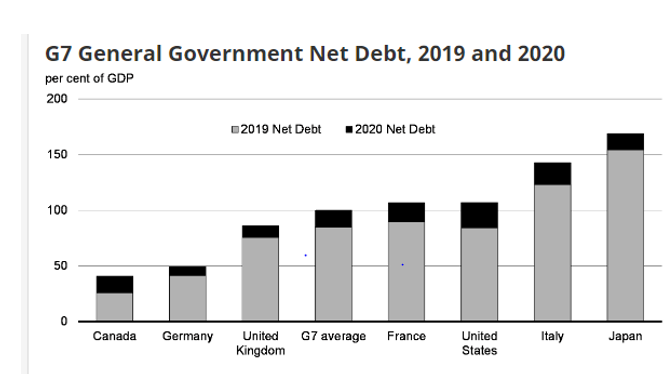
Source: IMF and Canada Dept of Finance
This is an extraordinary time for governments to issue debt cheaply. Canadian long-term interest rates are at historic low levels, resulting in overall borrowing costs that will actually fall as percent of GDP. Debt charges are expected to be less than 1% of GDP through 2020-21.
(Click on image to enlarge)
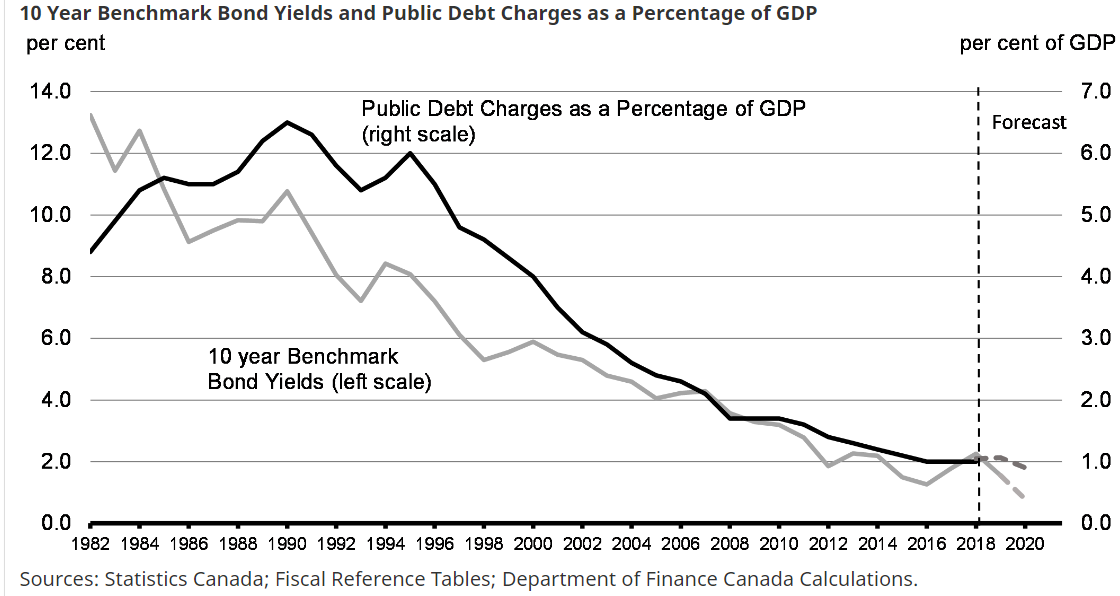
Canadian governments have customarily borrowed mostly in the short-to medium- term bond market. Now, the government is rightly taking advantage of issuing more debt in the 10-year and 30-year market where rates currently sit at 0.7% and 1.0%, respectively. Moreover, the bulk of Canadian long-term debt is in the hands of Canadian institutions such as pension funds, insurance companies and related financial institutions which have regulatory obligations to purchase Canadian government assets. Tapping into the long-term bond serves both the needs of the issuers and borrowers. As the Finance Minister put it:
With this Debt Management Strategy, the government intends to issue a historic level of long-term bonds to manage the significant increase in debt resulting from the response to COVID-19. In light of the unique situation posed by the COVID-19 crisis, the government will continue to review the Debt Management Strategy for opportunities to borrow at longer maturities and lock in historically low interest rates, as well as enhance the predictability of debt servicing costs.
Make no mistake, the recovery from the devastation of Covid-19 will take years and the impact on governments will be profound. We do not know how revenues and (non-interest) expenses will evolve over the next few years. The Federal government has to deal with the impact on individual sectors and different segments of the population harmed by the pandemic. It will take years before national budgets will approach any semblance of balance. The only saving grace is that current interest rate environment does provide a unique opportunity to fund the recovery process at the least cost in decades.



Comments
Log in or sign up to join the conversation.