


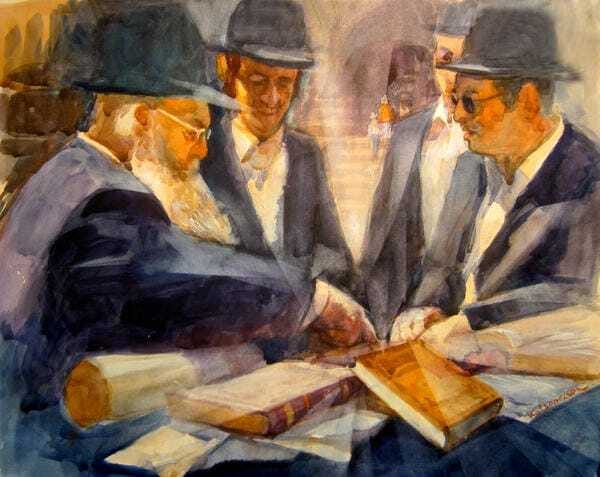
Watercolor "In Studio" is by my father Naum Katsenelson
P.S. Music Note: Today I want to share with you one of the most popular arias, “Nessun Dorma,” from the opera Turandot, composed by Giacomo Puccini.
I heard it for the first time in 1990 when I watched The Three Tenors concert at the FIFA World Cup (watch it here). The Three Tenors were Luciano Pavarotti, Placido Domingo, and Jose Carreras. At the 1990 World Cup Pavarotti sang “Nessun Dorma” solo; however, at the 1994 World Cup concert in Los Angeles the other two tenors joined him (watch it here). The Three Tenor concerts had a tremendous impact on me – arguably, they were the reason I fell in love with opera. You can watch the whole 1994 concert here.
What would you get if you crossed Warren Buffett, Richard Branson and Steve Jobs? Answer: Masayoshi Son, the Korean-Japanese, University of California, Berkeley–educated founder of one of Japan’s most successful companies, SoftBank Corp.
Just like Buffett, Son is a tremendous capital allocator with a very impressive record: Over the past nine and a half years, SoftBank’s investments have had a 45 percent annualized rate of return. A big chunk of this success can be attributed to one stock: Chinese e-commerce giant Alibaba, a $100 million investment SoftBank made in 2001 that is worth about $80 billion today. Though you may put Alibaba in the (positive) black swan column, Son’s success as an investor goes well beyond it — the list of his investments that have brought multibagger returns is very long. Today, at the tender age of 57, he is the richest man in Japan, and SoftBank, which he started in 1981 and owns 19 percent of, has a market capitalization of $72 billion.
Son, like Apple co-founder Jobs, is blessed with clairvoyance. He saw the Internet as an amazing, transformative force well before that fact became common knowledge. In 1995 he invested in a then-tiny company, Yahoo!, earning six times his investment. But he didn’t stop there; he created a joint venture with Yahoo! by forming Yahoo! Japan, putting about $70 million in a company that today is worth around $8 billion. (Yahoo! Japan is a publicly traded company listed in Japan).
What is shocking is that Son saw that the iPhone would revolutionize the telecom industry before Apple announced it or even invented it. See for yourself in this excerpt from an interview with Charlie Rose, where Son describes his conversation with Jobs in 2005 — two years before the iPhone was introduced:
“I brought my little drawing of [an] iPod with mobile capabilities. I gave [Jobs] my drawing, and Steve says, “Masa, you don’t give me your drawing. I have my own.” I said, “Well, I don’t need to give you my dirty paper, but once you have your product, give me for Japan.” He said, “Well, Masa, you are crazy. We have not talked to anybody, but you came to see me as the first guy. I give to you.”
Similar to Virgin Group founder Branson, who had the testicular fortitude to create Virgin Atlantic Airways in the U.K. to compete against the state-owned behemoth British Airways, Son started two telecom businesses in Japan — one fixed-line and one wireless — with which he challenged the state-owned NTT monopoly. In 2001, disgusted with Japan’s horrible broadband speeds, he convinced the government to deregulate the telecom industry. When no other companies emerged to compete with NTT (I don’t blame them, really), Son took it upon himself to start a fixed-line competitor, Yahoo! BB (Broadband). Thanks to him, now Japan enjoys one of the highest broadband speeds in the world and Yahoo! BB is a leading fixed-line telecom.
It took Son four years to bring his broadband business to profitability. This is how the Wall Street Journal described that period in 2012:
“The problems at the broadband unit contributed to losses for the entire company for four consecutive years. Mr. Son set up an office in a meeting room 13 floors below his executive suite to be closer to the problem unit. He slept in the office at times and routinely summoned executives and partners for meetings late at night. . . . He worked out of the meeting room for 18 months, until the broadband unit had cut enough costs and moved enough customers to more lucrative plans.”


Comments
Log in or sign up to join the conversation.