

“Bonds Overpriced Relative to Stocks” says Bloomberg
It Follows that Equities Underpriced Relative to Bonds.
Yields Fall as Bond Bulls continue to Charge.
In a Bloomberg article published on June 13 entitled “Most Expensive Bond Market in History Has Come Unhinged. Or Not”, Susanne Walker Barton and Liz McCormick assert that U.S. government bonds are overpriced relative to stocks. The corollary is that stocks are underpriced relative to bonds.
“The yield of the 10-year bond closed yesterday at 1.61% the lowest close since 2012. That’s about a half-percentage point below the 2.17 percent dividend yield for the S&P 500. On that basis, Treasuries have been more expensive than U.S. equities for five months, which has occurred on only two other occasions -- in 2008 and 2012, data compiled by S&P Global Inc. show.”
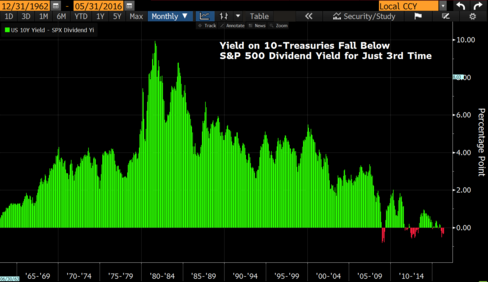
Chatter about risk in the bond market seems to be devoid of any positive comments about the equity market. While Treasuries posted their worst annual returns on record, losing 3.7 percent in 2009 and 3.4 percent in 2013, equities had spectacular returns of 21.5% and 28.6% respectively.
A similar situation is true of the relationship between the US 30 T Bond yield and the DJII yield. The ratio of bond yield to the equity yield fell below 1 in 2008, and 2012. It is below parity again today.
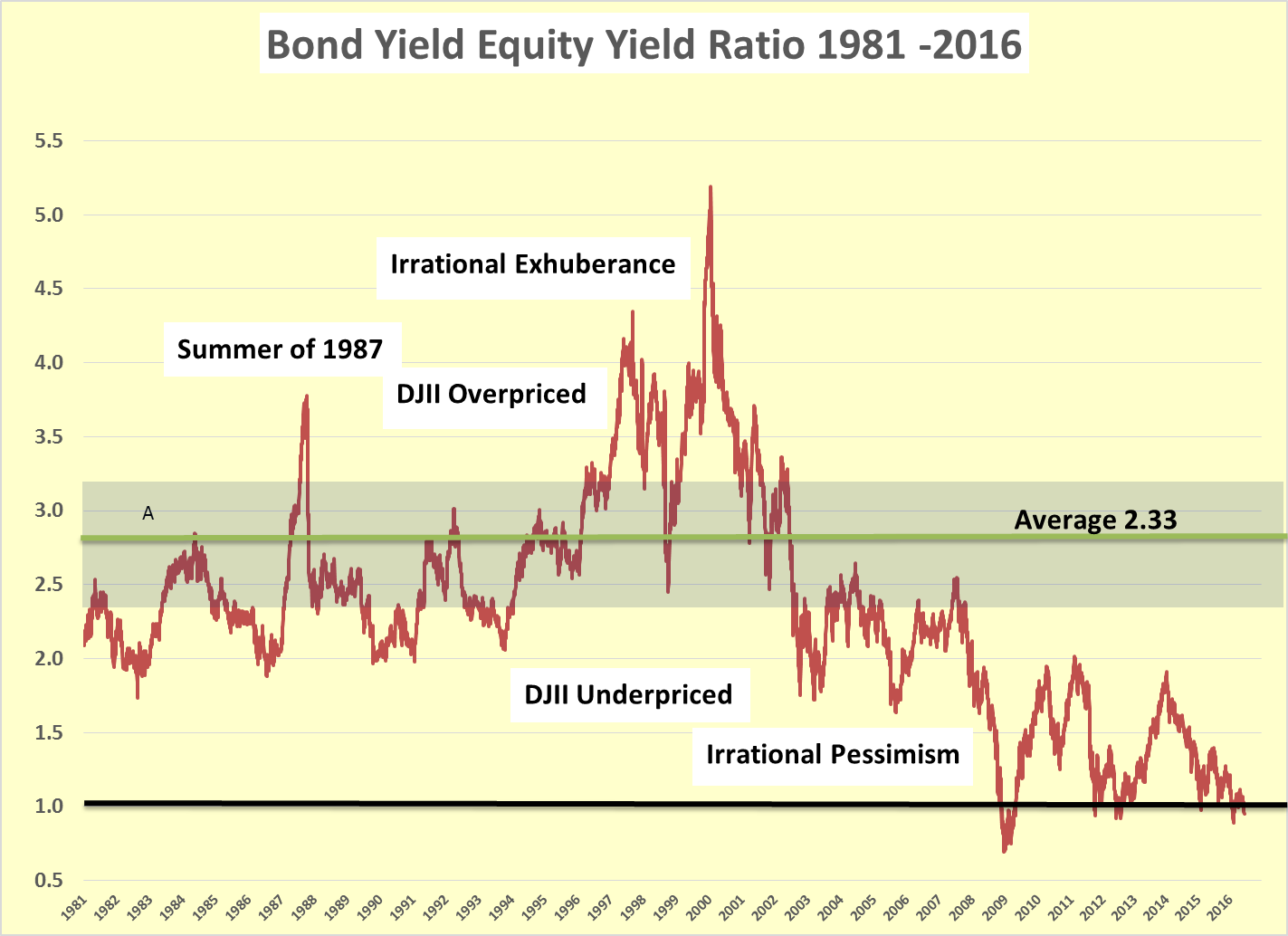
This chart supports strongly the argument that the risk is in the bond market rather than the equity market. The DJII is priced with fear and trepidation in anticipation of interest rates returning to “normal” as well as a seemingly near-term expectation of yet another recession. The price of the DJII is already anticipating a rise in the yield of the 30 year T Bond to 6%.
However, it is highly improbable that there would be both a rise in the long bond yield of that magnitude if a recession were to occur in the near-term. From this it might be concluded that the risk in owning equities is minimal. Particularly with sovereign yields falling rather than rising.
Long Rates Not Rising but Falling.
Despite prognostications to the contrary, yields of U.S. treasuries are falling as the bond bull charges on. Driven by low and negative international sovereign yields along with the much vaunted insufficient supply of new U.S. treasury issues.
International central banks are using negative interest rates to discourage the parking of excess reserves in their vaults in an effort to stimulate their respective economies. This increases the amount of money sloshing around the world looking for yield and safety. Hence the attraction of U.S. treasuries which still have positive yields.
Fed Quandary: To raise or not to raise.
While stating to be data-dependant the Fed also takes into consideration developments in international markets on deciding what to do next. There seems to be a desire to return to “normal” rates without stating what they might be.
Should the Funds rate be increased by 25 beeps there is a high probability that the deposit rate will also rise by the same amount to O.75% per annum. In a world of low and negative rates, such a level, which is better than on 2 year government paper, must look increasingly attractive to the commercial banks that are holding an unprecedented, pre-Lehman, amount of US$2.3 trillion of excess reserves at the Fed.
Although the Fed’s action will have an impact on short rates, including the two year rate, the long end of the market is unlikely to be much influenced. The continuing demand for safety and yield could well push long U.S. rates even lower. Couple this with a higher Fed Funds rate and the yield curve would flatten even further. In turn this would incorrectly be seen to presage a recession spurring even more demand for safety and yield.
It is conceivable that the Fed may not increase the deposit rate and may even reduce it, even so far as negative levels in order to drive the commercial banks to fulfil their supposed task of lending money into the real economy. This is what international central banks are doing by imposing negative deposit rates.
Lowering the deposit rate would of course push even more money out into the long end of the spectrum resulting in yet further downward pressure on long rates and a continuation of the bond bull market, making bonds even more risky and overpriced relative to equities.
Buying Bonds and Selling Equities: Abject Madness
A steady dividend and falling 30 year T bond yield would push up the relative yield of the DJII even further. On an after-tax basis the return from the DJII dividend would be even higher than it is, thereby adding greatly to its attraction.
The risk of investing in the DJII today appears minimal relative to 30 year T bonds which, while expensive, could become even more so. On balance the potential reward of the investing in the DJII appears to outweigh greatly the risk of investing in long U.S. treasuries. Despite this market participants are doing precisely the opposite.
It seems that when most market participants are either buying or selling something they don’t understand it is usually the time to do the opposite. Remember March 9, 2009 when the DJII closed in the depths of despair at 6,547 and the October 19, 1987 close of 1,739. They were excellent days to buy.
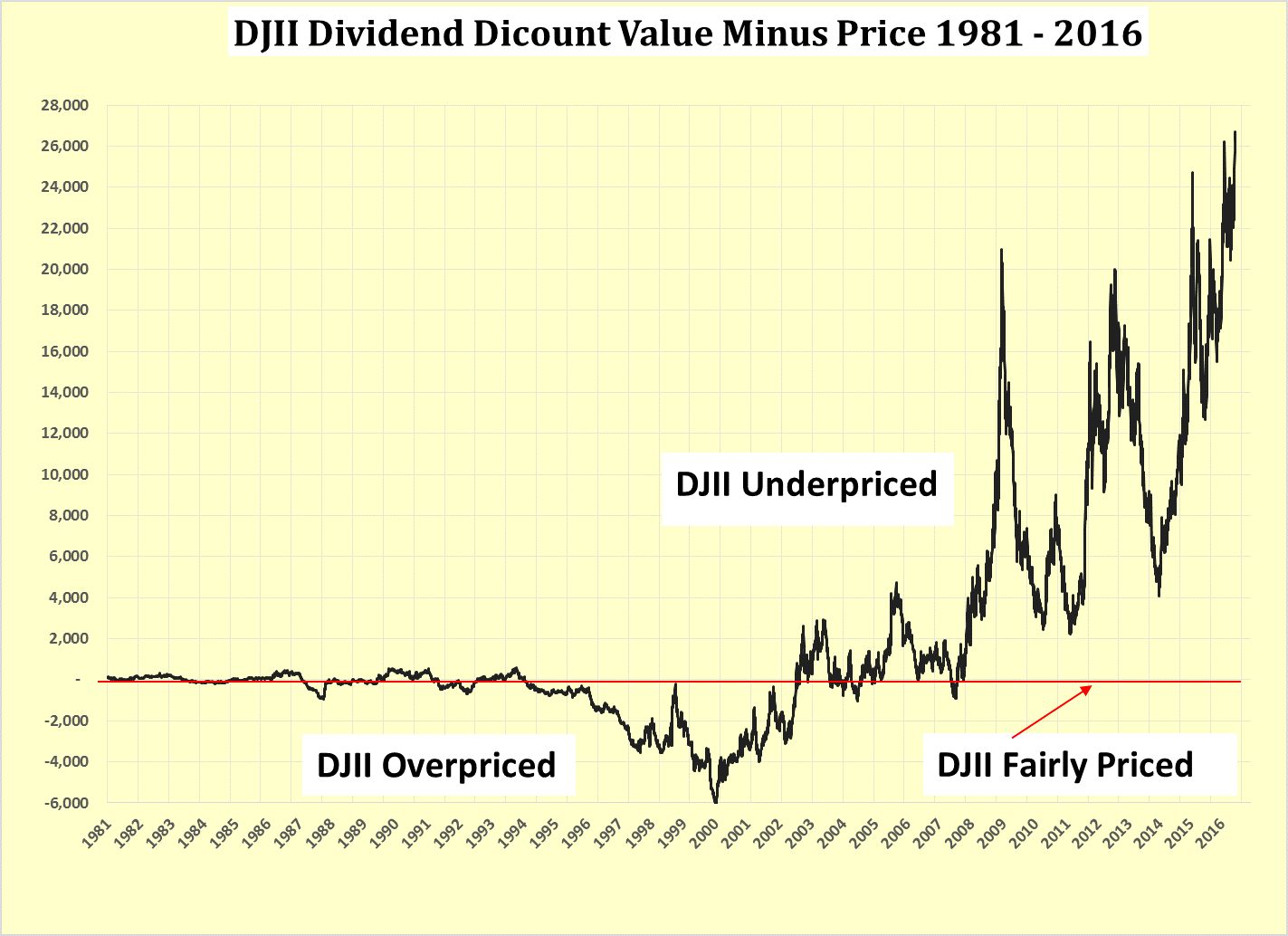
While the madness of negative interest rates with their brand new paradigm of taking money from the lender and giving it to the borrower may continue for a while, it seems certainly true that the selling of equities at these prices is folly beyond belief. Particularly, when the dividend-discount value of the DJI is at a record high of 44,344 which is also at a record 26,681 above its price of 17,675
Buy the DJII and take No Prisoners!


Comments
Log in or sign up to join the conversation.