


Berries - a cold winter weather warning!
It might seem strange to read gas buying advice knowing that since the collapse of the natural gas price in the US long ago - caused by the shale gas revolution - that price has both remained in the doldrums and become the most volatile of all commodity prices. (I will use natgas for simplicity purposes in the rest of this article).
For years the price has been dictated by the weather forecasts for Boston and ignored the needs of Berlin and Beijing plus huge new demand coming soon from many things including electricity generators for AI, quantum computing and from other countries.
Natural gas prices have not participated in the price increases that oil has had due to the Middle East wars (Iran and Yemen) - US retail diesel jumped around 66% to 75.47% in the past year. Now there is news of destroyed infrastructure in Iran but - unlike oil - the US price of natural gas has not been affected whereas the Europe's benchmark natgas price that has more than tripled this year to its highest levels since the 2022 energy crisis. Those wars are disrupting about 20% of global LNG supplies.
As far as weather is concerned a very cold, snowy winter in Europe this year is forecasted by the wise old wives warning about many berries on plants such as hawthorn and holly through Autumn. The photo above taken recently in my home garden in Switzerland shows a typical picture in much of central Europe this year. Modern day forecasters recently warned (in a FT report) of a potential "sudden stratospheric warming" - a major meteorological even involving a raid rise in temperatures high in the polar stratosphere - that could drive a blast of cold Artic air into northern Europe.
Gas is a primary energy source for room and water heating, accounting for roughly 30% to 40% of residential heating across European households. Other than households, major gas and electricity form the backbone of European industry, with natgas representing roughly 31% to 33% of final industrial energy consumption. Yet EU storage sits at the lowest seasonal level recorded since 2011! Germany's - the EU's industrial power house - storage level is less than 62% full. That will not change easily with Middle Eastern LNG deliveries to Europe remaining roughly 80% below year-earlier levels due to reroutings around the Cape of Good Hope that also makes alternative supplies from major LNG producer Australia more difficult and more expensive.
Britain's own natgas production is insufficient and is forecasted to need more than three times as much as it currently produces over the next twenty years.
The chart below shows how dramatic the US natgas price collapse was and is possibly an indication that prices can only go up from here, having mostly flatlined since then apart from a spike up to $10 in 2022 when Russia invaded Ukraine. Those wars in Ukraine and the Middle East reinforce the need for a more secure and reliable energy system. Today, only the US can provide that.
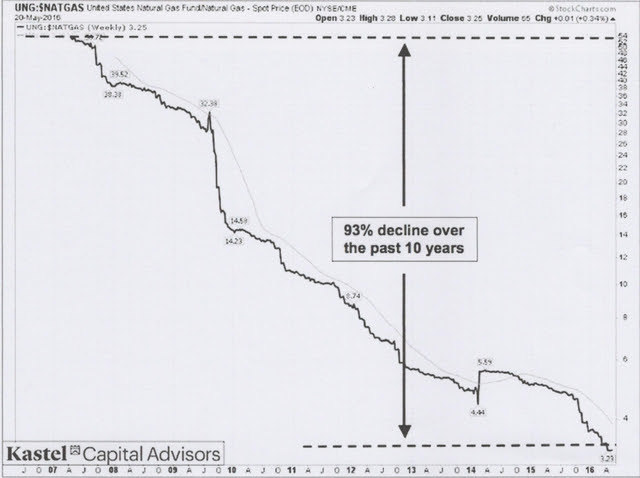
In 2007 the price was over $50 per MMBtu. It's high in 2026 was around $ 3.30. Today, as I write, it is $2.87. The U.S. Energy Information Administration (EIA) forecasts the price will average $3.44 for this year.
Even at that price my chosen US producers (names later) - whose breakeven price is around $2 or less - will make good profits but I believe the price will soon start to soar maybe back to $10 again as new demand comes on stream and especially given the huge difference between US and other world prices...
Current global average prices are approaching 500% higher than US prices!
United States | Henry Hub | $2.52 – $3.65 / MMBtu | |
Europe | Title Transfer Facility (TTF) | $16.75 – ~$22.00 / MMBtu (EU TTF at ~€85.21–€85.49/MWh or ~$16.75–$21+ per MMBtu) | |
Asia | Japan Korea Marker (JKM) | $17.75 – $30.40 / MMBtu |
The latest European prices have now surged above E100/MWh for the first time since Russia's invasion of Ukraine in 2022. US natgas prices have been busy going nowhere!
That must change because in addition to war caused supply blockages there is ...
THE BIG PICTURE OF MASSIVE NEW DEMAND
Generally continued demand for US equities will ensure some gain for most sectors, including energy. I wrote about that in October last year in an article headed Follow The Money - Invest In The US. (LINK to insert under there) Follow The Money - Invest In The U.S. - TalkMarkets.pdf.
Perhaps I could "modestly" claim that the power of my articles led on to a Financial Times (FT for short) report stating that foreign investors are now buying more US stocks than government bonds and that international flows into US stocks reached 2.8% of US GDP in the first half of this year helping the S&P500 to be on track for four consecutive years of double digit gains; up over 11% so far this year. Gross payments of all kinds into the US in Q2 were a mountainous 30% of GDP. Another FT report said "foreign investors made a record $942bn in net purchases of US equities and investment fund shares in the 12 months to July, accelerating a shift in
overseas investment towards American stocks and away from debt. The flows represented the highest rolling 12-month total in Treasury data going back to 1985. Net purchases of US equities and investment fund shares by foreign investors jumped to $426bn in the second quarter, up 62 per cent from the same period in 2025, and surpassing the previous quarterly record of $299bn in 2022, according to the Bureau of Economic Analysis.
Soaring energy exports were the cause of part of that but things at home are going very well too with the Association of American Railroads reporting that US rail carloads rose in July for the seventh consecutive month, up 2.7% for the year. Intermodal did better being up 3.8% for the year. That growth is faster than GDP growth and might be reflect in the super 3.4% US GDP growth in Q3 - way ahead of the EU's 0.5%. Interestingly US rail coal volumes fell again and are now less than half what they were 20 year ago! Gas and other cleaner power sources have replaced dirty coal!
Powering the rally has also been vast AI investments that are driving profits to new highs and taking us into an ...
AI Super Cycle ushering in a partly gas powered new electrical age. That super cycle is in the early stages with big gains made by early investors until recently when stock market herd panic talked of a bursting bubble. The balloon has only just started to be inflated and it will be some time yet before it reaches bursting point! Along the way we shall see large and much needed AI created productivity gains that will generate widespread wealth increases. An article in the FT on 22 October by Robert Armstrong - that I will repeat here - quoted estimates from Stijn Van Nieuwerburgh of Brookings that the AI infrastructure boom will cost the equivalent of 3.6% of US GDP a year over the eight year period to the end of 2032. That will equal the annual spending on the railroad boom of the late 19th century, plus the interstate highway projects of the mid-20th plus about two thirds of the electrification spending of the early 20th century. The total bill for the physical build alone excluding software he estimates to be $10.3tn. The ripple effect will be enormous, in one case supporting over 300,000 jobs making critical equipment like transformers according to Stanford's Institute for Economic Policy. US steel makers like Nucor (NUE) are booming due to demand for steel for multiple data centre purposes - founded in 1905 that old age steel maker's share price has increased by nearly 90% in the past year of this new age!
The so-called hyper scalers are projected to spend as much as $700bn this year alone on data centres. The benefits at the end of this super cycle might be as long lasting as the railroad investments made long ago that are still in use today! Annual power consumption from data centres is projected to double from now to 945 TWh by 2030, around the same needed for the whole of Japan, with AI accounting for 40% of that total.
American re-industrialisation continues apace with imports of capital goods - factory machinery and computers for manufacturing - now at record levels. According to a report from the US Council of Economic Advisors inflation adjusted non-residential fixed investment in the first half of 2026 grew at an annual rate of 6.9% compared to 3.8% in 2025 and only 2.3% in 2024. That investment needs lots of energy for the building process and for operations later. Natgas will supply a good share of that.
Hot weather demand. Europe had heat waves this summer causing an estimated 50,000 heat-related deaths according to a report in the FT yet only around 20% of European households have air conditioning, whereas nearly 90% of U.S. homes are equipped with it.
A report by the International Energy Agency, IEA, warned that this is one of the "biggest blind spots in international energy policy". A fascinating report from the agency on the future of cooling suggested that the increase in electricity generation needed to power all the new systems installed by 2050 could equal the entire consumption of the US, EU and Japan today. If lives are to be saved in a global warming era then lots of gas will be needed to generate the electricity needed.
Cold weather demand and a pending heating crisis in the US north-east. At the beginning of this article I mentioned that "For years the price has been dictated by the weather forecasts for Boston". Winter woes are coming home to roost across the US north-east this year! Unlike most parts of the US that use mostly gas and electricity to heat homes many households use distilled petroleum in heating boilers - around one half in Maine and more than a third in New Hampshire, Vermont and Connecticut. The price of distilled petroleum has soared since President Trump's war on Iran began. For many years some of those states leaders prevented the building of pipelines to bring gas into their states and are now having rethink fast. There is plenty nearby that could be taken in by train or - the so-far unthinkable - the Jones Act could be waived to allow US LNG to be shipped around the coast on foreign built LNG carriers.
U.S. Energy Information Administration said in its Short-Term Energy Outlook projected domestic gas consumption will rise from a record 91.9 bcfd in 2025 to 92.2 bcfd in 2026 and 94.3 bcfd in 2027.
"Crazy" LNG demand. Crazy because Middle East country Qatar is the world's third largest LNG exporter and one of America's main LNG export competitors is about to become a major customer! The US is number one and is about to become even larger because Cheniere Energy (LNG) recently signed long-term sale and purchase agreements with QatarEnergy to supply 4M metric tons/year of liquefied natural gas through 2054 and Venture Global (VG) is in advanced talk with them for a long-term supply deal involving at least 3M metric tons/year of liquefied natural gas. They are doing so to stop customer supply agreements being upended by the Gulf war that has already caused Qatar Energy to declare forces majeure on contracted deliveries to Italy. Interesting to note also that these US agreements are long term suggesting they might have plans to leave its war zone home - peace being a delusion.
Australia is the other main LNG supply country and US competitor but its main supply company - Woodside Energy (WDS) - has been investing in US LNG export projects because of problems at home that include workers, politicians and Greenpeace. Woodside's Louisiana LNG plant has 16.5 mtpa export capacity under construction and will supply QatarEnergy with up to 3M metric tons/year of LNG for 20 years from there.
Parts of gas plentiful Australia are even planning to import LNG from the US - Australia is the world’s second-largest exporter of liquefied natural gas, but high demand and falling supply on the east coast have caused challenges in recent years. In response, Australia has an LNG terminal under construction in Port Kembla, NSW that is on track to receive imported LNG from 2027. Around 85% of the Australian population inhabits the east coast, which includes the country’s three largest cities: Sydney, Melbourne and Brisbane. (Source)
Normal US LNG export demand will increase too as countries diversify those unreliable supply sources - China, Japan(a big buyer of Australian LNG) and Europe will want more from the US and will compete for it thus driving up prices.
Iran was a major gas producer but air strikes on its processing plants have curbed production significantly. It exported a large amount to Turkey and Iraq so maybe they will now have to find a new supply source
Data centres. They are estimated to consume 12% of total US electricity demand by 2028. Worldwide annual power consumption from data centres is projected to double from now to 945 TWh by 2030, around the same needed for the whole of Japan, with AI accounting for 40% of that total.
That will need masses of new power supply much of which will be supplied by gas fired generators. Longer term more of those will come on stream and even if analysts at companies - such as Bernstein who estimate that only about 35% of planned projects are credible prove right - the demand needed way into the future is still too vast for existing and already overloaded power supply sources to cope. To overcome that problem President Trump recently said he will require data centres to provide their own electricity and give “any excess” energy to neighbouring communities to prevent rising electrical costs. To address that need companies making gas fired generators such as GE Vernova (GEV) have full order books stretching into the next decade. In the Q3 results report GE Vernova CEO Scott Strazik said “We delivered strong financial results in the third quarter as demand for electricity infrastructure increases around the world. We now expect our backlog to exceed $200 billion in the fourth quarter, with improved margins, and to exit 2026 with at least 130 GW of gas equipment under contract. Given our performance and confidence in our trajectory, we are raising our 2026 financial guidance.” Caterpillar (CAT) had this to say about their results "Power generation grew 75%, driven by continued very strong demand for turbines and large reciprocating engines used in datacenter applications" (Chairman & CEO Creed),
That equipment will require vast amounts of gas when up and running!
EU demand. From January 1, 2027 - just two months from now - the EU will ban further LNG imports from Russia. It will not be able to get more from Qatar or Australia. Even a normal winter would leave the EU's storage at perhaps 20% of capacity by the end of March and all those berries on bushes tell us this will not be a normal winter, proving those wise old ladies right!
Non US companies expanding in the US. Billions have been announced in recent times. In my view some maybe running away from the Chinese conquerors. Europe's largest car maker Volkswagen (VW) - and the world's second largest after Toyota - is shedding over 100,000 jobs at home and stopping car production at four plants in Germany. It will build a $4 billion plant in Macon, Georgia, where its luxury Audi brand cars will be made creating several thousand new jobs. That will need a lot of electricity and natural gas is the state's most important single source of electricity, accounting for around 41% to 44% of total electricity generation.
South Korea is nearing an agreement on a major U.S. energy investment aimed at supporting the country’s growing artificial-intelligence infrastructure, according to the Wall Street Journal. The deals, potentially worth more than $100B, would involve South Korea financing the construction of up to eight nuclear power plants along with a natural-gas project, people familiar with the matter told the WSJ.
Blackouts. There have been warnings of these in the US in 2027 if new power supply does not come on stream soon and PJM, which operates much of the grid across the northeast and Midwest, has predicted it will confront a 60 GW power supply shortfall over the next decade; at its last auction in December, PJM reported a 6.5 GW deficit.
The demand story is likely to continue growing and, likewise, the opportunities for investors if they...
BUY US NATURAL GAS SUPPLIERS BEFORE THE COMING DEMAND PULL PRICE SURGE.
My personal picks are...
Antero Resources (AR) Antero Resource is one of the largest natural gas producers in the U.S., with over 850,000 largely contiguous acres in the core of the Marcellus Shale, one of the largest shale plays in North America. The Q3 results say "Net production was a company record at over 4.2 Bcfe/d, an increase of 23% from the year ago period" and "Total cash operating costs were below the low end of the guidance range at $2.05 per Mcfe, a decrease of $0.39 per Mcfe, or 16%, from the year ago period".
I said this earlier "my chosen US producers (names later) whose breakeven price is around $2 or less will make good profits".
AR also owns around 30% of Antero Midstream (AM) and manages it. That gives it gas transport to LNG export terminals and other sources of demand. AM also pays a nice dividend of 4.34% that adds nicely to AR's cash intake.
AR is making very good profits yet has a low PE (price earnings ratio) of only 9.5 meaning plenty of room for gain. AR has done nicely for me since I bought in at $2.43 in 2020. The last closing price was $42 - an acceptable gain of over 1,600%. Hopefully it will do that again! More on AR's website.
Expand Energy (EXE) is a recent buy for me. It was formed in 2024 through the combination of Chesapeake Energy and Southwestern Energy and is North America’s largest natgas producer. EXE operates positions in the natgas rich Appalachia and the Haynesville. A statement on the company website claims - "As North America’s largest natural gas producer and leading natural gas marketer, Expand Energy has the scale, resource depth and commercial capabilities to serve growing global LNG demand. We connect North America’s natural gas at scale with growing demand around the world." My points above show how huge that demand will be.
In the meantime they recently they had pulled back on some production in Q3, including by dropping a rig in Northeast Appalachia and a completion crew in the Haynesville, and could curtail more work late this year and into 2027, citing weaker prices for natural gas. That will preserve profits and reserves until higher prices come.
A September announcement adds to my enthusiasm for EXE as a long term investment - “Today we officially merge Expand Energy’s unmatched scale, resource depth and financial strength with Twin Eagle’s marketing and optimization platform to build an advantaged commercial platform. We’re not just capturing additional margin across the natural gas value chain, we’re cementing our position as the leading integrated natural gas company in North America,” said Michael Wichterich, Expand Energy’s Interim President and Chief Executive Officer.
EXE's PE is only 8. More, including financials, on EXE's website.
EQT Corp (EQT) may soon oust EXE as North America's largest natgas producer if/when its agreed takeover of Range Resources (RRC) completes; currently scheduled for Q1 of 2027. EQT President and CEO Toby Z. Rice stated, "This transaction brings together two of the highest-quality, longest-duration asset bases in North America and creates a company uniquely positioned for the next era of natural gas". The combined company will have an un-leveraged cash flow breakeven on its natgas production of under $2 per MMBtu. RRC will add to extra profits with its large production of valuable natural gas liquids - NGLs - that sell at much higher prices than natgas - $7.13 MMBtu in July, 2026 compared with the natural gas price then of $2.59 per MMBtu.
EQT also has gas takeaway facilities via its ownership of midstream assets that includes pipelines https://infopost.eqt.com/CustomerPortal/.
According to a report on Bloomberg that will expand further with EQT's leasing of two LNG tankers and plans to start trading cargoes of LNG. Another 10 vessels maybe added, depending on customer sales in Europe or Asia. The company announced one deal last month to supply Lithuanian energy company Ignitis with LNG. EQT (EQT) is also looking to expand its three-person LNG team in
Houston, open offices in London and Singapore by next summer, possibly trade European gas another 10 people supporting LNG trading could be hired between the three locations by the end of next year.
EQT's PE is 12.9. RRC's is 14.3.
More, including financials, on the companies websites here and here.
In October the top two energy stocks were RRC - up 46.12% and AR up 22.73%
Number10 was...
Cheniere Energy (LNG). That appropriate ticker helped Cheniere be my number one investment ever. I bought in at $3.42 in 2010. The last closing price was $330.32 - a record high and a gain for me of 9,558%! Pity I took profits along the way!
I shall keep what I still have because there is still much gain to come. Its latest report said Q3 net income rose 12% Y/Y to $1.17B, adjusted EBITDA climbed 18% to $1.9B, and revenues jumped 39% to $6.17B; it exported 188 cargoes of LNG, up 15% from the year-earlier quarter, with LNG volumes loaded rising 17% to 685 TBtu. They boosted guidance for FY 2026 adjusted core profit to $8.75B-$9.25B from its previous outlook for $7.9B-$8.4B and said it completed the seventh and final train of its Corpus Christi Stage 3 project in August, adding more than 20% to its LNG production capacity, and it plans to greenlight its 6M tons/year Phase 1 expansion at its Sabine Pass facility as soon as it receives the regulatory approvals expected by the end of the year.
I mentioned above its order from Qatar. That was not expected. “These pivotal, multi-decade agreements with QatarEnergy, one of the world’s most important energy companies and a cornerstone of the global LNG industry, represent a major long-term commercial commitment and reinforce Cheniere’s position as the leader in U.S. LNG, ” said Jack Fusco, Chairman, President and Chief Executive Officer. And "We look forward to reliably supplying QatarEnergy from both Sabine Pass and Corpus Christi into the second half of this century."
LNG's PE is 23. More, including financials, on LNG's website.
Last, but not least, of my holdings is ...
Venture Global (VG). The company say this of itself - Venture Global is an American producer and exporter of low-cost U.S. liquefied natural gas (LNG) with over 100 MTPA of capacity in production, construction, or development. Venture Global began producing LNG from its first facility in 2022 and is now one of the largest LNG exporters in the United States. The company’s vertically integrated business includes assets across the LNG supply chain including LNG production, natural gas transport, shipping andregasification. The company’s first three projects, Calcasieu Pass, Plaquemines LNG, and CP2 LNG, are located in Louisiana along the Gulf of America. Venture Global is developing carbon capture and sequestration projects at each of its LNG facilities.
I wrote a lengthy article last year on VG titled A Clean and Profitable Venture with Venture Global.
I was a bit ahead of time - or the markets behind the times! - as the price has not yet delivered the gain of 76% that I expected. But that will come in the year ahead given the points above with news coming in often including this recent statement - "Venture Global, Inc and China Gas Holdings Limited (“China Gas”; stock code: 0384.HK), a leading natural gas operator in China,announced the execution of a new Sales and Purchase Agreement (SPA) for the purchase of 0.5 million tonnes per annum (MTPA) of U.S. liquefied natural gas (LNG) from Venture Global for twenty years starting in 2030. This SPA brings Venture Global’s current long-term offtake with China Gas, to 2.5 MTPA under 20-year SPAs supplied across Venture Global’s portfolio.
“Venture Global is pleased to expand our LNG partnership with China Gas, a leading natural gas operator in China, supplying the country’s growing energy needs with reliable, low-cost
American LNG from across our Louisiana projects,” said Venture Global CEO Mike Sabel.
China imports around 30% of its LNG needs from Qatar and now that source has dried up VG has also been holding early-stage discussions for long-term contracts with at least three Chinese LNG importers, including PetroChina,
VG is also expanding into other activities such as to expanding its infrastructure capabilities beyond LNG exports to data centres via a recently announced agreement with GE Vernova, (GEV) and Baker Hughes (BKR) for as many as 16 gas-fired power islands of 720 MW each, enough to support up to 10 GW by 2034, which it would build and lease on a triple-net basis.
Venture Global is an American producer and exporter of low-cost U.S. liquefied natural gas (LNG) with over 100 MTPA of capacity in production, construction, or development. Venture Global began producing LNG from its first facility in 2022 and is now one of the largest LNG exporters in the United States. The company’s vertically integrated business includes assets across the LNG supply chain including LNG production, natural gas transport, shipping and regasification. The company’s first three projects LNG, and CP2 LNG, are located in Louisiana along the Gulf of America. Venture Global is developing Carbon Capture and Sequestration projects at each of its LNG facilitie
Venture Global is an American producer and exporter of low-cost U.S. liquefied natural gas (LNG) with over 100 MTPA of capacity in production, construction, or development. Venture Global began producing LNG from its first facility in 2022 and is now one of the largest LNG exporters in the United States. The company’s vertically integrated business includes assets across the LNG supply chain including LNG production, natural gas transport, shipping and regasification. The company’s first three projects, Calcasieu Pass, Plaquemines LNG, and CP2 LNG, are located in Louisiana along the Gulf of America. Venture Global is developing Carbon Capture and Sequestration projects at each of its LNG facilities.


Comments
Log in or sign up to join the conversation.