

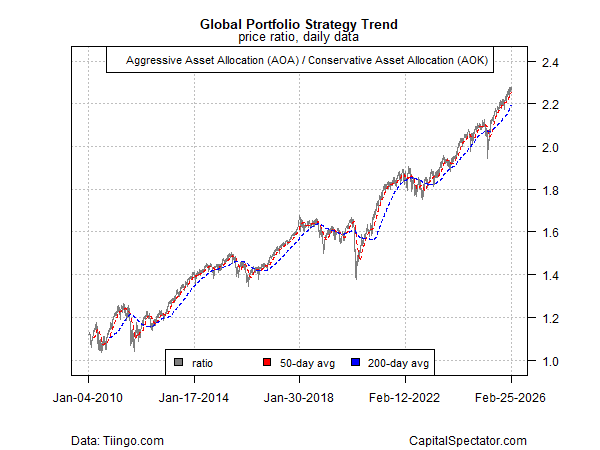
Optimism may seem scarce in the headlines, but a bullish trend still powers global asset-allocation strategies, based on a set of ETFs through yesterday’s close (Feb. 25). Although the risk appetite from a global perspective has periodically wavered in recent history, betting against the trend has been a losing proposition.
An ETF-based proxy for monitoring the directional bias of multi-asset-class strategies continues to skew positive, based on the ratio of two funds: an aggressive asset allocation strategy (AOA) vs. its conservative counterpart (AOK).
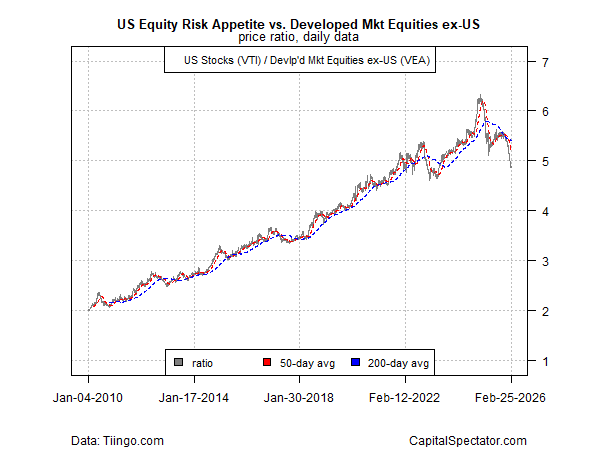
Looking below the surface, however, reveals substantial changes in leadership as bullish momentum accelerates in foreign stocks relative to US shares.
The previous relative strength in American equities (VTI) has fully reversed against stocks in developed markets ex-US (VEA).
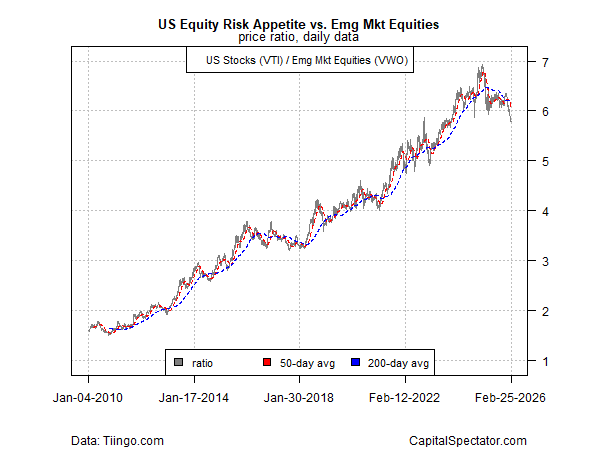
A similarly sharp U-turn is in progress for US equities (VTI) vs. stocks in emerging markets (VWO).
Another notable change: Within the US stock market, sentiment has recently shifted in favor of large-cap value (IWD) over large-cap growth (IWF).
Although this turn is significant in that it breaks the long-running dominance of large-cap growth, it’s not yet clear if this is yet another short-term change or the start of a secular trend.
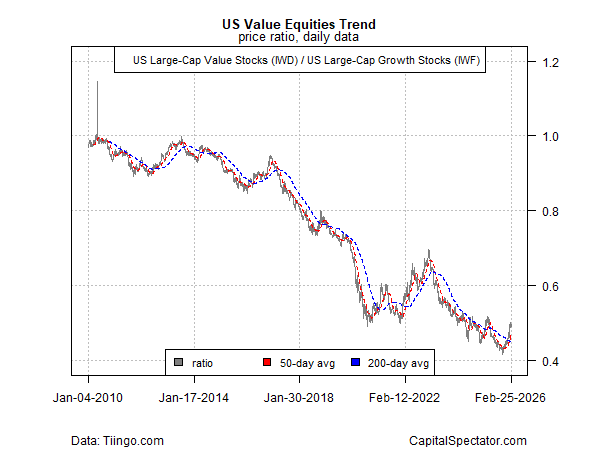
As the chart above shows, there have been several periods since 2010 of short-lived relative strength for large‑cap value that quickly faded. The current pivot into value looks solid so far, but it’s still an open question if this trend signals a durable change in market sentiment.
If the value leadership persists, some analysts say it could have implications for the broader stock-market outlook. Stifel (SF)’s chief equity strategist, Barry Bannister, warns in a research note this week that some investors view the recent value rebound and growth-stock weakness as a sign of cyclical economic recovery. However, if this fade for growth relative to value accelerates and deepens, history suggests it could lead to declining price-to-earnings ratios and weaker S&P 500 returns.


Comments
Log in or sign up to join the conversation.