


A few days ago I mentioned this passage from a Barron's article
A popular choice is a fixed indexed annuity with an income rider. Fixed indexed annuities offer protection against market downturns by limiting upside in a bull market. With an income rider, there’s the option to turn on an income stream at any time and collect guaranteed income for life.
And then I quipped
Or, instead of an annuity, someone could use a buffer strategy for a while and then flip that into derivative income when they are ready to take income (it may not last for life though).
I've been thinking about that I think there might actually be something to it. A few times over the last couple of years I've talked about the idea of circumstantially annuitizing part of the portfolio, not buying annuities, more like creating your own annuity (annuitizing) without the complexity or expense.
After that post last week, I plugged it into Copilot for a second opinion on the idea expressed in my quip. It liked the idea a lot but there needs to be a grain of salt taken with that sort of feedback, it also said I was tall and unusually handsome (joking). The strategy underlying the first half of the fixed indexed annuity (FIA) reads like a buffer fund. Here's a quick study of buffer fund strategy.

BUFR has more equity market sensitivity than BALT. Just using BALT without any BUFR, has compounded at 6.05% since BALT's inception with a volatility reading of 3.27%. The blend I am trying to create would come close to what bonds used to do before interest rates bottomed out in late 2021.

I'm going to circle back to the treasuries backtest in a minute so disregard the dollars and focus on the growth rates and volatility numbers. They're close to the buffer blend numbers.
Let's set up an example. An investor in 2005 is 55 and wants to retire in 2015 at 65. In 2005 he has $500,000 in his 401k in a balanced fund like VBAIX and $250,000 in a taxable account. He puts the $250,000 into 7-10 year treasuries and leaves it alone while he continues to work. After ten years, the $250,000 becomes $429,476.
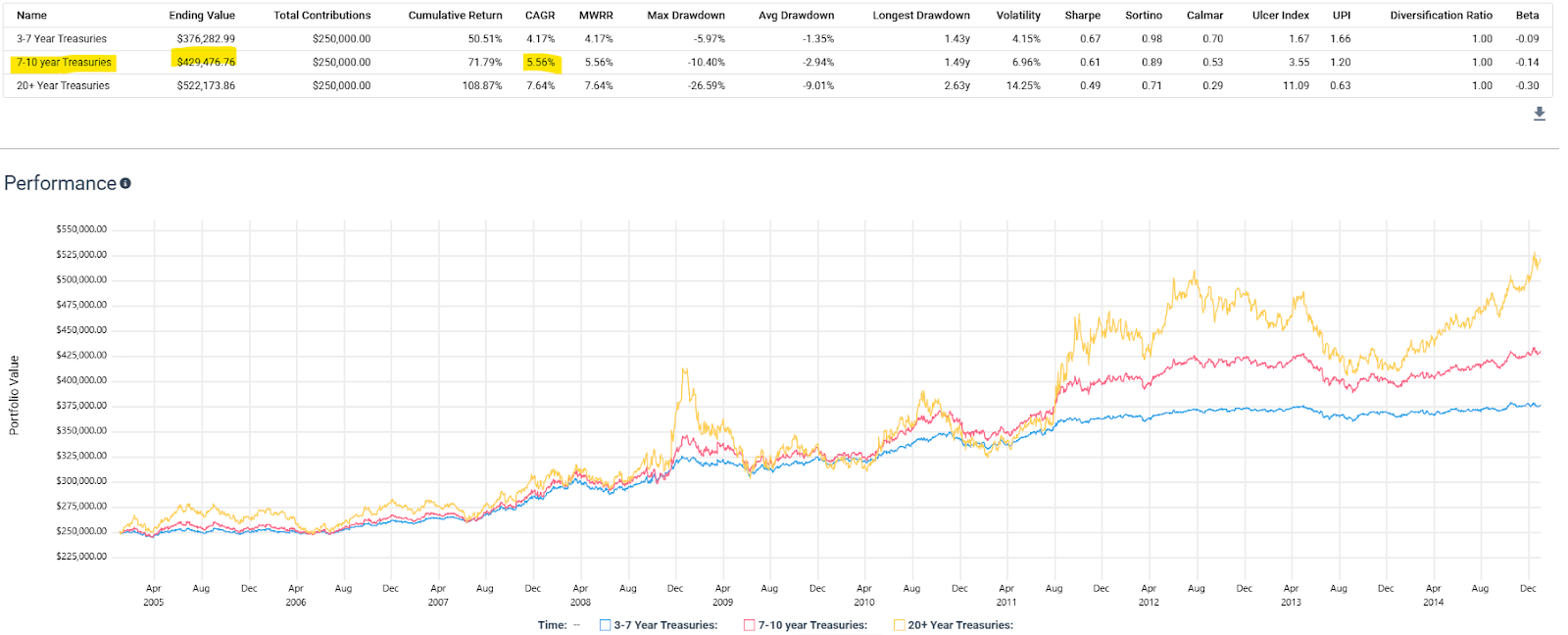
At year end, 2014 he is ready to activate the "income rider" from his self created annuity and he puts the entire $429,476 into SPXX with the plan of taking out $5000/mo. That's not sustainable but it can function as a bridge to taking RMDs at for him would be at 75, from the 401k that was subsequently rolled into an IRA. SPXX is a derivative income closed end fund with a long track record.
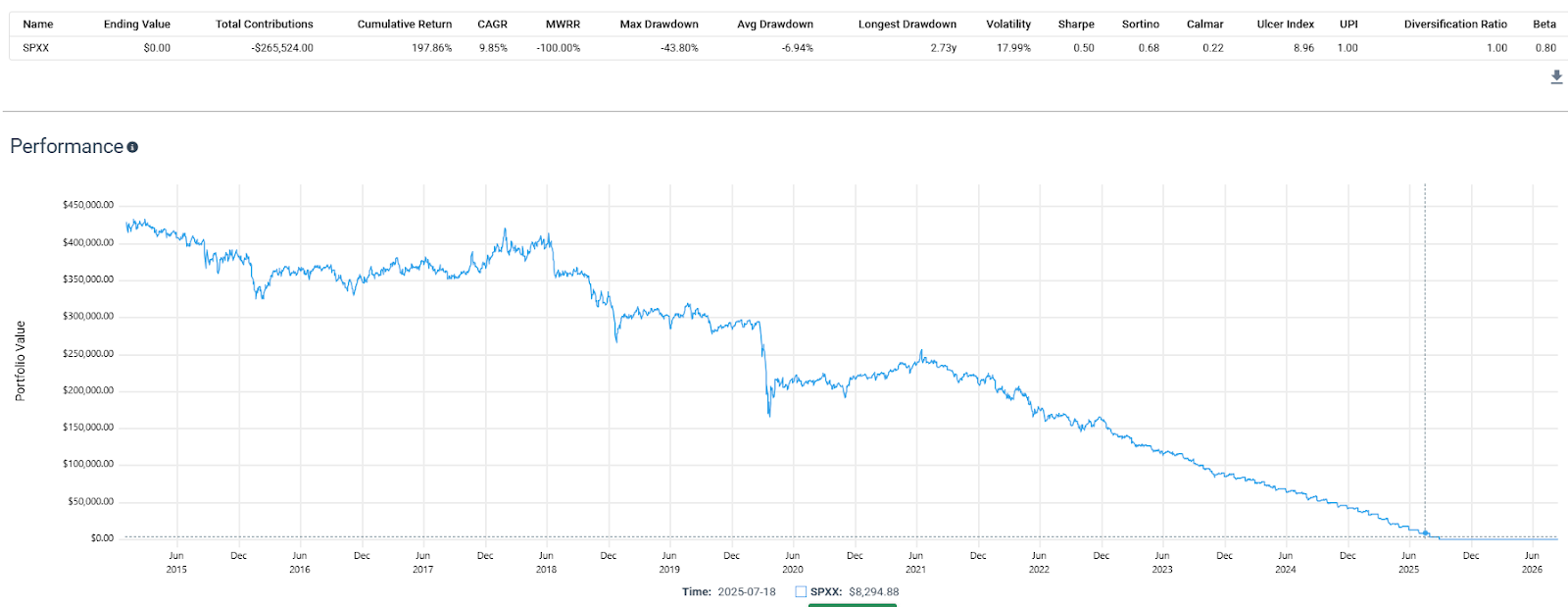
At $5000/mo, the original $429,476 invested in SPXX depletes in the summer of 2025 as he is about to start taking RMDs.
Back to the balanced fund in his 401k which we said was $500,000 in 2005.
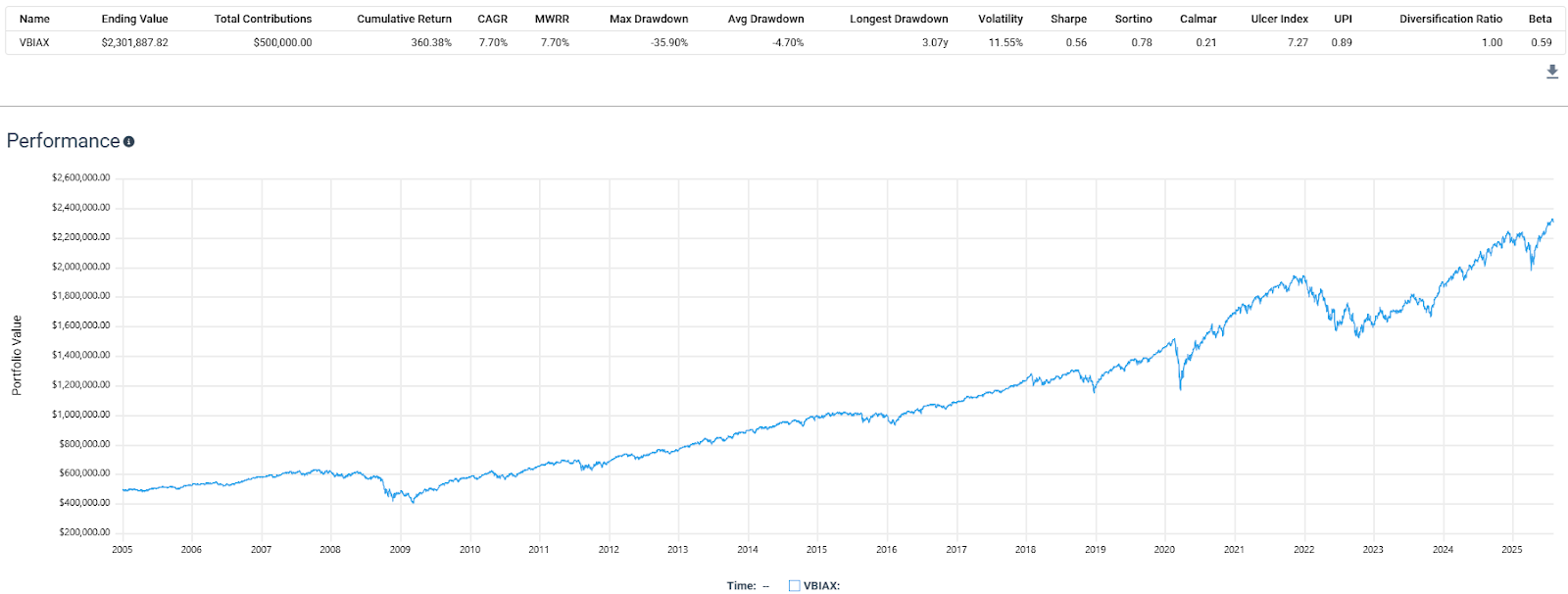
When SPXX depleted last August, the 401k>>Rollover IRA if untouched, grew to $2,301,887 which allows for $92,075/yr in withdrawals or $7692/mo assuming a 4% withdrawal rate. The $7692/mo is a little bit ahead of inflation. Starting at $5000/mo in 2015 would now equate to $7110/mo accounting for inflation.
The ten year depletion of SPXX is worth digging into a little more. According to Copilot, the "lifetime income from an FIA usually averages out to 12-14 years" for those who take the income. Not everyone does. So the ten year window fits into individual circumstance we created but falls short of 12-14 years. However, starting this exercise in 2005 and then the SPXX income rider in 2015 was all done when there was far fewer choices available.
A combination of different strategies with completely different risk factors can be blended together to nudge up the "yield" and very likely extend out the depletion date. Things like catastrophe bonds, closed end funds, derivative income funds, autocallables (a different kind of derivative income fund) and so on, even Annaly Mortgage (NLY) that we looked at recently, can be sized and managed to mitigate risks in case something bad happens. We've built out this yieldy concept before.
Let's see if I can articulate this point clearly but with some of these products that are starting to build a longer track record, yes there is absolutely risk but at some point you go from looking out for and managing risks to looking for a ruinous Black Swan event. Not the same thing. We might be at that point with buffer funds. Here is a long read from Morningstar about how well investors are doing in buffer funds with the implication that those investors have the correct expectations.
There's now a wide swath of buffer funds. The arguments against them are valid and generally correct but they haven't malfunctioned, broken or needed to invoke any sort of immediate termination. So using them might be better thought of as dealing with something that is suboptimal. AQR says instead of a buffer, investors would be better off with less equities. If someone is looking for an equity strategy with less volatility, then sure, just own less equity. I don't think that's what we're talking about here. Can a combo of buffers be put together to replace what treasuries used to do? That seem plausible to me, we just did it.
Similar story with derivative income funds. If you buy AMZY, you are not going to get what Amazon (AMZN) does. Thinking you're getting the stock is the wrong framing. For AMZY to be successful, yes, the common needs to not blow up but AMZY is about harvesting the volatility of Amazon for a different outcome, "yield" not growth. And doing that comes with its own risks including depletion at some point if all the distributions are taken out.
Is any of this worth it? Gemini says that every year, there are between 850,000 and 1.3 million FIAs sold every year and notes the annual fee for the income rider is 1.2% and the surrender costs (that is where the commission gets paid) is typically 8% but I should note I thought the surrender charges were more like 7%.
That many people buying FIAs (it does seem high but who knows) tells us there is demand for positive compounding that doesn't have full exposure to the equity market's volatility. Assuming no malfunction with the product or the insurance company, FIAs before the income rider do that and so do buffer funds. The income rider pays income for life and there is demand for that too but as we saw, that isn't necessarily a long time based on averages. The next question is whether a bridge strategy or depletion bucket can last sufficiently long until the next relevant financial milestone. Taking 10% out per year from a very high yielding portfolio that lasts for 12 years seems plausible but there can be no certainty.
Some sort of idiosyncratic risk to one type of alt can be pretty easily diversified away which leaves us back to worrying about some sort of macro Black Swan that would derail the concept. But that can happen to insurance companies too. My brother used to work in the industry and he put our mom into some sort of annuity in the late 80's and the insurance company went bust in 1990 or 91 so insurance companies are not immune. That might be a contributing factor to my bias against annuities.
There are some complex details to drive by quickly that should be delved into if you go down this road. Return of capital as part of the distribution lowers cost basis so there's no tax on that part of the payout until the cost basis goes to zero. At that point all ROC distributions are taxed as capital gains. If you put $10,000 into a crazy high yielder and over a period of many years taking out the distributions leaves the value of the position at $1000, the the capital gains tax at that point would be quite low. Including a narrow slice of your "income rider" portfolio to a crazy high yielder seems the most likely way to run into this issue.
Also, whatever faith you put into an insurance company guaranteeing anything for life, that does not exist for building your own annuity with buffer funds and then moving to derivative income and other high yielding niches.
Annuitizing yes, annuities no. I've said before that the fund space will figure this out and there are some product lines that sort of go down this road so I think it will happen but in the mean time, this is interesting to me.
Copilot said no one else has written about this but if you know about anyone else who has looked at this idea, please drop the link in the comments.



Comments
Log in or sign up to join the conversation.