

Broadcom, Inc. (AVGO) stock is now at a 6-month low, but analysts' price targets are well above that. Moreover, Broadcom is generating strong revenue and free cash flow (FCF). AVGO could be worth significantly more - over 64% at $530 per share.
That seems too much. AVGO could rise significantly ahead of its earnings and afterward if it shows continued strong FCF growth and margins. This article will discuss this.
AVGO closed at $321.68 on Friday, Oct. 24, down slightly. But over the last three weeks, it has dropped $54.83 from $376.51 on Oct. 7, down 14.6%. Over the last 6 months, AVGO is down over $100 from $422.65 on April 22, or 23.9%.
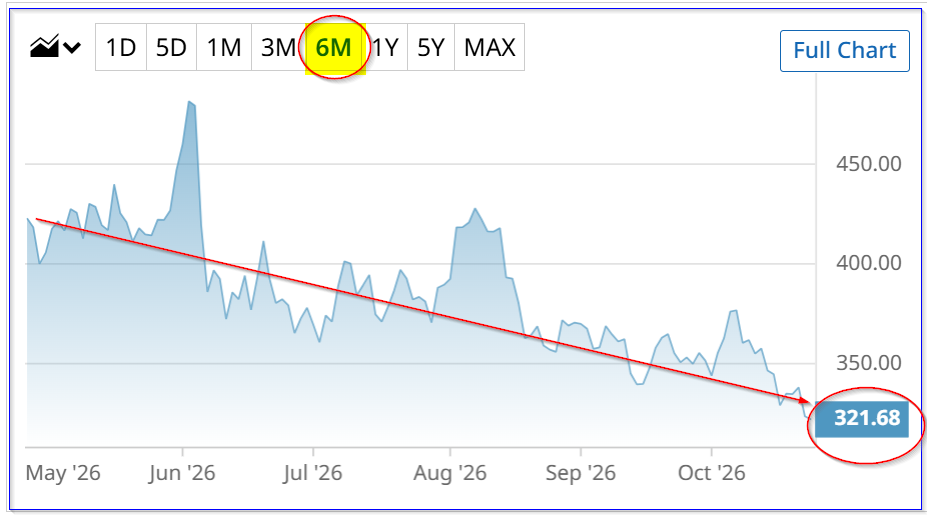
AVGO stock - last 6 months - Barchart - Oct. 23, 2026
This doesn't make much sense. Its underlying earnings power and free cash flow are very strong, driven by the AI demand boom for semiconductors.
Strong FCF Results and Forecasts
I discussed this in two prior Barchart articles after its strong fiscal Q3 results ending Aug. 2 (Sept. 27 and Sept. 4). The bottom line is that Broadcom generated $13.665 billion in quarterly FCF, representing 46.18% of revenue.
Over the prior trailing 12 months (TTM), it produced $39.4 billion or 44.2% of revenue.
That's the bottom line. Moreover, there is every reason to believe this will continue.
For example, next year (FY ending Oct. 31, 2027), analysts project revenue will rise over 64% to $174.14 billion. (That's higher than the $173.15 billion projected on Sept. 4).
So, if Broadcom maintains a 44% FCF margin, FCF could rise to $76.6 billion (i.e., $174.14b x 0.44).
This implies AVGO could be undervalued. If its upcoming Q4 results (expected on Dec. 10) show similar strong FCF growth and margins, AVGO could rise.
In fact, I suspect that the stock will appreciate ahead of this. That's because the underlying valuation is too low.
AVGO's Valuation and Price Targets (PTs)
Using a 3.0% FCF yield metric, AVGO could be worth $2,553 billion (i.e., $2.533 trillion):
$76.6b FCF est. / 0.03 = $2,533 billion fair market value (FMV)
That's $1 billion higher than Broadcom's present $1.536 trillion market cap, 64.9% higher:
$2.533 trillion FMV / $1.536 trillion mkt cap = 1.649x
So, the PT is 64.9% above Friday's close:
$321.68 x 1.649 = $530.45 PT
Other analysts agree. For example, Yahoo! Finance's survey of 51 analysts is $529.10, and Barchart's mean survey PT is $524.33. Similarly, AnaChart's survey of 31 analysts' PTs is $511.62.
The bottom line is that most analysts see Broadcom's underlying is over 60% higher.
Three ways to play AVGO, given how cheap it seems, are to (1) sell short near-term out-of-the-money (OTM) puts, (2) buy long-dated in-the-money (ITM) calls, and/or (3) invest in a put credit spread with a near-term expiry period. Moreover, investors can do a mixture of these plays.
Short OTM Put and Put Credit Spread Plays
Shorting an out-of-the-money (OTM) put for a one-month expiry period allows an investor to set a lower potential buy-in point and also collect income while waiting.
For example, the Nov. 27 expiry period shows that the $300 strike price put option has a midpoint premium of $6.88. That allows an investor to collect $688 after posting $30,000 in collateral.
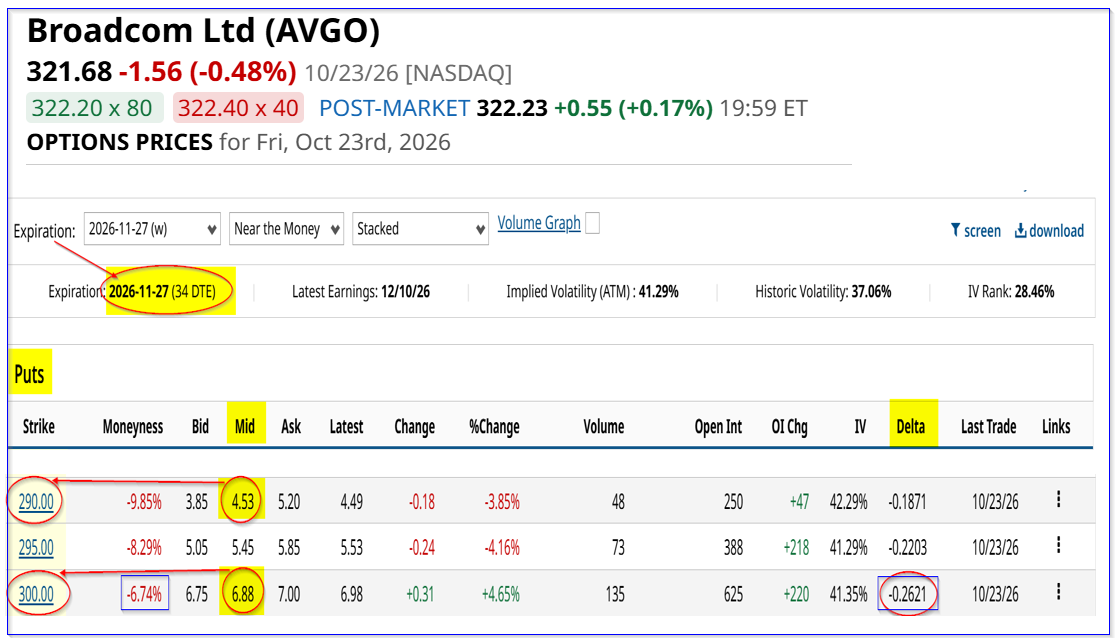
AVGO puts expiring Nov. 27, 2026 - Barchart - As of Oct. 23, 2026
In other words, the expected yield is 2.293% ($688/$30,000) over the next month, assuming AVGO stays above $300. Note the delta ratio is low at -0.262, implying a 73.8% chance of success.
Even if AVGO drops to $300, the investor's breakeven point would be $293.12 ($300 - $6.88), or -8.89% lower.
However, not everyone can post $30K to do this play. One way around this, is to do a put credit spread. However, the risks are higher.
This entails buying a $290 put (i.e., a long purchase) along with the short put at $300. The net credit collected is $688-$453, or $235. However, the collateral required is only $1,000 to do this play. Moreover, the at-risk amount is $1000-$235, or just $765.
Therefore, the expected return is very high:
$235/$765 = 30.7% over the next month
So, by doing 3 put credit spreads, the income would be similar to the short-put play: $235 x 3 = $705 vs. $688. The return is 10x higher but the risk is higher as well. The investor stands to lose $3,000 - $705, or $2,295:
$705/$2,295 = 30.7%, but the potential loss is $2,295, vs. only an unrealized loss with a short-put play.
Moreover, the investor gains no upside in AVGO if it rises. One way around that is to use the income to buy in-the-money (ITM) calls.
Long-Dated ITM Calls
For example, look at the $300 call option for expiry on April 16, 2027, about six months from now (176 days to expiry). The midpoint premium is $52.40, i.e., $5,240 for 1 call contract.
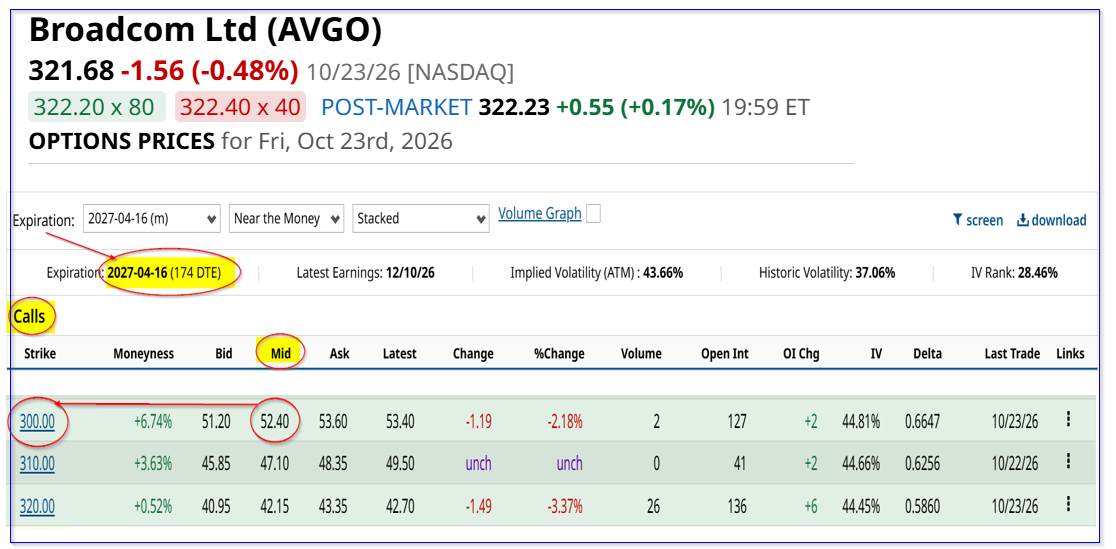
AVGO call options expiring April 16, 2027 - Barchart - As of Oct. 23, 2026
That means that an investor could gain upside in AVGO with some downside protection. That's because the call is already worth at least $2,168 (i.e., ($321.68 - $300.00) x 100). The rest is extrinsic value (i.e., at-risk amount of $3,074).
Moreover, if an investor invests in 5 put credit spreads for 4 months, the upfront $3,825 collateral cost produces $1,175 in monthly income each month:
$1,175 x 4 = $4,700 vs. $5,240 ITM call option cost (i.e., a net cost of $540)
In other words, in just 4 months, the 6-month ITM call is mostly paid for ($540 leftover cost). That's because, as long as AVGO stays above the put option legs, the collateral is returned to the account. (Note: This assumes the same put credit spread could be made each month for 4 months.)
The Bottom Line
Let's say AVGO rises to $380 in 6 months, up 18.1%. The ITM call would be worth $8,000 (i.e., $380-$350), providing a profit of $2,760, or 52.67% (i.e., $2,760/$5,240).
That's significantly higher than just buying AVGO and making 18%. Moreover, by shorting OTM puts or put credit spreads, the cost would be even lower, enhancing the yield.'
The bottom line is that AVGO looks too cheap here, especially if its upcoming results confirm its strong FCF margins.



Comments
Log in or sign up to join the conversation.