


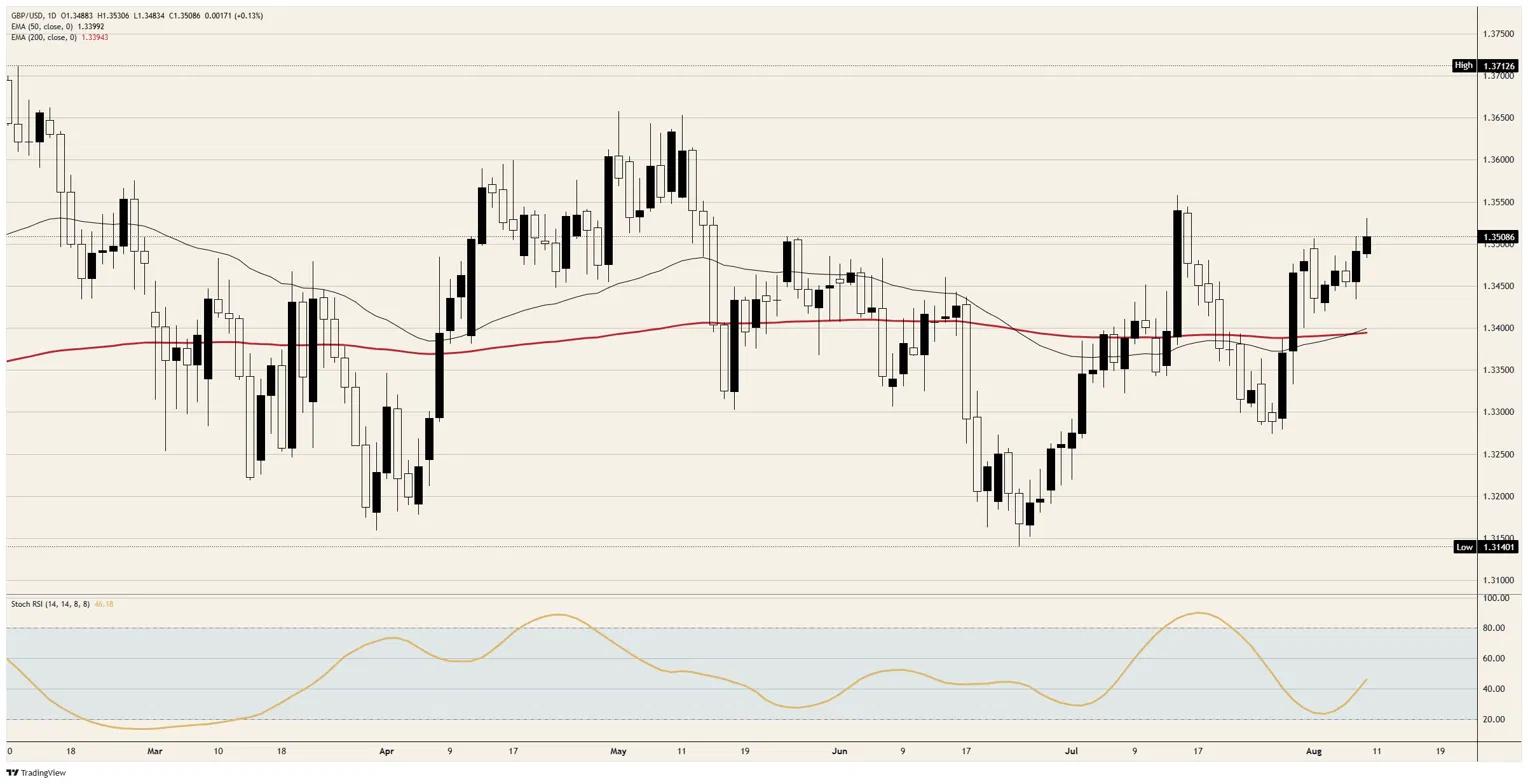
Cable has spent the session inside a band of barely 45 pips straddling 1.3500, up 0.13% and holding its best ground since mid-July. The floor sits fractionally beneath the handle and the ceiling short of 1.3550, which describes a market checking whether a level holds rather than one trying to break it. Close to two cents have been added since the early-August trough just under 1.3300.
Almost none of that advance was earned in London, where the domestic calendar has produced nothing of consequence for a fortnight. July nonfarm payrolls contracted by 23K against an 80K consensus, June was revised down to 20K, and the Dollar index went to its weakest level since early June on the back of it. The Pound is at 1.3500 because the other side of the quote stopped working, which is a different thing from being wanted.
The rally has an American author
Rate pricing has travelled further than the exchange rate over the same fortnight, and it has not travelled in a straight line. A September 16 increase is priced at 49.93% against 50.07% for a hold, the flattest reading this cycle has produced, after the payrolls miss knocked the odds into the mid-forties on Friday. October 28 carries a 76.50% chance of at least one move and the current range is given no chance at all of surviving December 9.
What that arrangement hands Sterling is a rally with a conditional attached. The Pound has not been repriced on its own merits at any stage of this move, so the two cents it holds are a rebate on American tightening odds rather than a payment for British ones. Rebates get taken back, and Wednesday's inflation print is where the American side gets to decide whether to take this one back.
What three hawkish votes were worth
The Bank of England (BoE) held at 3.75% on July 30 with a Monetary Policy Committee (MPC) split of 6-3, three members preferring 4.00%, which was a more hawkish arrangement than the market had modelled going in. Pricing has since run toward a 4% Bank Rate by October, one of the firmer tightening cases in the G10. Sterling did essentially nothing with any of it.
The reason the split bought so little is that the vote and the tone pointed in opposite directions, with the Governor's language cautious enough to strip the dissent of forward meaning. Speculative net short positions were being rebuilt into that meeting rather than covered, so the squeeze when it arrived came out of Washington instead. British Retail Consortium (BRC) like-for-like sales growth slowed to 1% YoY in July from 1.7%, short of a 1.5% consensus, which is the consumer a committee with three tightening votes is now looking at.
Thursday is the only British number
The domestic calendar stays empty until 06:00 GMT on Thursday, when the preliminary second-quarter Gross Domestic Product (GDP) reading lands alongside the June monthly figure and the production data. Consensus has quarterly growth slowing to 0.4% from 0.6% and the June month contracting 0.1% after a 0.1% gain, with industrial production at 0.1% MoM and manufacturing output at -0.3%. The annual comparison firming to 1.1% from 0.9% is arithmetic rather than momentum.
That is the awkward part of the arrangement, because the week's only scheduled British catalyst is expected to print a deceleration. A reading in line does very little for a currency already trading somebody else's calendar, and a sharper miss would strip the September tightening premium out of the Pound at the precise moment the level needs domestic help to hold. The hawkish vote and the growth path cannot both be right for long.
Everything else on the week is American and carries the red bands. July consumer prices arrive at 12:30 GMT on Wednesday with consensus at 0.1% MoM from -0.4% and the core rate at 0.2% from 0%, taking the annual core to 2.5% from 2.6%. Producer prices follow on Thursday at 4.9% YoY from 5.5%, retail sales on Friday at 0.2% MoM, and two regional Fed presidents speak either side of the Thursday release.
Levels
Resistance: 1.3500 is in test and capping, with the mid-July peak near 1.3550 the first genuine barrier above it. A daily close through 1.3550 opens 1.3600 and the February high near 1.3700 beyond that.
Support: The session floor just beneath 1.3500 comes first, then 1.3450. The 50-day and 200-day Exponential Moving Averages (EMA) are converged near 1.3400, roughly 110 pips under spot, and that band is the structure August reclaimed.
Bias: Bullish while the 1.3400 band holds, objectives 1.3550 then 1.3600, with the daily Stochastic Relative Strength Index (Stoch RSI) near 46 and rising off the early-August trough. This is a Dollar call rather than a Pound call, and a daily close beneath 1.3400 ends it.
GBP/USD daily chart



Comments
Log in or sign up to join the conversation.