

As we noted at the time, Friday saw exceptional volatility at the short end of the yield curve. Even as I was writing that day’s missive, 2-year Treasury yields had risen by 10 basis points, up from 7 when I started writing. They finished the day over 11 basis points higher. This was the largest move in that tenor since a 13-basis-point jump on June 17th. Do you care to guess who triggered that prior move?
Indeed, when Kevin Warsh talks, people listen.[i] The problem is that short-term fixed-income traders generally don’t like what they hear. Although his July 29th press conference was greeted calmly, with 2-year rates dropping by a single basis point, his first FOMC press conference as Fed Chair was greeted with a similar reassessment of the likelihood of rate hikes. If hikes are more likely, then short-term rates rise to reflect that. CME FedWatch now shows a 66% probability for a September hike, up from 36% on Thursday, while IBKR Prediction Markets show a more sanguine 56% “Yes”, which is up from 31% prior to Jackson Hole.
The rise in short-term rates is by no means Warsh’s fault. Rates began rising in March, coinciding with the start of hostilities in the Persian Gulf, and have marched steadily higher since. Bear in mind, too, that Jerome Powell’s last press conference as Chair on April 17th was followed by its own 12-basis point rise in 2-year rates. Over the past few months, it has become clear that the primary concern for the FOMC has shifted from employment to inflation. This is why long-term rates have been pushing higher as well. While the long end of the curve stayed relatively stable on Friday, today we see 4-5-basis-point bumps in 10- through 30-year bonds. Higher oil prices, resulting from renewed hostilities in the Gulf overnight, are a likely culprit.
Stocks seem generally able to shrug off the prospect of higher rates, even if that path seems glaringly obvious. The following statistics put this into perspective. On February 27th, the last day before missiles began flying around the Persian Gulf region, 2-year notes yielded 3.38% and 10-years yielded 3.94%. Those levels are currently 4.34% and 4.76%, respectively – both nearly a full percentage point higher over 6 months (96 and 82 basis points each, respectively, to be more precise). Over that same period, the S&P 500 (SPX) and Nasdaq 100 (NDX) are roughly 11.5% and 17.6% higher, respectively. It is quite clear that equity investors are paying far more attention to solid corporate earnings than to the higher cost of money. Quite frankly, most companies’ return on investment far outpaces the return on government debt.
At some point, higher rates can, and should, weigh on equity valuations. Remember, in theory, a stock’s current value is determined by the present value of its future earnings and/or cash flows, and the higher the long-term rates, the lower that value. But if those earnings and/or cash flows are rising faster than interest rates, we can make a case for valuations improving nonetheless.
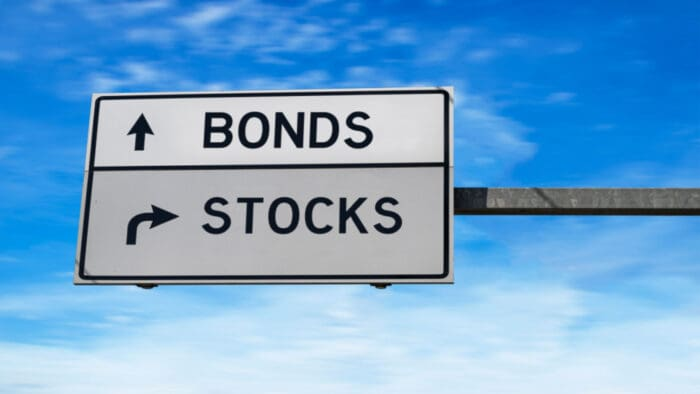
Yet there would seem to be a level where rates will matter. Might it be something mechanical, like a 10-year yield above 5%? We have flirted with that level only twice in 20 years, most recently in October 2023, and before that in June 2007. (In the 1990s, 10-year yields routinely exceeded 5%). Might it be something more subtle, a point where cash-hungry AI builders decide that their cost of funds become uneconomic? Perhaps, but if investments are being based on limitless potential, a few basis points here and there shouldn’t matter, should they? Until we resolve those questions, stocks are likely to remain on a divergent path from bonds – until one day, they’re not.
[i] I’m reminded here of the old commercials with the tagline, “When E.F. Hutton talks, people listen.” That brokerage firm is long gone, absorbed into the late-’80s-to-early-‘90s miasma that was Shearson Lehman Hutton American Express, or whatever they called themselves that month (I think I have my old business cards with various permutations of the firm’s name somewhere), but their commercials made a lasting impression.
Comments
Log in or sign up to join the conversation.