

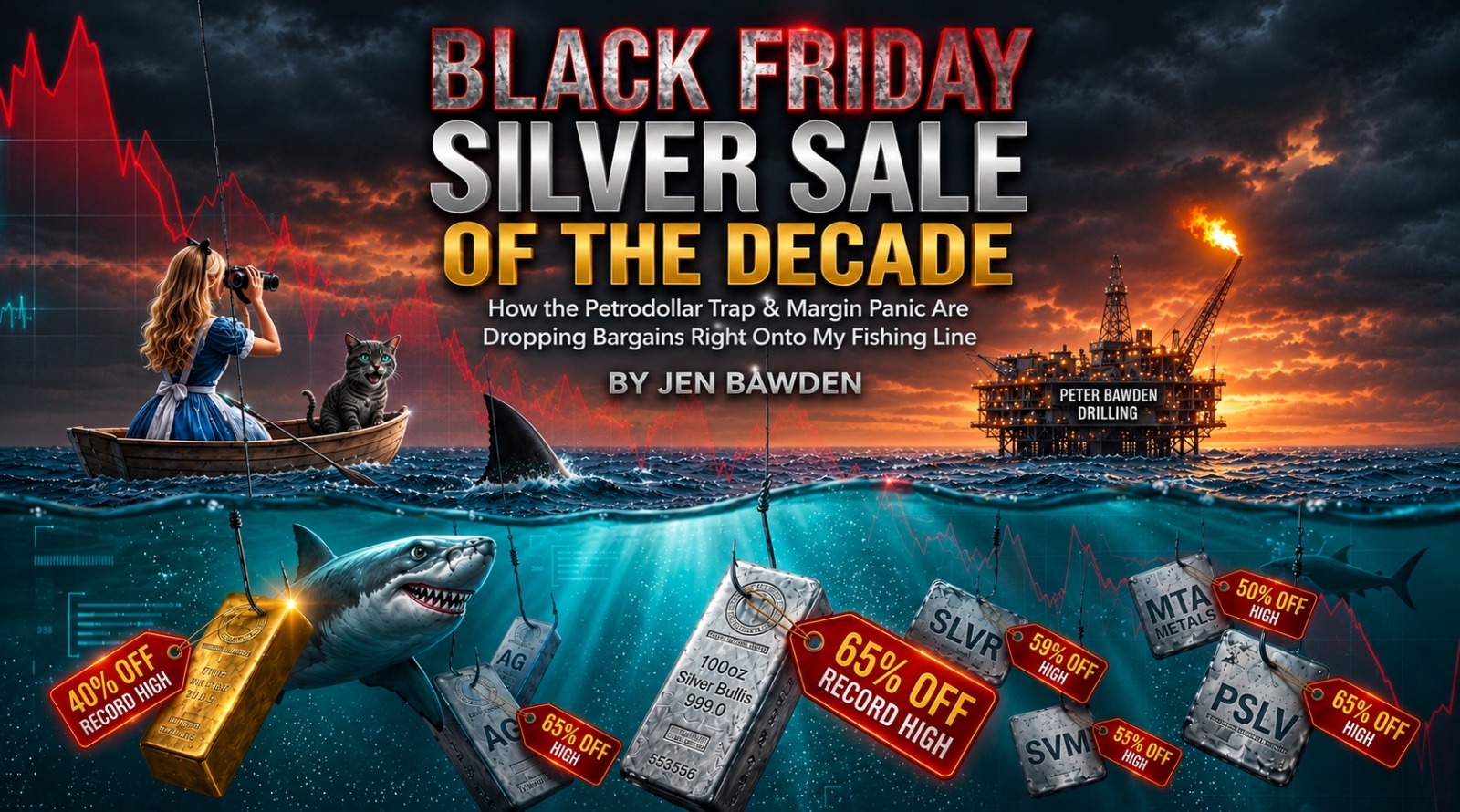
While everyone else is elbowing through crowds for discounted flat-screen TVs this week, Wall Street just handed disciplined resource investors the best Black Friday present of the decade.
After breaking below $50 at the end of October, silver just endured another violent margin-call washout, sliding into the low $41s on Friday, November 20 (roughly 66% below its $121.64 record high) before catching a sharp bounce to roughly $43.50 - $44 on Monday morning. Gold followed the same script, briefly touching a 14-month low near $3,515 per ounce on Friday before rebounding on Monday.
To momentum traders who chased the highs, the Friday screen looked like a disaster. To seasoned resource investors who understand paper-market plumbing, this is not the end of the commodity bull market, it is the exact liquidity air pocket we have been waiting for. Better yet, because the war in the Persian Gulf is far from over, surging oil and a squeezed U.S. dollar can still push paper metals even lower before this washout finishes. The deal of the decade is soon upon us.
The Petrodollar Trap: Why a Middle East Oil Shock Hammers Silver First
The question confuses many retail metals investors right now, and the biggest blind spot in mainstream market coverage is simple: "If the Strait of Hormuz is a war zone and Brent crude is trading around $90 - $92 a barrel after spiking to a 2026 peak near $126 in April, why are gold and silver falling?"
The answer is what I call the Petrodollar Trap.
Because global crude oil is priced and settled in U.S. dollars, every spike in Middle East war risk triggers an immediate dollar scramble among major energy, importing nations like Japan, South Korea, India, and Germany. To keep their power grids and refineries running, commercial importers must dump their own domestic currencies on the open market to buy massive blocks of greenbacks, while foreign central banks burn through dollar reserves trying to defend their sliding currencies.
That sudden rush for dollars pushes the U.S. Dollar Index higher and keeps Treasury yields elevated, creating a temporary headwind for paper gold and silver. Here is the irony Wall Street misses: those exact same surging oil and diesel prices are pushing mining costs even higher across an industry where major primary silver producers like First Majestic Silver (30–$35/oz guidance) already need roughly $28 to $35 per ounce just to sustain production. Trying to keep paper silver suppressed below its real-world marginal cost of production in the middle of a sixth consecutive annual physical supply deficit economics simply won't allow it for long.
Wall Street’s Liquid ATM: The 2008 & 2020 Playbook Repeats
At the same time, Treasury yields sitting near two-decade highs (the 10-year closed at 4.92% on November 20) are pricking the overvalued AI and mega-cap tech bubble. Future tech profits are worth less today when safe bonds pay close to 5%, and borrowing billions for data centers has suddenly become expensive.
When stretched equity books crack and margin calls hit, big funds don't sell what they want to sell, they sell whatever is easiest to turn into cash in seconds. Gold and silver futures are Wall Street’s favorite liquid ATM:
Fall 2008: After Lehman Brothers collapsed, gold fell 29% and silver plunged over 50% alongside stocks, before gold rocketed 170% and silver surged back toward $50.
March 2020: During the initial dash for cash, gold dipped 10% and silver fell 35% in days, before gold jumped 39% to a new record and silver exploded 150% higher within five months.
Today’s selloff is that exact same forced-liquidation movie playing on repeat, while physical buyers in Shanghai quietly absorb real bars every time Western algorithms slam paper futures.
What Could Test This Thesis Short-Term?
Even inside a secular commodity bull market, straight-line recoveries are rare. Before you deploy a single dollar, keep three realistic near-term risks on your radar:
A Hawkish Fed Into December: The Federal Reserve held rates at 3.75% - 4.00% in October, and recent FOMC minutes show policymakers leaning toward tighter policy ahead of the December 8-9 meeting. If sticky energy inflation pushes the Fed into another hike, high real yields could keep a lid on silver longer than bulls expect.
Industrial Demand Drag in an Oil Recession: Roughly half of silver’s annual demand comes from solar panels, electronics, and autos. If $90+ crude triggers a sharp global slowdown, industrial consumption could soften temporarily before investment buying takes over.
Junior Miner Dilution Risk: If silver lingers in the 35 - 42 range for six to nine months, cash-burning exploration juniors may be forced to raise money at depressed share prices. That is why focusing on tier-one jurisdictions, physical silver, and cash-rich producers matters more than ever.
My Black Friday Playbook: Fishing Lines 10% to 30% Below Today’s Lows
Because the Iran conflict is still escalating and the dollar can squeeze higher, I am not chasing green morning bounces or guessing the exact bottom tick. Instead, I am bottom fishing with pre-set Good-Til-Canceled (GTC) limit buys sitting well below Friday’s lows, quietly waiting for the falling knife to drop right onto my fishing line.
Why cast staggered traps on the way down? Because in thin mining and metals order books, all it takes is one big seller hungry for cash, a leveraged fund hit with an afternoon margin call dumping at market, to create a sudden 15 minute air pocket that pulls prices temporarily down to absurd bargain levels. If your limit orders aren't already sitting in the water before that seller hits the button, you miss the fill.
While I am keeping my favorite high-torque junior silver developers in safe jurisdictions close to the vest until my personal stink bids fill, this Black Friday markdown has already put fire-sale pricing on premier, liquid silver vehicles I own and am scaling into in tranches:
Sprott Physical Gold Trust (PHYS): Holds allocated physical gold bullion stored at the Royal Canadian Mint, NOT paper futures, and closed Friday at $26.55 (down roughly 37% from its $42.36 52-week high) while trading at a 3.05% discount to its $27.39 Net Asset Value, letting you buy physical gold for less than melt value in a margin-call panic.
Sprott Physical Silver Trust (PSLV): Holds allocated physical silver bars at the Royal Canadian Mint, not paper futures, and closed Friday at $13.17, down roughly 65% from its $38.12 52 - week high.
Wheaton Precious Metals (WPM): A tier-one streaming giant near $110 (down 33% from its $165.76 peak), offering clean upside torque without direct mine cost inflation.
Metalla Royalty & Streaming (MTA): Closed Friday at $5.84, nearly 50% off its $11.60 high, giving diversified royalty exposure at half price.
Sprott Silver Miners & Physical Silver ETF (SLVR): Down nearly 59% from its $85.89 high to $35.34, blending physical silver with leading producers in one liquid basket.
First Majestic Silver (AG): Closed Friday at $10.91 down 66% from its $32.04 52-week high, backed by a $1.07 billion cash war chest and $882 million in working capital has a high chance to weather any storm without dilution.
Why the Next Decade Belongs to Hard Assets
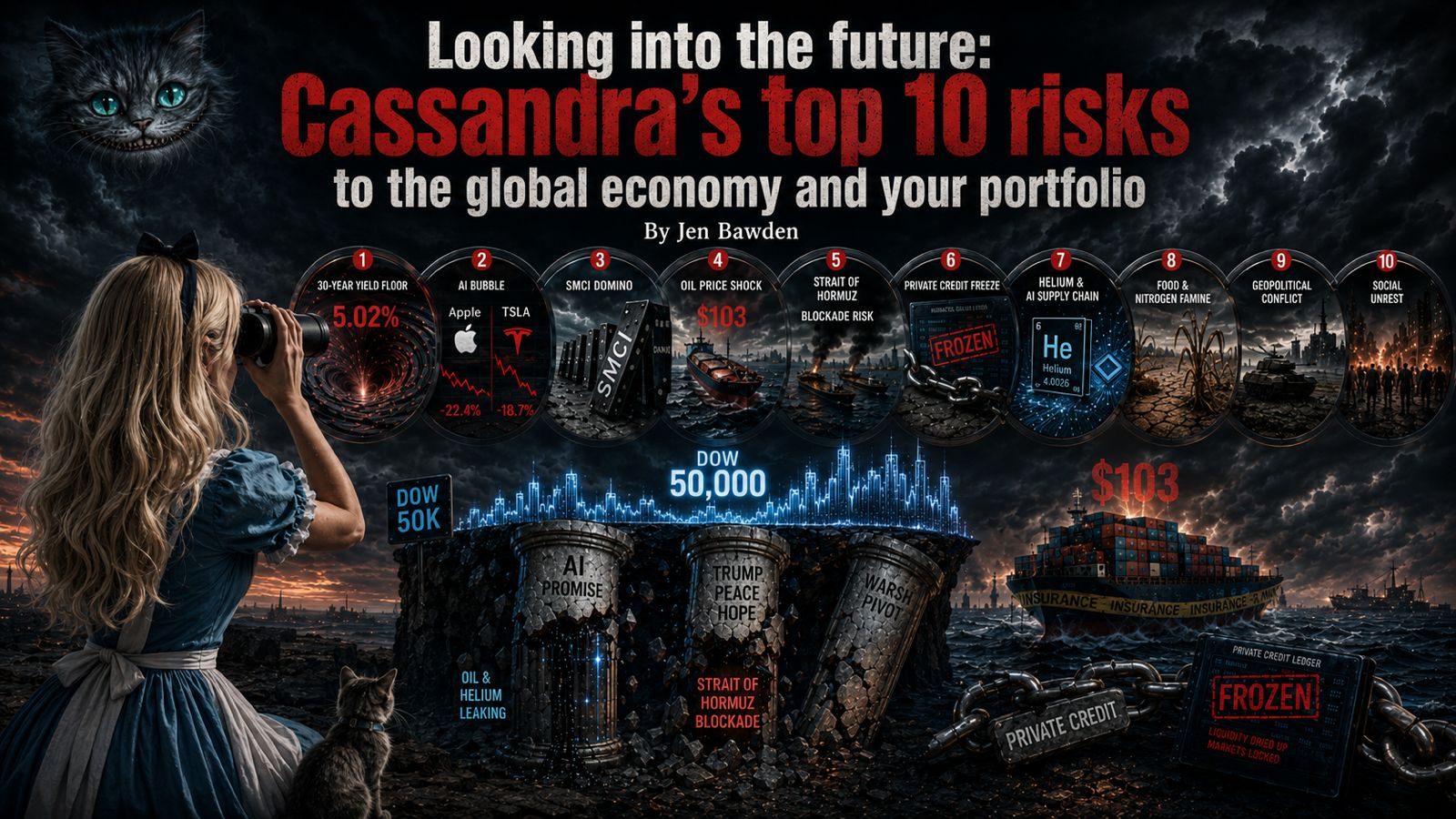
Never lose sight of the endgame. The largest sovereign debt bubble in human history cannot survive near-5% interest rates indefinitely without breaking something in the banking system or the real economy. When that breaking point hits, central banks will be forced to choose between deep recession and slashing rates. The moment they blink, the dollar’s war-driven spike will roll over and trillions in global capital will stampede out of overvalued paper into gold, silver, and oil.
We aren't at the pivot yet which is why my fishing lines are sitting 20% below Friday’s lows. Enjoy the Black Friday sale, never use margin on volatile miners, and let the panic sellers fill your traps.


Comments
Log in or sign up to join the conversation.