

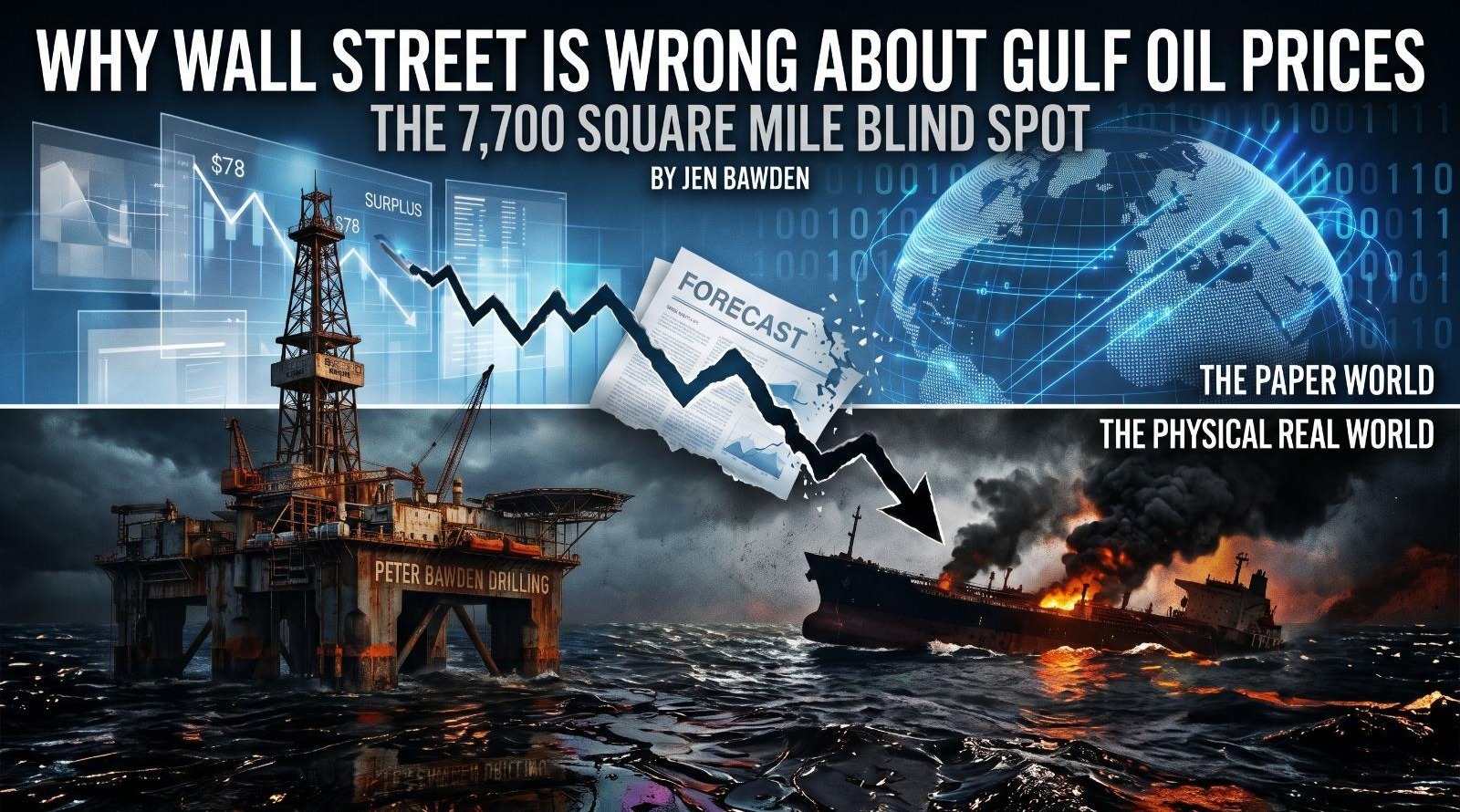
I grew up visiting drilling rigs. My father built the largest privately owned international drilling company, Peter Bawden Drilling. Long before I ever went to college, looked at a Bloomberg terminal, or traded a commodities portfolio, I learned the oil business from the ground up, in the mud, the steel, and the physical reality of extracting energy from the earth.
Because of that background, I see things differently than Wall Street analysts who treat crude oil like another digital ticker symbol on the screen. And looking at what is happening in the Persian Gulf right now, the paper market’s math is simply not adding up.
If you read the mainstream financial news this week, you’ll see traders bidding Brent crude down toward 90 - 91 and WTI toward $82. Goldman Sachs and short term trading desks are projecting a supply surplus for the fourth quarter of 2026 and into 2027, forecasting that Brent will slide back to $78 by December 2027 and average $88 a barrel next year. Their spreadsheets assume that once a political ceasefire is signed, the Strait of Hormuz will magically reopen and Gulf production will snap back to normal overnight.
As someone who understands the physical oil business, I’m seeing clear signs that Goldman Sachs is wrong. Even the International Energy Agency’s flagship World Energy Outlook 2026, released on November 19, confirmed that the Hormuz disruption has already inflicted the largest energy supply shock in history, cumulative losses of 2.8 billion barrels of oil and 60 billion cubic meters of natural gas, with IEA Executive Director Fatih Birol warning that "the energy world will not go back to what it was before the war started". Goldman’s models are blind to a massive, spreading catastrophe in the water that a diplomatic treaty can’t fix.
The Satellite Proof: 540 Bleeding Wounds
The market hasn’t priced in what European space radar is mapping. Every number I am about to give you is backed by the European Union’s Copernicus Sentinel satellites, mapped by Greenpeace, and corroborated by maritime tracking intelligence.
Using Synthetic Aperture Radar, which sees straight through clouds and darkness, satellites have tracked over 540 distinct oil spills across the Persian Gulf, the Strait of Hormuz, and the Arabian Sea since late February. Combined, these slicks cover approximately 20,000 square kilometers or 7,722 square miles, an area roughly the size of New Jersey or Wales.
People ask me: Is this the most oil ever spilled in the Gulf? By sheer volume, the intentional dump during the 1991 Gulf War remains the largest. But we have never seen a decentralized, multi front contamination event of this frequency. We are looking at a constellation of 540 separate bleeding wounds.
Why are so many showing up all at once?
The "Dark Fleet" Factor: Much of the traffic still moving through the Strait consists of tankers running with their AIS transponders switched off, including aging, sanctions dodging shadow fleet vessels with thin insurance cover. They have already caused some of the worst spills of this war: Greenpeace tracked a slick spreading along Oman’s southern coast from the Caroline Bezengi, a sanctioned Russian shadow fleet tanker that ran aground there. Shadow fleet tankers also have a documented record of leaving oil slicks and sailing unchecked in European waters. And deliberate dumping is a chronic problem at sea even in peacetime: satellite analysis by SkyTruth found that vessels account for 81% of ocean oil slick area, much of it illegally discharged bilge waste. With patrols stretched and cleanup crews kept out of a war zone, the cover for that kind of dumping has never been better.
Cleanup Is Impossible in Active Conflict Zones: Normally, when a spill happens, specialized fleets rush in with containment booms and skimmers within hours. You cannot send environmental cleanup crews into a live minefield. Damaged hulls, destroyed coastal storage tanks, including the strikes on Iran’s Lavan Island facilities and sunken wrecks are resting on the seabed, bleeding crude indefinitely.
Why Wall Street’s Surplus Projection Is an Illusion
Goldman Sachs believes that because headline production capacity exists, oil will flow freely soon. Yet in Goldman’s own November 16 research note, the bank admits that U.S. wholesale diesel will remain at an elevated $150 per barrel in 2027 and explicitly flags “near term upside risks" from shipping attacks and infrastructure damage. They are hedging their own call because they know the physical mechanics are broken.
Here is what their headline surplus model is missing, and what I believe will actually happen:
1. The Desalination Chokepoint: The Middle East relies on coastal seawater desalination plants for up to 90% of its drinking water. We are already playing Russian roulette with the region’s freshwater supply. When the damaged tanker Gem No. 2 leaked off the Emirates, satellite tracking confirmed its slick drifted within 2 kilometers or 1.24 miles of the UAE’s Naqa’a desalination plant before emergency crews contained it. If thick, weathered oil gets sucked into those intake valves, it destroys the reverse-osmosis membranes. Coastal refineries, ports, and military bases won’t run without fresh water. An energy blockade is rapidly turning into a freshwater crisis, and those very desalination plants become prime targets if the war escalates.
2. The Silent Loss of Tanker Capacity: Supertankers pump vast amounts of seawater to cool their engines. Crossing a heavy oil slick risks clogging those cooling intakes and fouling heat exchangers, which can force engine shutdowns in the worst possible waters. And a ship that does make it through doesn’t simply sail into port with oil on its hull. At Fujairah, one of the world’s largest bunkering hubs, removing oil stains from a hull requires a port permit and an approved oil spill response contractor, and hull cleaning is not allowed inside the port itself. After Singapore’s 2024 spill, P&I insurer Gard advised that oil stained vessels arrange mandatory inspections and hull cleaning. Every day a tanker spends waiting for decontamination is a day of lost global tanker capacity, and with hundreds of slicks in the water, the risk compounds. If the Strait is as safe and open as Wall Street claims, why was Saudi Foreign Minister Prince Faisal bin Farhan in Brussels this week pressing the European Union for naval escorts?
3. Possible Lasting Reservoir Damage: Oil fields can’t be switched off and on like a tap. With Gulf storage full and ships unable to load, producers have been forced to shut in active wells. For mature, high pressure fields, prolonged shut ins can allow water to migrate into oil producing zones and unbalance reservoir pressure. That can lower well output when production restarts and, in the worst cases, require costly workovers or leave crude uneconomic to recover. While some large fields recover quickly, the scale of lasting loss makes a post reopening supply rebound far slower and smaller than models assuming a clean restart.
4. The War Is Escalating, Not Ending: Despite Thursday’s Trump Xi Putin trilateral summit in Shenzhen, the joint statement failed to mention let alone resolve the Strait of Hormuz blockade. Meanwhile, Bloomberg reported on November 20 that Iran has intensified tanker attacks in the Strait even as paper crude slides. Kuwait formally notified the International Maritime Organization that eight of its tankers have been attacked, an ADNOC product tanker strike left one crew member missing and 11 injured, and fresh Kpler data shows the seven-day average of Hormuz crude transits plus Gulf of Oman ship to ship transfers dropped from 13.4 million barrels per day at the start of November down to roughly 10 million barrels per day.
The Macro Takeaway: A Paper Crash vs. A Physical Squeeze
I want to be clear: What goes up on cheap money eventually comes down on expensive money. Even though AI is genuinely transforming creativity and productivity, years of ultra low interest rates inflated equity valuations far beyond reality. Now, with the U.S. 10 year Treasury yield hovering near 5.05%–5.1% and the Federal Reserve signaling a December rate hike, global capital is flooding into high yielding U.S. debt. Combined with safe haven demand from the war, that double push has driven the U.S. Dollar Index to 19 month highs near 103.8 / 104.
Here is how that connects directly to crude: Because most of the world outside China and Russia must buy and settle its fuel in U.S. dollars, a surging dollar drives up the real cost of oil worldwide. In the short term, computer algorithms may trigger an acute liquidation in overvalued tech and equities, temporarily dragging paper crude futures down into the $70s or $80s just like crude crashed in late 2008 before roaring back past $100.
But a short term paper liquidation is not due to a physical surplus, its currency, not due to the supply of new barrels. When physical supply is genuinely scarce and buffers have been run down as the IEA just warned foreign buyers are forced to pay up in strong dollars, pushing both the dollar and oil higher together.
Worse still, Wall Street is ignoring that in the oil business, time is the enemy. Every additional week the Strait of Hormuz remains mined, attacked, and restricted, the physical harm compounds: coastal storage tanks hit capacity, more mature wells suffer permanent reservoir damage when shut in, and 540 unchecked oil slicks spread deeper into critical desalination intakes and shipping lanes. Wall Street is modeling a smooth diplomatic return to normal that ignores sunken ships, ruined wells, and a 20,000 square kilometer or 7,722 square miles environmental and logistical paralysis.
When the paper market finally wakes up to the physical reality that this oil cannot be easily moved, extracted, or insured, the repricing will be violent. This is why I am ignoring the short term noise, holding my shorts on overvalued tech, and letting my limit orders sit patiently to accumulate hard assets at distressed liquidation prices.
Paper models always look perfect until they collide with physical reality. And right now, the physical reality is covered in oil.

Comments
Log in or sign up to join the conversation.