

This week’s initial jobless claims came in at 216K which was slightly above expectations of 215K. That leaves claims basically in the middle of the past year’s range although it is an improvement from last week’s revised number of 223K.
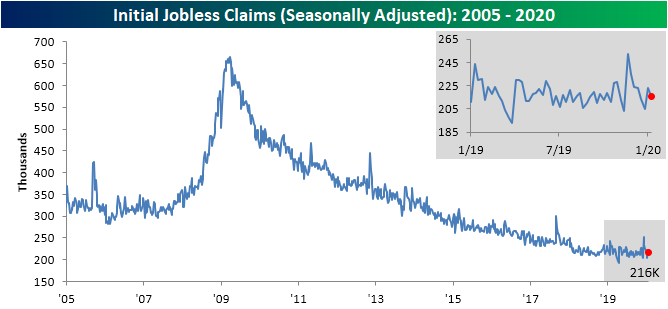
Given they remain in a range, the revision to last week’s print was one of the more notable aspects of this week’s data. Originally, last week’s seasonally adjusted number was much stronger at 211K, but that was moved 12K higher to 223K. While that does not leave claims significantly higher than any of the past year’s readings—it was the highest since the last week of December’s equivalent reading—the size of the revision was also the joint largest upward revision (January 18th of 2019 also experienced a 12K revision) since January of 13th of 2017 when claims had been revised upwards by 14K.

If those most recent large revisions were any clue, January has historically been the month of the year that seasonally adjusted jobless claims go through the largest upwards revisions. In other words, while the large revision this week is notable, it can be mostly chalked up to seasonality. As shown in the chart below, the weekly releases in January since the year 2000 have averaged an upward revision from the first release of 7.2K. No other month averages revisions nearly as large with the next highest being July averaging a 4.9K revisions.

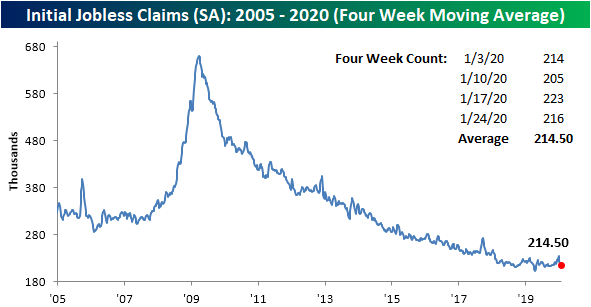
Despite that upward revision, the four-week moving average has fallen for a fourth consecutive week. Now at 214.5K, it is at its lowest level since early October when the moving average was 213.75K.
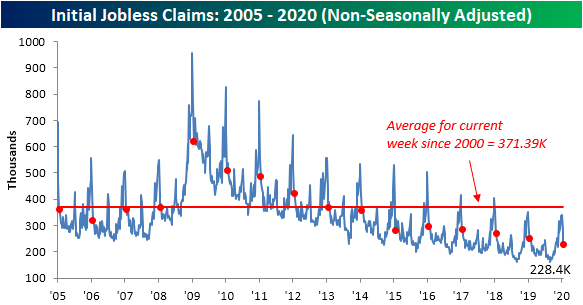
In terms of the non-seasonally adjusted data, claims are continuing to work off of their seasonal peak, falling to 228.4K this week from 282.1K last week. Given that the data is non-seasonally adjusted those week to week comparisons do not mean much and a better look is through the year-over-year change. By this measure, claims fell 22.4K YoY.



Comments
Log in or sign up to join the conversation.