


Belgium’s economy is off to a soft start to the year, and the near-term outlook remains subdued. Higher energy prices are part of the story, but they are not the whole story. Fiscal consolidation is now starting to feed through to households, and that could make consumption less resilient in the second half of the year
1. A weak first half, with industry still under pressure
Belgian GDP expanded by just 0.2% quarter-on-quarter in the first quarter (0.8% year-on-year). The positive surprise came from households: consumption rebounded by 0.6% after stagnating in the second half of 2025. But beneath the headline number, the picture remains fragile. Industrial activity contracted again, by 0.2% on the quarter, and the sector’s value added has still not returned to growth compared with its level at the end of 2019!
The first-quarter data say little about the economic fallout from the war in the Middle East. The first strikes came late in February and, in the early weeks of the conflict, households and companies probably still assumed that the shock would be temporary. Energy prices reacted quickly, but behaviour did not change fundamentally at that stage.
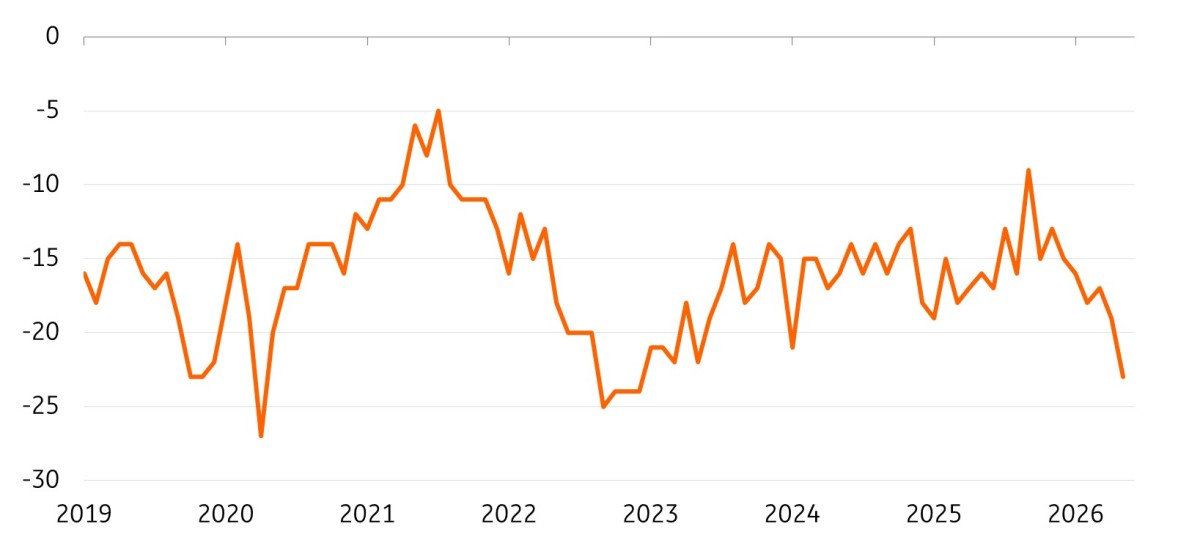
The second quarter looks weaker. Higher energy prices have clearly hit confidence among both companies and households. The deterioration is particularly visible in households’ assessment of whether now is a good time to make major purchases. This energy shock is also being felt more directly than in previous episodes because the authorities have introduced virtually no offsetting measures for households or firms. The reason is straightforward: there is little room left in the public finances.
Against that backdrop, the National Bank’s assessment of growth, based on Nowcasting models, point to stagnation in the second quarter, broadly in line with our own forecast. A slightly negative quarterly growth figure would not even come as a major surprise.
Chart 1. Belgian households are becoming less willing to make major purchases over the next 12 months
Consumer confidence indicator: opportunity for major purchase in next 12 months
Source: National Bank of Belgium
2. Fiscal measures are about to bite
The federal government has adopted a package of measures designed to reduce the public deficit while also lifting potential growth, mainly by increasing labour market participation. Many of these measures have now entered into force, or are about to do so. In an environment of weak activity and elevated inflation, three of them deserve particular attention.
Limiting unemployment benefits
Job creation remained weak in the first quarter, and sluggish growth is unlikely to help. Since 1 January, unemployment benefits have been limited to two years, whereas they were previously unlimited in duration. This will reduce the number of benefit recipients and generate savings for the federal government. But the macroeconomic impact depends on what happens next. The government’s assumption is that people reaching the end of their entitlement will intensify their job search. If that proves right, the measure could support labour supply. If not, the loss of income for the households concerned could weigh on consumption and growth in the second half of the year.
Making the labour market more flexible
The government has also broadened an existing scheme that allows people already in employment to take on an additional part-time job with flexible hours under highly favourable tax conditions. The objective is twofold: to help sectors facing flexible staffing needs and to allow workers to boost their income. In principle, this should support activity. But the measure also has limitations. It generates little revenue for the state, it may encourage some workers to reduce hours in their main job in favour of more lightly taxed flexible work, and could make it harder for unemployed people to access jobs in sectors where employers prefer flexible and lightly taxed labour. The extension of the scheme to all sectors will therefore need to be judged on whether it actually raises total employment.
Limiting automatic indexation
A further measure will take effect in July: wages will temporarily be indexed only up to €4,000. For social benefits and pensions, the ceiling will be €2,000. With inflation already above 4%, even a temporary limitation of indexation will squeeze purchasing power for some households. The government expects the impact to fall mainly on savings, assuming that the households affected have a relatively high saving rate. That assumption will be tested in the second half of the year. For now, we expect the measure to have a modest but negative effect on consumption momentum.
3. Public finances: Belgium gets some breathing space, but not a solution
Belgium’s public finances remain under clear pressure, as reflected in recent sovereign rating downgrades by two agencies. The federal government is looking for €6-7bn in structural savings. If an agreement were reached quickly and measures were implemented as early as the second half of the year, the impact on growth could be material, especially as an adjustment of that size would be hard to deliver without some tax increases. For now, however, no concrete package has emerged, and a rapid agreement looks unlikely given the scale of the effort required. That may reduce the immediate hit to activity, but it also means that Belgium’s fiscal position remains weak.
There is one piece of good news. The European Commission has decided, for now, to put the excessive deficit procedure against Belgium on hold. This is not the same as closing the procedure. But it does suggest that the Commission recognises the efforts already made and does not see a need to escalate the process at this stage.
Bottom line: weak growth, stubborn inflation
Taking all this together, and given the broader eurozone backdrop, we expect Belgian growth to remain weak this year, at around 0.7%, down from 1.0% last year. High energy prices should continue to weigh on business investment and household consumption, while fiscal measures are likely to become an additional drag. The National Bank’s latest projections, published today, are even more cautious, with growth expected at 0.6%.
Inflation, by contrast, remains uncomfortably high. It is currently running above 4%, and we expect it to average 3.6% this year, slightly above the National Bank’s 3.4% forecast. In short, Belgium faces a difficult mix: growth is losing momentum just as inflation and fiscal constraints leave policymakers with little room to cushion the shock.



Comments
Log in or sign up to join the conversation.