


The Belgian housing market started 2026 on a strong footing due to lag effects from 2025, but underlying dynamics are weakening. Declining transactions, weaker mortgage demand and rising interest rates signal easing demand, reduced borrowing capacity and more moderate price growth ahead
Early 2026 strength driven by lag effects, as demand and financing conditions weaken
Following a strong 2025, with median prices for existing homes rising by 5.6% year-on-year, the first quarter of 2026 appeared robust. Prices increased by 2.0% compared to the previous quarter and were 2.4% higher than a year earlier. This strength should, however, be interpreted with caution. Notary data reflect the moment when deeds are signed rather than when transactions are agreed upon. As deeds are typically executed within four months, part of the activity recorded in early 2026 still stems from decisions taken in 2025. Looking ahead, we expect the underlying market dynamics to soften from the second quarter onwards.
Initial signals are already visible. The number of transactions declined by nearly 14% compared to the previous quarter and was almost 5% lower than a year earlier, pointing to weaker demand. At the same time, financing conditions have started to shift. According to the National Bank of Belgium, the average interest rate on mortgages with a fixed rate of at least 10 years edged up from 3.29% to 3.34% in the first quarter. Rates on variable loans declined slightly, resulting in a change in the composition of new lending. The share of long fixed-rate loans fell from 68% in January to 59% in April, while shorter fixed-rate products gained some ground.
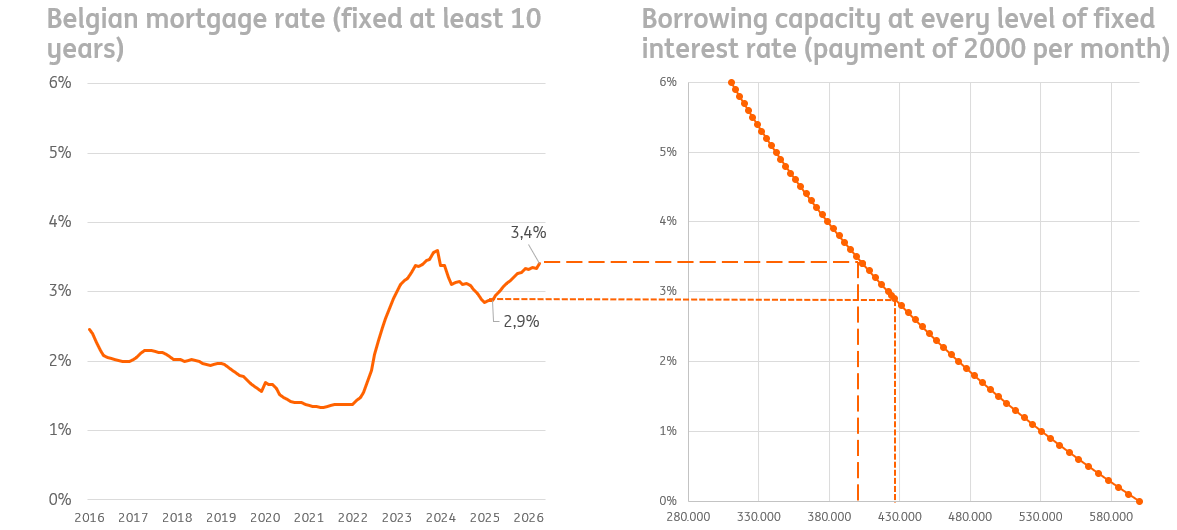
More recently, upward pressure on long-term interest rates, partly linked to higher inflation expectations due to the Middle East war, has pushed mortgage rates higher. By April, the average rate for loans with a fixed rate of at least 10 years had increased to 3.41%, up from 2.95% a year earlier. This rise has a tangible impact on borrowing capacity. For a monthly payment of €2,000 over 25 years, households can now borrow nearly €21,000 less than one year ago, narrowing the set of affordable properties and weighing on housing affordability.
Housing affordability is closely linked to financing costs
Mortgage activity signals cooling and points to more moderate price growth
This shift is already visible in mortgage lending, often an early signal of where the housing market is heading. In the first five months of 2026, the number of new mortgages was about 11% lower than a year earlier. Even if activity remains higher than in 2023 and 2024, the decline points to easing demand and more moderate price increases ahead.
In that sense, recent developments point to a cooling of price momentum, with price growth expected to continue at a more moderate pace. Median prices for existing homes are projected to increase by around 3.0% in 2026 and 2.5% in 2027, well below the strong growth recorded in 2025.



Comments
Log in or sign up to join the conversation.