

Thursday's Bank of England decision makes clear what we already knew: that the prospect of a November rate hike will depend entirely on energy prices. A hold is still our base case, assuming energy prices cool over the next six weeks. If they don't, then we'd expect the Bank to reluctantly hike rates in November and probably in February too
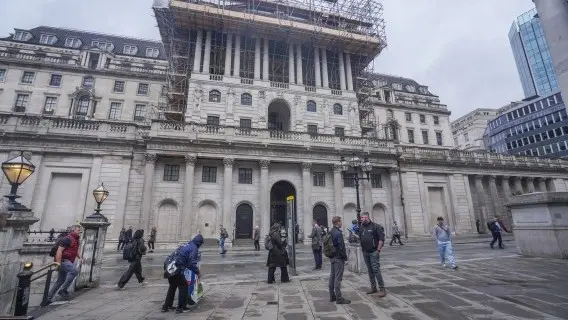
The Bank of England, which today decided to keep interest rates on hold.
The Bank of England has voted 6-3 in favour of keeping rates on hold at 3.75%, but the overriding message is clear: it is prepared to hike interest rates if energy prices stay high. The chances of a November hike hinge entirely on whether oil and natural gas prices come lower.
Our global base case assumes that they will. That would enable the Bank to stay on hold, as it voted to do today, and even cut rates in 2027. But if we’re wrong, it’s clear the Bank is prepared to hike in November – and if it does, we suspect it will do so again in the new year. It’s as simple as that. But either way, it suggests market pricing of four rate hikes over the next year looks overdone.
What’s striking is that the Bank now thinks inflation will peak a bit above 4% early next year. It’s not difficult to see why: if natural gas prices stay where they are today, then we’re looking at a 25% rise in the household energy cap in January.
This matters because previous BoE research has shown that when inflation surpasses 4%, we’re statistically more likely to see second-round effects. Deputy Governor Sarah Breeden – one of those voting to keep rates on hold – nodded to this today, saying that inflation is approaching “levels associated with non-linear effects”.
The key question now is whether that 4%+ inflation forecast is maintained in November.
Still, the reality is that there’s no sign that the rise in fuel and household energy bills is spilling into other parts of the inflation basket. Our gauge of inflation for energy-intensive goods and services has actually fallen this year. Food inflation is going down – the opposite of what you’d expect. Some of this may simply be lags, but we doubt the story will dramatically change over the next six weeks.
Today’s decision makes it clear that most officials still agree with this. So if the Bank does decide to hike rates, as Governor Andrew Bailey suggested today it could, it won’t be because of the economic data between now and November.
Instead, it will be an insurance hike – and it’s interesting that those voting for a rate increase at today’s meeting continue to characterise it through the lens of ‘risk management’.
That matters, because unlike the US or even the eurozone, where there is a live debate about whether interest rates are restrictive, that is a much harder argument to make in the UK. The jobs market is weaker, fiscal policy is tighter and rate-sensitive sectors are under more obvious pressure. The majority of those who voted to keep rates on hold made the point that financial conditions are bearing down on economic activity right now. Contrast that with Kevin Warsh at the Fed, who said the central bank was removing a “dose of accommodation”.
The case for higher UK rates remains far from compelling, and though we aren’t ruling out a rate hike later this year if energy prices remain high, market pricing for the Bank of England continues to look disconnected from the current economic reality.


Comments
Log in or sign up to join the conversation.