

AutoZone, Inc. (AZO) stock has risen in the last month since my last Barchart article. An interesting way to play AZO is to invest in a one-month put credit spread. The expected return is over 40%.
AZO is at $3,097.88 as of Monday, Oct. 19, up 11% from a recent low of $2,792.03 on Oct. 2. It could be worth much more, based on my analysis as well as other analysts' price targets.
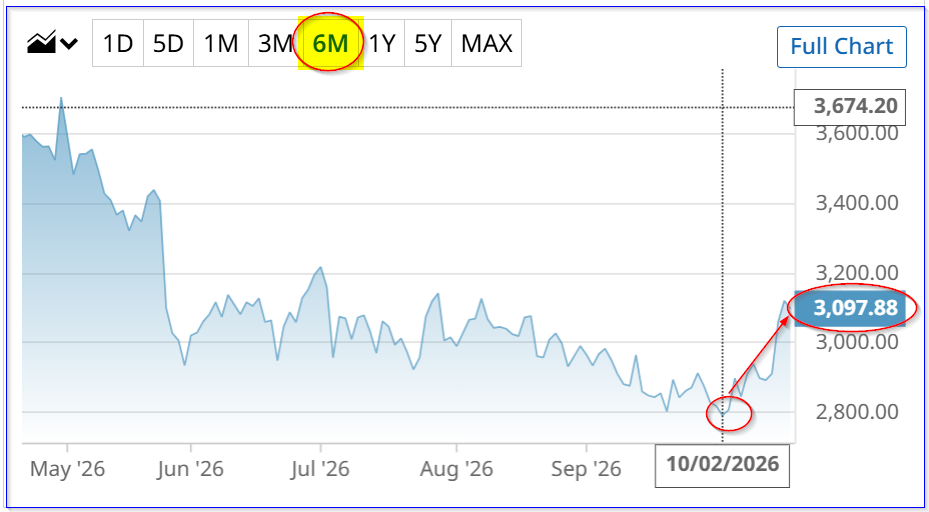
AZO stock - Last 6 months - Barchart - Oct. 19, 2026
I discussed this in my Sept. 25, 2026, Barchart article, “AutoZone Generates Strong Q4 Free Cash Flow - Is AZO Stock Too Cheap?”
The article shows that AZO could be worth $3,656 per share using three methods: FCF forecasts and FCF yield metrics, analysts' price targets (PTs), and historical price/earnings (P/E) metrics. That is still 18% above Monday's close.
Those points are still valid, and, in fact, analysts' PTs have actually risen. However, the article didn't address the best way to play AZO. Let's look at that.
Difficulties Using AZO Options
For example, for most investors it's hard to buy in-the-money (ITM) options or even sell out-of-the-money (OTM) puts. This is because the outlay required is very high.
For one, buying a $3,000 call option expiring in 5 months (March 17, 2027), which is in-the-money (ITM) by almost $100, costs $35,020 (i.e., $350.20 x100) for 1 call contract. Most people don't want to put that much money in 1 stock.
Similarly, shorting a one-month out-of-the-money (OTM) put option expiring Nov. 20, 2026, at the $3,000 strike price requires $300,000 (i.e., $3,000 x 100) in collateral. The investor collects $7,475 in midpoint premium income for an attractive yield (2.49%).
However, the delta ratio is a bit too high at -0.3442. That implies just a 65.58% chance of success, even though the strike price is 3% or so below the trading price (i.e., OTM).
So, one way around these issues is to invest in a put credit spread. It lowers the required collateral and increases the expected return, but the risk is higher.
AZO Put Credit Spread Play
For example, look at the Nov. 20, 2026, put option chain below. It shows that the midpoint premium for the $2,970 put strike price has a midpoint premium of $64.30 (with a lower 30.81% delta ratio), and the $2,960 put strike price has a $61.40 premium.
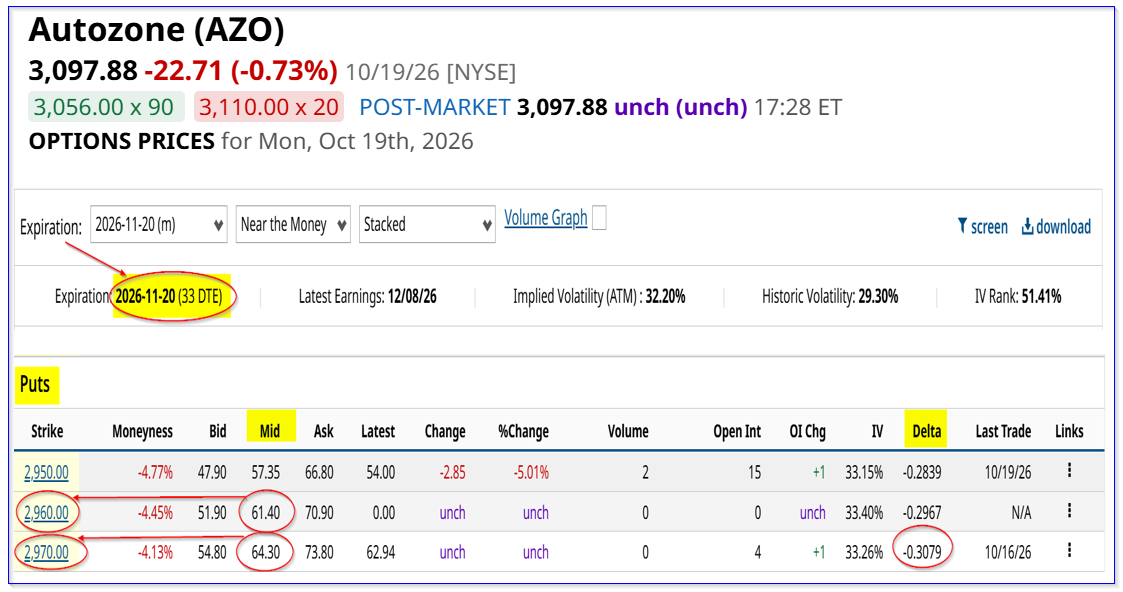
AZO puts expiring Nov. 20, 2026 - Barchart - As of Oct. 19, 2026
So, if an investor sells short the $2,970 put (collecting a $6,430 credit) and buys long the $2,960 put (costing a $6,140 debit), the net put credit collected is $290.00.
However, the investor only has to post $1,000 in collateral (i.e., $297,000 - $296,000) with their brokerage firm. As a result, the net at-risk amount is $1,000 - $290, or $710.
So, the expected return (ER) is:
$290/$710, or 40.85% over 1 month
As a result, an investor could do 5 put credit spreads for $5,000 in collateral and collect $1,450 ($290 x 5) in net put credit with $3,550 at risk of loss (i.e., $5,000 - $1,450). The expected return is:
That is about 20% of the short-put play at $3,000 income, but the required collateral is only 1.1% of the collateral required (i.e., $3,450 vs. $300,000).
The risk is that AZO falls below $2,967.10 ($2,970 - $2.90 spread income collected), which is 4.22% below today's price. The investor stands to lose the full $710 at risk per put credit spread if it drops to $2,960 or lower (i.e., 4.45% lower).
Nevertheless, for value investors able to take a risk, given AZO's potential upside, this could be a speculative play worth considering. After all, the chance of success is high at almost 70% (i.e., 1-0.3079 delta ratio = 69.21%).
Moreover, as we have shown, PTs for AutoZone are significantly higher, and its underlying value is $3,656 per share, +18% higher. The bottom line is that a short put AZO credit spread play provides up-front income and a very high expected return for AZO investors.



Comments
Log in or sign up to join the conversation.