


Analysts have raised their 2027 revenue forecasts for Palantir Technologies Inc. (PLTR), implying higher adjusted free cash flow (FCF). Price targets are also higher, despite PLTR's dip. Could PLTR be 38% too cheap here? This article discusses why that might be the case, and several ways to play PLTR.
PLTR closed at $163.59 on Wednesday, Nov. 25, ahead of Thanksgiving, up 1.50% for the day. That's up from a recent trough of $143.49 on Nov. 20, but still down over 21.7% from an Oct. 9 peak of $209.05.
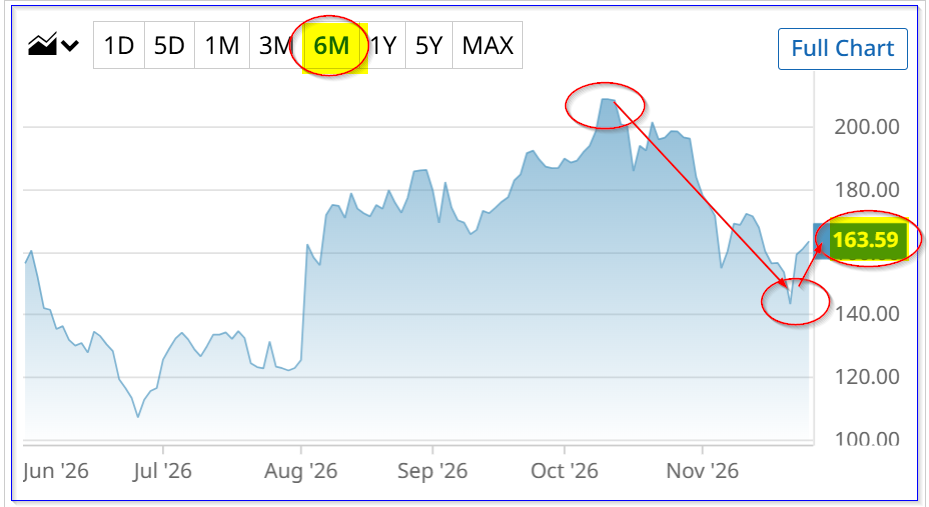
PLTR stock - last 6 months - Barchart - Nov. 25, 2026
Let's review what's happened since Palantir released its Q3 earnings.
Higher Revenue and Adj. FCF Forecasts
Palantir released its Q3 earnings on Nov. 2, 2026, showing strong revenue and adj. FCF growth and margins. I wrote about this in a Nov. 3 Barchart article, “Palantir Technology Shows Huge Unusual Call Options Activity - Is PLTR Stock Too Cheap?”
For example, in Q3, its adj. FCF margin was 52.3%, and management projected 2026 revenue of up to $8.534 billion and adj. FCF of $4.9b at the midpoint of its forecast range. That implies a 2026 adj. FCF margin of 57.4% (i.e., $4.9b/$8.53b).
Anthropic Bull vs Bear ETFs
Leveraged ETFs involve significant risks and are designed for short-term trading. Read the prospectus before investing. Distributor: ALPS Distributors, Inc.
Moreover, analysts now project even higher 2026 revenue of $8.55 billion. And for 2027, they forecast $13.14 billion (the prior forecast was $12.88 billion, as I discussed in my article).
As a result, if we assume at least a 55% adj. FCF margin (i.e., halfway between the Q3 margin and the estimated 2026 margin), Palantir should generate over $7 billion next year:
$13.14b 2027 revenue est. x 0.55 = $7.227 billion adj. FCF
That's 47.5% higher than the 2026 adj. FCF forecast. As a result, PLTR could have a higher fair value.
Higher Palantir Valuation and PLTR Price Targets
In my last article, I used a 1.333% FCF yield to value Palantir's adj. FCF. That's because right now Palantir has a market cap of $392.17 billion, according to Yahoo! Finance:
$4.9b 2026 est. adj. FCF / $394.17b = 0.0124 = 1.24% adj. FCF yield.
My higher 1.333% FCF yield metric is more conservative. For example, 1/0.0124 works out to an 80.6x multiple, whereas 1/.0133 has a lower 75.2x multiple.
Here is how that will work out using my new 2027 adj. FCF estimate:
$7.227b 2027 adj. FCF x 75 = $542 billion fair value
That's over 38% higher than its existing $392 billion market cap today (as well as my prior $512 billion fair value estimate in the Nov. 3 Barchart article). That means the price target (PT) is higher:
$163.59 price on Nov. 25 x 1.38 = $225.75 PT
That compares to my prior $208 PT. Moreover, analysts surveyed by Yahoo! Finance have raised their PTs as well: $222.90 today, vs. $216.00 on Nov. 3.
The result here is that analysts have raised their revenue forecasts, which automatically pushed up adj. FCF forecasts, as well as price targets.
Nevertheless, there's no guarantee PLTR won't keep falling. One conservative to play the stock is to sell short out-of-the-money (OTM) puts in nearby expiry periods.
Shorting OTM PLTR Puts
For example, the Dec. 31, 2026, expiry period shows that the $145.00 put option contract, over 11% below Wednesday's close, has a midpoint premium of $5.20.
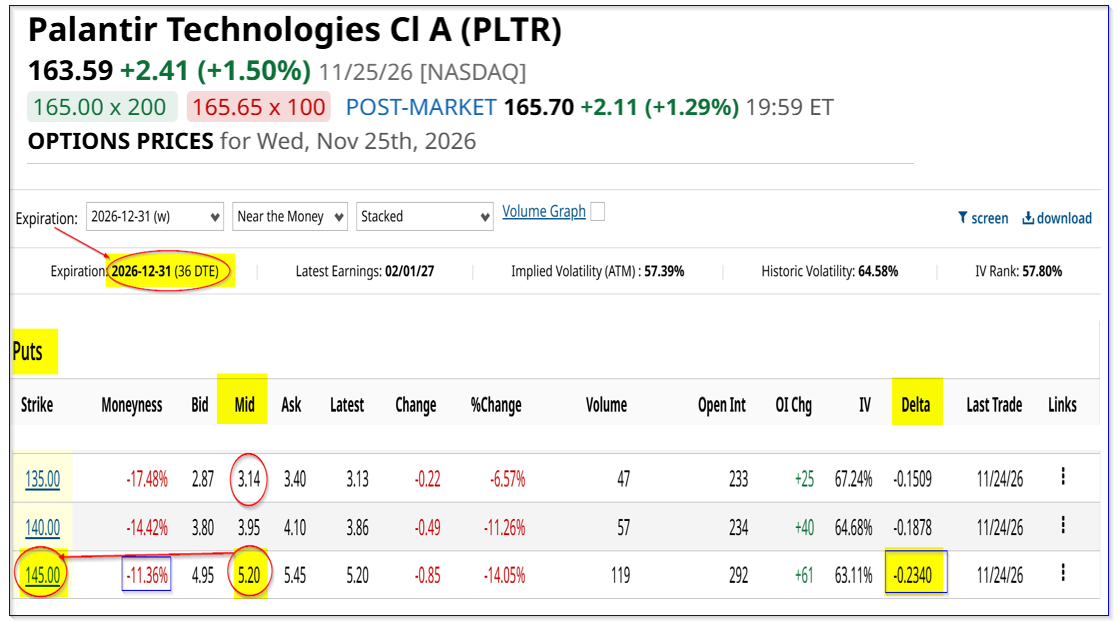
PLTR puts expiring Dec. 31, 2026 - Barchart - As of Nov. 25, 2026
That means an investor who enters a trading order to “Sell to Open” this put, collects $520 upfront after posting $14,500 as collateral.
So, the expected yield is 3.586%, assuming PLTR doesn't drop to $145.00 on or before Dec. 31.
However, note that even if that happens, the investor enjoys an attractive breakeven buy-in point: $145 - $5.20 = $139.80. That's 14.5% below the Nov. 25 closing price.
The risk is that if PLTR drops below $139.80, the investor owns 100 shares with an unrealized loss. The investor can then either wait or sell covered calls.
PLTR Put Credit Spread Play
Some investors, who have more risk tolerance, and don't want to post $14,500 in collateral, can buy a lower put, like the $135.00 strike price ($314 cost).
As a result, this put credit spread generates just $206 in collected income ($520-$314). However, the brokerage firm only requires $1,000 in collateral (($145-$135) x 100). So, the at-risk capital is just $794, with a much higher expected return:
$206/$794 = 24.9% over 1 month
However, the risk is much higher. If PLTR drops to $135.00, the brokerage firm will debit 100% of the collateral.
But consider this: the $135 strike price delta ratio is low, only -0.15. That implies an 85% chance PLTR won't drop to $135 by year-end.
Moreover, the investor can do 3 put credit spreads (i.e., to collect $618 with $2,382 at risk) to make a little more than the short-put play above. The benefit here is that only $3K collateral is required, or 21% of the $14.5K in the short-put play.
Summary and Conclusion
The bottom line is that PLTR looks even more attractive today after its Q3 earnings release. That's because analysts have raised their forecasts and PLTR stock has dipped.
As a result, expected returns from out-of-the-money (OTM) PLTR option plays have risen.


Comments
Log in or sign up to join the conversation.