

Here we calculate what buffers, if any, are built into Japanese and South Korean rates. We find that official rates in both centres remain too low. On top of that, both currencies are both a symptom and reaction to the requirement for higher rates. Both need official rates to be 100bp higher than they are today.
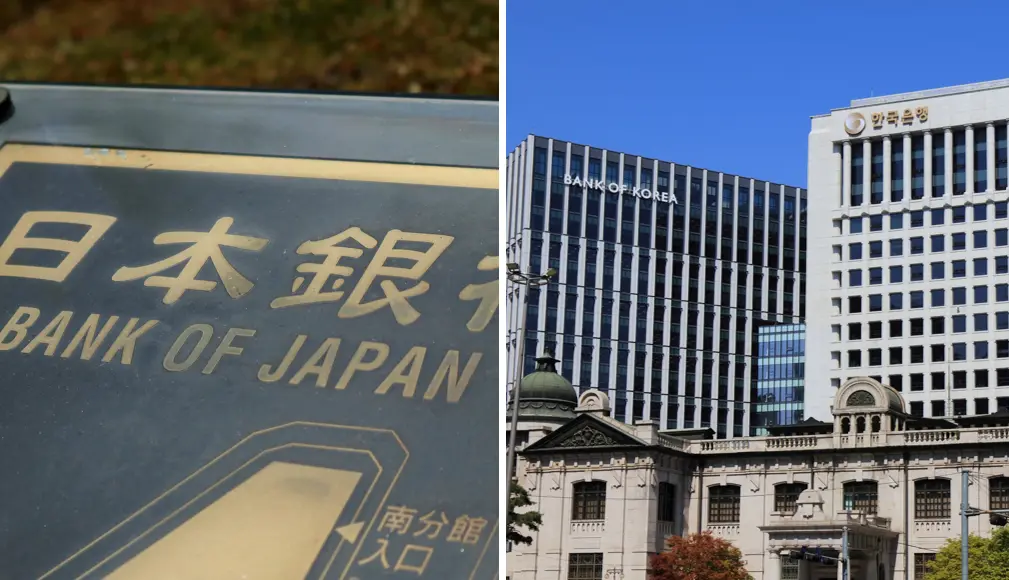
There are many differences between Japan and South Korea. But here we focus on similarities, and, in particular, on interest rate hike pressures. Both economies are seeing inflation pressures, either currently or ahead. And importantly, both economies have seen material FX weakness. That's unusual for high current account surplus economies, and questions whether respective domestic rates are pitched appropriately.
Here we deploy our interest rate pressure model(s) to help answer some questions, starting with Japan.
Rate Pressures for Japan
Calculating the interest rate buffer
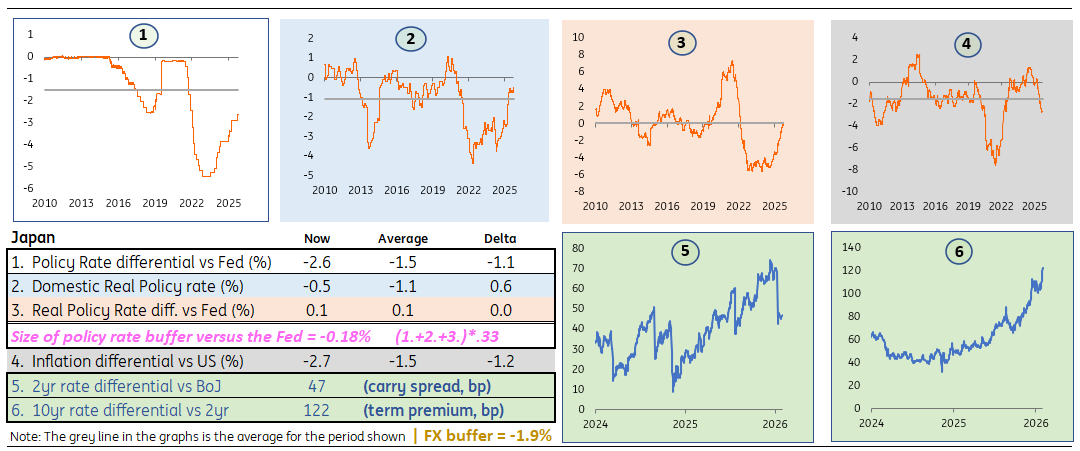
Above is our interest rate pressure model for Japan.
Our interest rate pressure model
We deploy pure statistical analysis that uses 15yr averages as neutral references.
We look at the rate differential versus the Fed, the domestic real policy rate and the real policy rate differential versus the US.
We take an equally weighted average of the delta of these three versus averages.
The outcome is a measure of the rate buffer. Positive is protective, while negative is loose.
It pops out an interest rate buffer of -18bp (negative, so no "buffer"). As a preliminary observation, the Bank of Japan (BoJ) could, or should, deliver a 25bp hike ahead, just to develop a very small positive buffer.
There are two key issues facing the BoJ. The first is inflation. Right now it's fine, at 1.5% year-on-year. But ahead, it's expected to re-accelerate as subsidy-related disinflation fades, and strong wage growth increasingly lifts underlying services inflation. It's headed for the 2.5% to 3% zone in the coming number of months. That, as a standalone, sustains pressure on the BoJ to adopt hawkish tendencies. The current BoJ rate of 1% remains ultra-low relative to these inflation dynamics.
And then there is the yen (JPY). Here there is looseness in play, as JPY has been trending exceptionally weak, based off the calculated deviation versus our purchasing power parity (PPP) model (versus the US dollar). Assuming that each 1.5% deviation from fair value equates to a 25bp move on the policy rate, we find that USD/JPY today is acting as a policy loosening to the tune of 190bp.
The spread between the BoJ rate and the 2yr TONA rate is 47bp ("carry spread"), signalling that there is an upside to the BoJ rate discounted. But not much. The 122bp spread from the 2yr rate to the 10yr rate ("term premium") is far more pronounced. It signals an unease with slow-grind hikes anticipated from the BoJ. The 5yr rate is at 2%, and that's the level that we believe the BoJ needs to get to. The issue is the BoJ is in no hurry to get there. Hence, the carry spread is too tight, and the term premium too pronounced, and that combination sustains JPY vulnerability.
Rate Pressures for South Korea
Calculating the interest rate buffer
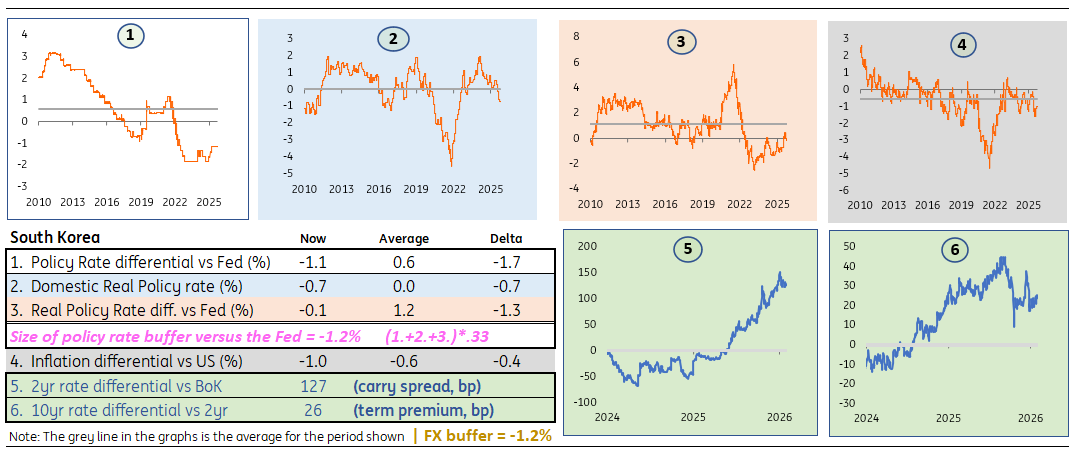
Turning to South Korea, we find there is an even larger negative interest rate "buffer" of -1.2% (so no buffer). Part of this (or, 40bp) can be explained away by the spread between the policy rate (2.5%) and the effective rate (2.9%). But that leaves an 80bp negative buffer. That's fine if macro circumstances warrant it, but S Korea currently has inflation running at 3.2% YoY, and GDP growth running at 3.8% YoY. Other things being equal, this warrants tighter policy, and a positive interest rate buffer (not a negative one).
The fact that the won (KRW) is trending weak versus the US dollar (USD) is also a point of vulnerability. On the same calculation used for Japan, our analysis shows that the current USD/KRW rate impliedly loosens policy by some 1.2%. On both counts, the negative rate buffer and the FX deviation, there is pressure for the Bank of Korea (BoK) to tighten policy.
Here there is a big difference versus Japan. The spread from the BoK rate to the 2yr rate is 127bp (carry spread). That points to more reactive hikes from the BoK in the coming months. Then, the spread from the 2yr rate to the 10yr rate (term premium) is relatively tame, at 26bp. It suggests relative comfort that the BoK will come in and hike as required, thus protecting longer tenors. Arguably here, the carry spread is too wide, while the term premium is too tight (2/10yr curve should be steeper).
All things considered, there is some 100bp in cumulative hikes to come from the BoK, bringing the policy rate to 3.5% (up from 2.5% currently). Our models suggest there is further upside for the effective rate beyond this, thus at least maintaining the current 40bp spread to the effective rate. The current 5yr rate at 3.95%, in a sense, reflects this.


Comments
Log in or sign up to join the conversation.