


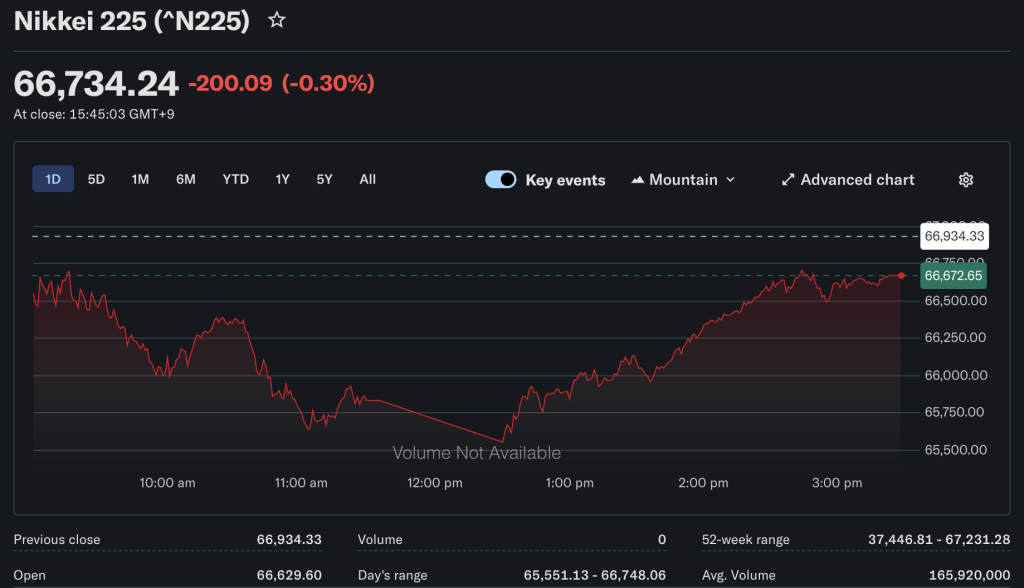
The Nikkei 225 fell -0.7%, and South Korean AI stocks dropped by up to -3.3% on Tuesday as markets reacted to Tehran’s halt in ceasefire negotiations with the US and renewed doubts about a partial truce between Hezbollah and Israel.
S&P 500 e-mini futures also declined by 0.3%, while Brent crude slipped -1% to $93.8 a barrel as some geopolitical risk premium diminished. The MSCI Asia-Pacific ex-Japan index posted a narrow 0.4% gain, masking significant disparities: declines in Korean stocks were offset by gains in China and Hong Kong.
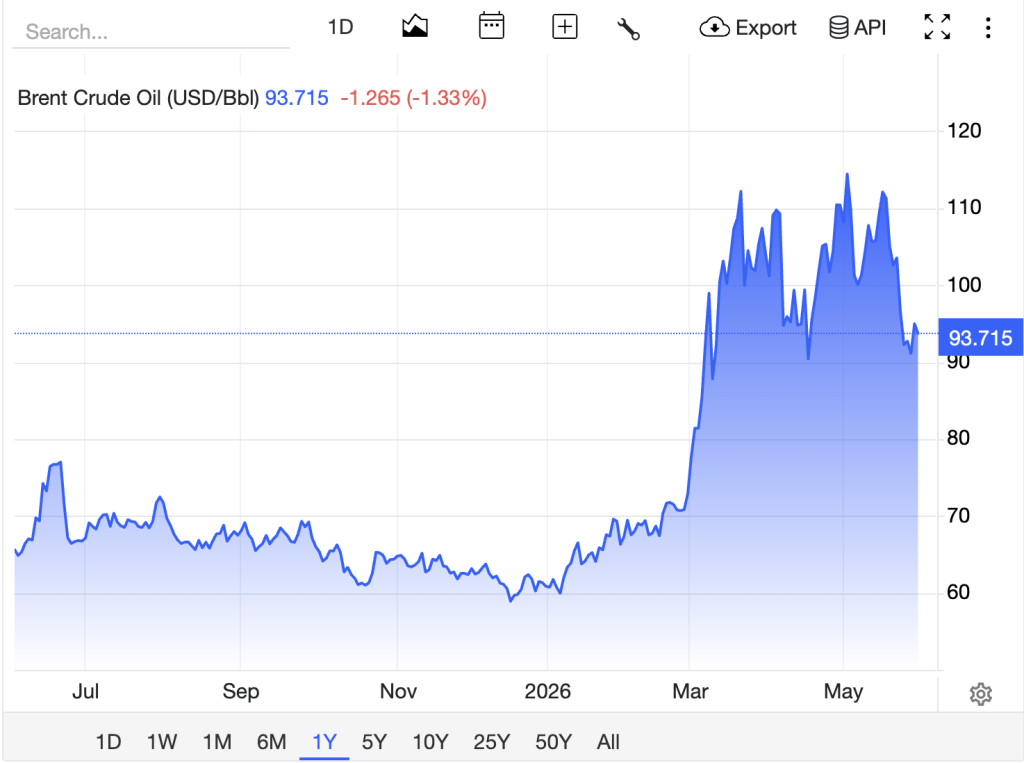
The tensions in the Middle East affect Asian markets through three main channels: rising energy costs for importers, safe-haven capital flows reducing equity risk appetite, and profit-taking in the AI sector following a strong momentum run.
The analysis will explore these geopolitical factors and their impact on key Asian indices and sectors, considering whether the current weakness is a brief pullback or the start of a deeper correction.
Middle East Escalation and Asia-Pacific Risk: How the Geopolitical Premium Is Re-Pricing Regional Equity Benchmarks
The recent volatility in the Middle East, marked by a temporary ceasefire announcement between Hezbollah and Israel, followed by Iran’s suspension of negotiations with the US, has affected market sentiment.
Fabien Yip, a market analyst at IG, noted that since April, ceasefire negotiations have repeatedly faltered, leaving residual risk premiums in energy prices.
This is particularly impactful for Asia, where countries like Japan rely heavily on oil imports. Despite a slight pullback, Brent prices at $94.13 continue to pressure margins in Japan’s industrial sector, affecting Nikkei 225 valuations. Similar energy premiums have been seen historically in Europe during tensions with Iran.
In a risk-off session, US Treasury yields fell, reflecting a shift towards safer investments, while gold prices rose. Additionally, momentum in Asian tech stocks, driven by news of potential IPOs and large equity offerings, is vulnerable to geopolitical tensions, increasing risk for AI-linked equities.
Nikkei 225, Hang Seng, and KOSPI: Session Breakdown, AI Stocks Sector Rotation, and the Safe-Haven Capital Flow
The Nikkei 225’s -0.7% decline highlights its vulnerability at elevated valuations, following a 61.9% rally since April 2022. Export-oriented tech and industrial stocks were pressured by a stronger yen, which erodes earnings for major exporters and draws foreign investment into JGBs rather than equities.
South Korean equities, notably the KOSPI, experienced extreme volatility, hitting a record high before dropping 3.3% intraday. Stocks like Samsung Electronics and SK Hynix fluctuated amid profit-taking, shifting market sentiment, and concerns over the Bank of Korea’s tighter policy and rising domestic inflation.
In contrast, the Hang Seng showed relative strength, supported by state flows and investor interest in Chinese stocks, which helped keep the MSCI Asia-Pacific ex-Japan index slightly positive.
However, the Hang Seng’s substantial gains leave it vulnerable to sentiment shifts, with key support at 22,670 and resistance at 27,500. Gold rose by 0.9% to $4,523.58, reflecting a shift towards institutional safe-haven assets rather than sector-specific rebalancing.
Key Resistance and the Geopolitical Pivot: What De-Escalation or Further Conflict Would Mean for Nikkei 225 and Hang Seng Directional Moves
The bull case hinges on a verifiable de-escalation signal, such as the resumption of US-Iran indirect talks or an extended ceasefire in Lebanon, which could lower the Brent risk premium below $90 per barrel and boost risk appetite in Asia.
In this scenario, the Nikkei 225 might recover to the 58,800–59,000 range, while the Hang Seng could target a retest of the 27,500 resistance level. The AI stocks sector remains supported by Anthropic’s IPO pipeline and Alphabet’s $80Bn infrastructure investment.
Conversely, the bear case emerges if Iran’s negotiations break down or the Lebanon ceasefire fails, potentially driving Brent above $94.13, which would increase Asia’s energy import costs and pressure the Nikkei 225 toward the 56,000–57,000 range. Korean equities could face added downside due to the Bank of Korea’s hawkish stance.
Currently, the base case reflects a cautious holding pattern with Brent expected to remain between $90 and $96 per barrel, as uncertainty keeps S&P 500 e-mini futures near flat. Key upcoming catalysts include the Federal Reserve’s policy meeting and developments in US-Iran talks.


Comments
Log in or sign up to join the conversation.