

The current account deficit broke its upward trend in April, while a marked improvement in the capital account helped lift official reserves.
The Turkish current account posted a deficit of US$5.7bn in April, higher than the market consensus and our call. However, given a large improvement in the monthly deficit over the previous year, the 12-month rolling figure dropped US$37bn or approximately 2.4% of GDP, from US$39.7bn a month ago.
A closer look at the monthly figures shows that the deficit narrowed by roughly US$2.8bn compared to the same month of 2025, primarily due to a lower trade gap, which deteriorated from US$-9.9bn to US$-6.8bn. This stemmed from an improvement in the core trade deficit and falling gold imports.
The US-Iran war, on the other hand, which has pushed energy prices significantly higher, led to a deterioration in the energy trade balance compared to last year and limited the extent of narrowing in the current account deficit.
Breakdown of the current account
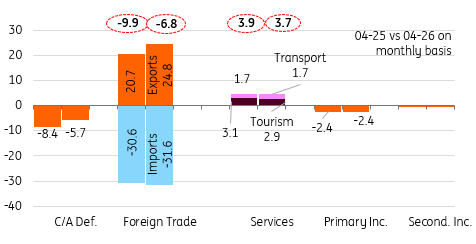
On the capital account side, with the announcement of a ceasefire in the Middle East war in early April, capital flows improved markedly to US$19.2bn, from record-high outflows in March. With slight outflows from net errors and omissions of US$1.5bn, and considering the current account deficit, official reserves expanded by US$12.0bn.
Further analysis reveals that resident activity led to inflows totalling US$1.9bn, primarily from the growing foreign deposits of local banks abroad, despite the continued acquisition of portfolio assets. Non-residents raised their Turkey exposure by increasing their portfolio investments by US$6.4bn and deposits held at local banks by US$4.2bn. Additional net borrowing of US$5.4bn also contributed to foreign flows in April.
In the breakdown of net borrowing, both banks and corporates secured long-term financing. This translates into long-term debt rollover ratios at 347% for corporations and 162% for banks on a monthly basis, compared to 224% and 150%, respectively, on a 12-month rolling basis. On the corporate side, an acceleration in rollover rates since mid-2025 towards above 200% levels is worth noting.
Breakdown of financing
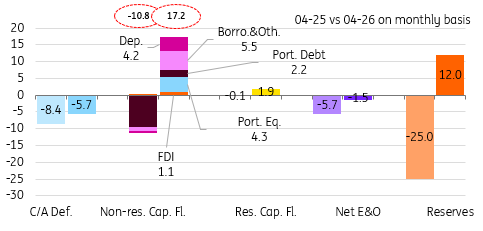
In the first four months, resident outflows rose slightly to US$10.2bn from US$9.6bn a year ago. Foreign inflows, on the other hand, recorded a jump, coming in at US$27.3bn, compared to a mere US$3.6bn in the same period of 2025. As a result, the capital account has moved to the positive territory with US$17.0bn, compared to a US$-6.0bn.
In addition, outflows via net errors and omissions remained elevated, totalling US$-17.7 bn vs US$-8.0bn in 2025. Taken together with the widening current account deficit, which grew from US$-22.6bn to US$-29.4 bn, official reserves were depleted by US$30.0bn vs a US$36.6bn fall recorded a year earlier.
Overall, the current account deficit in April ceased the widening trend, while recovering capital flows led to recovery in official reserves. Preliminary customs data from the Ministry of Trade suggest an improvement in the May current account, likely reflecting calendar effects. In the months ahead, the trajectory of the current account balance is expected to be influenced by a mix of external risks alongside domestic demand conditions. In this regard, geopolitical shock increases the upside pressures on the current account deficit given elevated trajectory of oil and gas prices in addition to a potential decline in tourism revenues and a rise in gold imports. Sign of agreement between US and Iran on the other hand should be supportive with easing pressure in energy pressures.



Comments
Log in or sign up to join the conversation.