Applied Materials The Punishment Of High Expectations

Applied Materials posted record revenue, but shares fell as flat margin guidance failed to meet high expectations.

When a stock more than doubles in a year, the market stops asking if the underlying business is good and starts demanding continued outperformance. Applied Materials proved its operations remain highly profitable by posting record revenue and record operating cash flow in its third quarter. Yet the stock fell immediately after the print. The setup illustrates the heavy burden of elevated expectations. The company delivered a modest earnings beat and fourth quarter guidance well above consensus, but investors focused on flat near term gross margin guidance and whether Applied can grow faster than its equipment peers. The divergence between a strong operating outlook and an already demanding stock price explains the selloff.

Main Note

The Burden of Perfect Expectations at Applied Materials

Applied Materials (AMAT) Quote

Verdict: The post earnings pullback in Applied Materials is a story about elevated expectations rather than business deterioration. Management delivered record results and a more balanced geographic mix. The catch is that investors wanted clearer proof of faster peer relative growth and more immediate margin expansion.

What happened

Applied Materials reported record fiscal third quarter revenue of $9.12 billion and adjusted earnings of $3.50 per share. Both numbers topped consensus estimates, although the beats were modest. The company also generated a record $3.04 billion in operating cash flow. Management guided fourth quarter revenue to roughly $10.25 billion, well above the analyst consensus, and guided adjusted earnings to $4.02 per share.

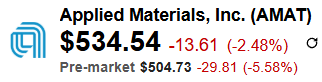
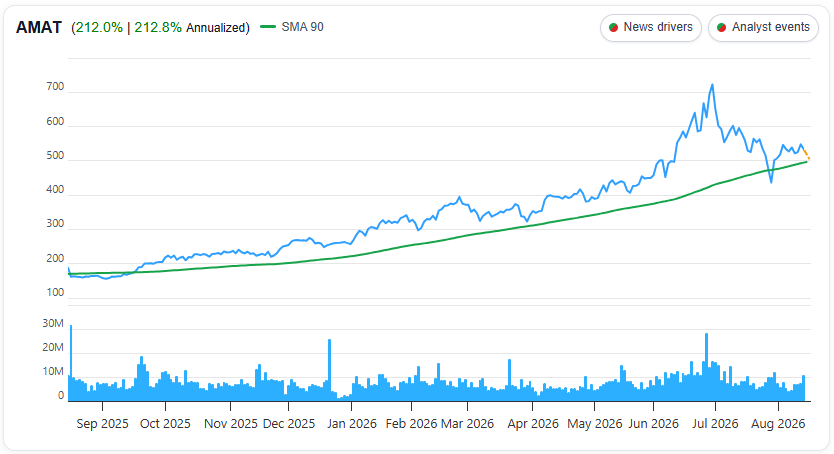
Despite this operational execution the stock sold off. Shares fell 2.5% during Thursday’s regular session to close at $534.54. They then dropped another roughly 5% after hours and remained down about 5% in Friday premarket trading.

Applied Materials (AMAT) 1 Year Chart

Applied Materials (AMAT) 1 Year Chart

Why it matters

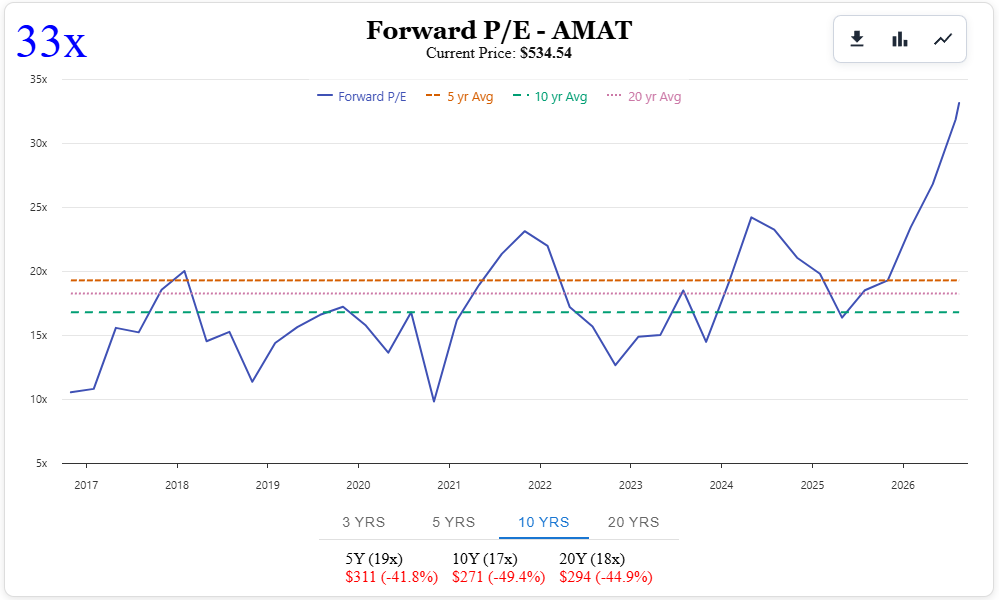
Valuation math is unforgiving. Applied Materials entered Friday trading at roughly 32 times forward earnings, not above 40 times. That is expensive in absolute terms, although its multiple was slightly below Lam Research, KLA (KLAC) and ASML (ASML). Management guided fourth quarter non GAAP gross margin to stay near 50.4%. The flat sequential outlook reflects hiring and capacity ramp costs along with a higher mix of lower margin display revenue. That is a near term headwind, but management still expects margins to improve slowly as revenue catches up with the spending.

What changed in the thesis

The market had been assuming that explosive demand for artificial intelligence hardware would translate into faster revenue growth and steady margin expansion. The quarter did not break that thesis, but it pushed the timing out. Third quarter non GAAP gross margin still increased 40 basis points sequentially and 150 basis points year over year. Fourth quarter guidance is flat because Applied is hiring and adding capacity ahead of demand. Investors now have to judge whether those ramp costs fade as revenue grows or become a more persistent drag.

What the market may be missing

The market is fixating on the flat margin guidance and may be underestimating the improvement in geographic mix. China fell from 35% to 28% of total revenue while United States revenue roughly doubled in dollars and increased from 9% to 15% of the total. The important nuance is that China revenue itself was almost flat at roughly $2.5 billion. The lower percentage mainly reflects faster growth elsewhere. That is real diversification, but one quarter does not prove China risk has disappeared or that legacy node demand has been permanently replaced.

Valuation and expectations

The stock entered the report trading at a significant premium to its historical average price to earnings ratio. Because the business now requires heavier internal manufacturing investments to meet demand stretching into 2030, free cash flow margins could temporarily dip. The core debate shifts from top line growth to whether the company can drive sequential margin expansion while absorbing the ramp costs needed to expand production capacity.

Applied Materials (AMAT) Forward PE Ratio

Applied Materials (AMAT) Forward PE Ratio

Bottom line

This is a valuation reset rather than evidence that demand has cracked. The business has better customer visibility through rolling eight quarter forecasts and longer term capacity discussions, but those are not the same as firm multi year orders. The stock is being asked to prove that today’s hiring and capacity build will turn into sustained market share gains and higher margins after the ramp.

Pre Market Pulse

  • Broad equity futures pointed to a mixed open following a record setting Thursday session where the S&P 500 closed near 7,800.

  • Producer prices were unchanged in July and increased 4.7% over the past year. The report was softer than expected, although the measure excluding food, energy and trade services still rose 0.4% for the month.

  • Treasury yields fell sharply on the soft inflation print with the two year yield dropping to roughly 4.15%.

Why it matters this morning

Thursday’s softer inflation data was supportive for growth stocks, but Friday’s increase in oil prices complicated the backdrop. Applied Materials’ decline appears company specific rather than part of a broad semiconductor equipment selloff. Investors focused on flat fourth quarter non GAAP gross margin guidance and whether the company can keep pace with faster growing peers.

Peer Read Through

Lam Research (LRCX)

Lam is highly exposed to memory and etch technologies. Applied Materials noted that memory equipment revenue jumped significantly which directly supports the strong demand environment Lam recently reported.

KLA Corporation (KLAC)

KLA dominates inspection and process control. The massive anticipated growth in advanced packaging over the next two years suggests inspection tools will remain in high demand even if legacy logic spending slows.

ASML Holding (ASML)

ASML holds a monopoly on the extreme ultraviolet systems that dictate the broader equipment cycle. Their recent earnings beat and premium valuation show that the most critical toolmakers are still commanding pricing power.

Group takeaway

The entire semiconductor equipment group is trading at steep historical premiums. The current multiple relies on the assumption that artificial intelligence capital expenditures are immune to standard hardware cycles. If any of these toolmakers signal a pause in enterprise spending, the group wide multiple compression could be severe.

What to Watch

  • Capital spending updates from major semiconductor foundries and memory producers regarding their 2027 equipment plans.

  • Execution on the roughly 50.4% non GAAP gross margin target during the next earnings release.

  • Revenue growth in advanced packaging, which management now expects to grow more than 70% in calendar 2026.

  • Whether recent insider selling remains elevated and how much of it reflects prearranged selling plans rather than a change in management’s view of the business.

Bottom line

The near term risk is not that demand has collapsed. It is that Applied is spending ahead of growth while investors are already paying for several years of strong AI related equipment demand. The key questions are whether customer forecasts turn into shipments, whether Applied can gain share against peers, and whether margins improve after the current hiring and capacity ramp. China exposure, export restrictions and the normal cyclicality of semiconductor capital spending also remain material risks.

STOCKS IN THIS ARTICLE

Also Mentions:

Comments