

One of the earliest reasonably documented military engagements between an overwhelming invader and a much smaller, but motivated, resistance was the Greek defense against the Persian invasion. Various pertinent lessons can be learned from that conflict and applied to the current one.

While the numbers of soldiers involved in the ancient Persian Wars are routinely discounted by modern scholars, three specific battles have remained among the most studied of human history. One, Marathon, involved the use of a thin line of heavy infantry managing to encircle a larger force of light infantry. The second, Salamis, involved small and maneuverable Greek ships moving between far larger Persian ships and sinking them in the ensuing chaos. The third, Thermopylae involved 300 Spartan soldiers holding off a massive Persian army for days by meeting them at a pass where only two soldiers could engage at a time. The superior Spartan infantry rotated and held off the more numerous Persian soldiers for several days before being encircled due to local treachery. Remarkably, due to weather conditions in northern Ukraine, all three of these battles are relevant to today’s conflict.
The Battle of Marathon laid out the ideal situation for a heavily armored conflict. You spread out your resources, they cover one another, and then they encircle and smash the enemy. Greek warfare followed this pattern for hundreds of years, with the heavily armored phalanx being almost unstoppable until the arrival of Alexander the Great. But during the Ukrainian conflict we have not seen tanks spread out and covering one another. Instead, we’ve seen them in vast columns. Like the Battle of Thermopylae, essentially only one vehicle at a time moves into a position of engagement with the enemy. In addition, any breakdown in the column results in a total loss of movement. These vast, largely immobile, columns have been sitting ducks for more agile light infantry, as in the battle of Salamis. Unable to maneuver, they are unable to defend themselves or launch any sort of effective offensive operation.
The Russian forces can’t have intended to enter the battle space in vast columns. Footage of operations from the Belarussian war games in early February showed military assets deployed in a more conventional arrangement. They traveled from place to place on the roads, but they then switched to operations across open country, arraying themselves in lines and deploying significant simultaneous firepower at the front. That is not the sort of arrangement we have seen in Ukraine.
The obvious question is: why?
Why, faced with literal traffic jams on the meager roads linking Ukraine to Belarus and Russia have the Russians not simply gone off road? The terrain is reasonably flat. It would seem ideal for this sort of workaround. The answer comes from one of the most familiar images from this war: tanks and other vehicles stuck in mud.
Abandoned #Russia' n Tor M1 Air Defence System stuck in the mud
— C4H10FO2P (@markito0171) March 6, 2022
/#Chernihiv area NE #Ukraine pic.twitter.com/3eLJZi1bKN
Fighting the land itself (and losing) - After getting stuck in mud, Russian tank crews abandoned their equipment and fled into the bush, near a Ukrainian swamp pic.twitter.com/Cd7N855Tc7
— The New Voice of Ukraine (@NewVoiceUkraine) February 27, 2022
Ukraine is famous for its mud. In fact, it and Russia have a mud season, known as Rasputsitsa. In the spring and the fall, mud has directly impacted military invasions of Russian itself. It is believed the Mongols, Napoleon and Hitler were all slowed by Russian mud prior to being hit by the Russian winter. The spring is particularly difficult due to the cycle of freezing and defrosting that causes ‘frost heaves’ in which the road is buckled due to thermal cycling. Tanks and heavy armored vehicles do significant damage to roads in the best of situations. When combined with poor road conditions, the roads can effectively cease to exist. Another familiar site has been vehicles with their tires torn to shreds. While poor maintenance and possible enemy action contributed to these situations, a common method of dealing with muddy conditions is the lowering of tire pressure. When tires that are already in poor shape have their pressure lowered, the result can be complete failure.
Ah yes, the mud. If you're a WWII buff, you know all about the two mud seasons — fall rain, spring melt — that brought everything to a halt twice a year on the Eastern front. And Putin decided to invade Ukraine during the rasputitsa 1/ https://t.co/B31wZ1UVca
— Paul Krugman (@paulkrugman) March 3, 2022
Prior to the First Gulf War in Iraq, U.S. forces apparently secretly crossed and laid down geomatting to provide a better surface for moving their armored assets. The Russians did not. Instead, they are relying on improvisational techniques to try to overcome the challenges they are facing.
Брошенная в грязи техника русской армии pic.twitter.com/vvrSfKIMO5
— IgorGirkin (@GirkinGirkin) March 3, 2022
The result of this is that instead of deploying their heavy assets in an ideal arrangement, as at Marathon, they have found them funneled into narrow corridors as at Thermopylae and then attacked by more mobile units as at Salamis. Every aspect of this military history eternalized over 2,000 years ago has been seen turning against the Russian armored forces.
Again, the question must be asked: why? Why would the Russian military, which must be aware of its own national history of using weather as a tool of warfare, make such a fundamental mistake?
Was it incompetence, hubris or some other factor?
The third option seems the most plausible. The Russian military ran a dry run of the Ukrainian invasion in Belarus only weeks before the actual conflict. They had no problems with mud there.
A look at the temperature graphs can explain why:
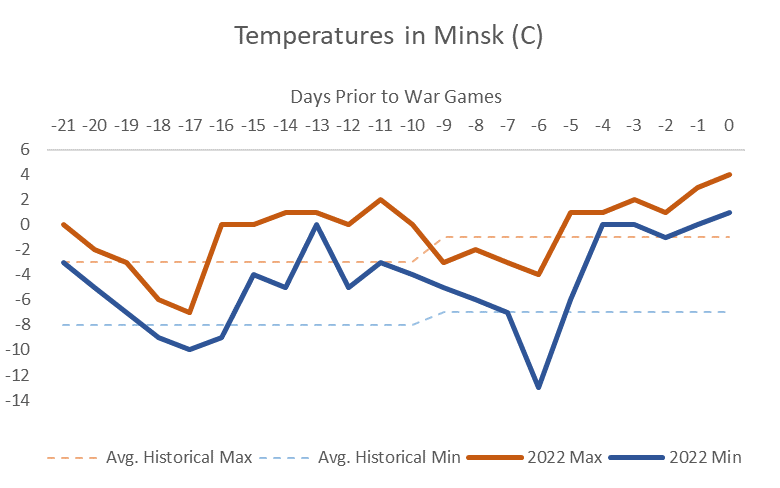
In Minsk, temperatures were somewhat above historical averages with an average high of -1 C (1.4 C warmer) and an average low of -5 C (2.9 C warmer than normal). While these are not ideal conditions to avoid mud, they were seemingly cold enough to support the exercises. At this point, everything checked out. The tank offensive could be supported.
Except… it couldn’t. Here’s a look at the temperature in Kiev for the three weeks prior to the Ukraine invasion.
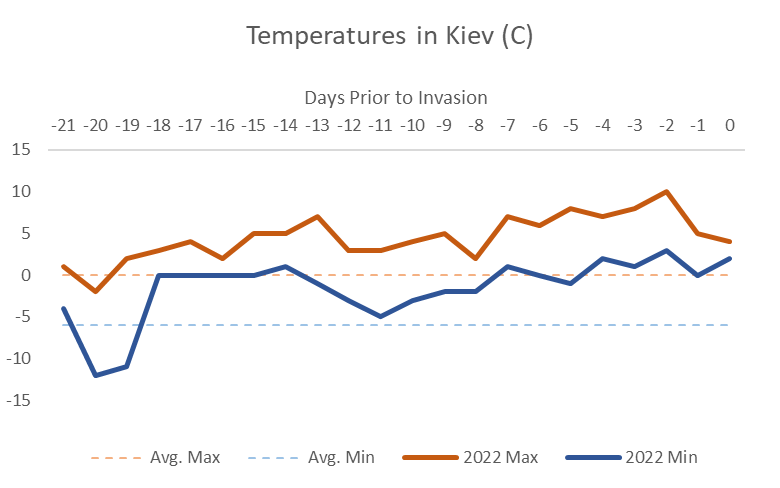
Here, temperatures were significantly above average with an average high of 4.7 C and an average low of -1.4 C. Both are approximately 4.6 C warmer than normal – a shocking differential. Critically, daily temperatures often remained at or above freezing. Given that the earth retains significant heat, this would have led – did lead – to ground that could not support Russian armored movements.
The dry run in Minsk was not representative of conditions in Kiev only two weeks later. Because of this, Russian armor was trapped.
Discussions of climate change are outside the purview of this review; this is only a small sample of a single year’s outlying temperature in Kyiv. Even between these two locations the differentials between average and actual temperatures are vastly different. Highs in Minsk were only 1.4 C above average while highs in Kiev were 4.6 C.
Irrespective of long-term climate trends, it seems clear that the early spring in northern Ukraine led to a massive battlefield disadvantage for the Russian heavy armor and equipment. There was an element of hubris in the decision to go ahead with the invasion nonetheless. The weather data was entirely public and knowable. The impacts of the mud could have easily been factored in. But the decision to invade had apparently already been made. Furthermore, there was an expectation that local resistance would collapse almost immediately making factors like weather irrelevant.
At this point, the Ukrainians have claimed over 11,000 Russian fatalities. If these numbers are to be believed, more Russians have been killed in 10 days of engagement in Ukraine than Coalition forces lost during the entirety of the wars in Iraq and Afghanistan combined. They have lost most soldiers than the USSR lost in 9 years in that same theater. While the Ukrainians have certainly suffered high casualties, the story to date would probably have been far different had temperature averages been maintained.
What lessons can be learned for the future?
Perhaps it is just this: despite massive advances in technology since the days of the Greeks, weather still matters and planners of all sorts – whether moving laptops or tanks – who fail to adapt to changes in weather can find themselves making serious and possibly fatal errors.

For a more humorous take on the hubris of planners, check out this excerpt from my autobiography.
If you want a broader understanding of the dynamics of the conflict, I’ve presented them in a relationship advice column.



Comments
Log in or sign up to join the conversation.