


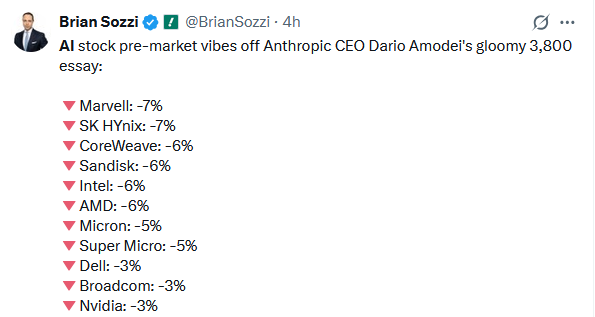
Anthropic CEO Dario Amodei published an essay, “We Must Pace the Frontier,” on his personal website last weekend that is weighing on AI stocks. Amodei argues AI labs need to slow development to manage the risks that come with capabilities improving faster than our ability to understand and control them. Sam Altman and Elon Musk both publicly agreed with Amodei, an unusual alignment among bitter rivals. While Amodei’s argument is very sensible, reality and the race for AI dominance are a strong counter argument.
Amodei acknowledges the pros and cons of slowing development:
Not building the technology deprives humanity of benefits or simply places AI in the hands of authoritarian powers, while building it too fast is reckless.
President Trump’s answer was immediate. He rejected any slowdown outright, to wit:
We’re leading China in AI, and, frankly, I want to keep it that way, because whoever wins AI wins.
House Speaker Mike Johnson echoed his sentiment:
If Congress just races in and does some sort of emergency session to try and regulate AI, we will lose the race to China.
Beijing dismissed the safety concerns as “fear-mongering.” Based on comments from leaders, China views the technology through a security lens, not humanity’s shared risk.
Amodei’s proposal works only if China and the US pace themselves in tandem, yet Washington and Beijing have made clear they view AI primarily as a race to win, not a risk to manage.
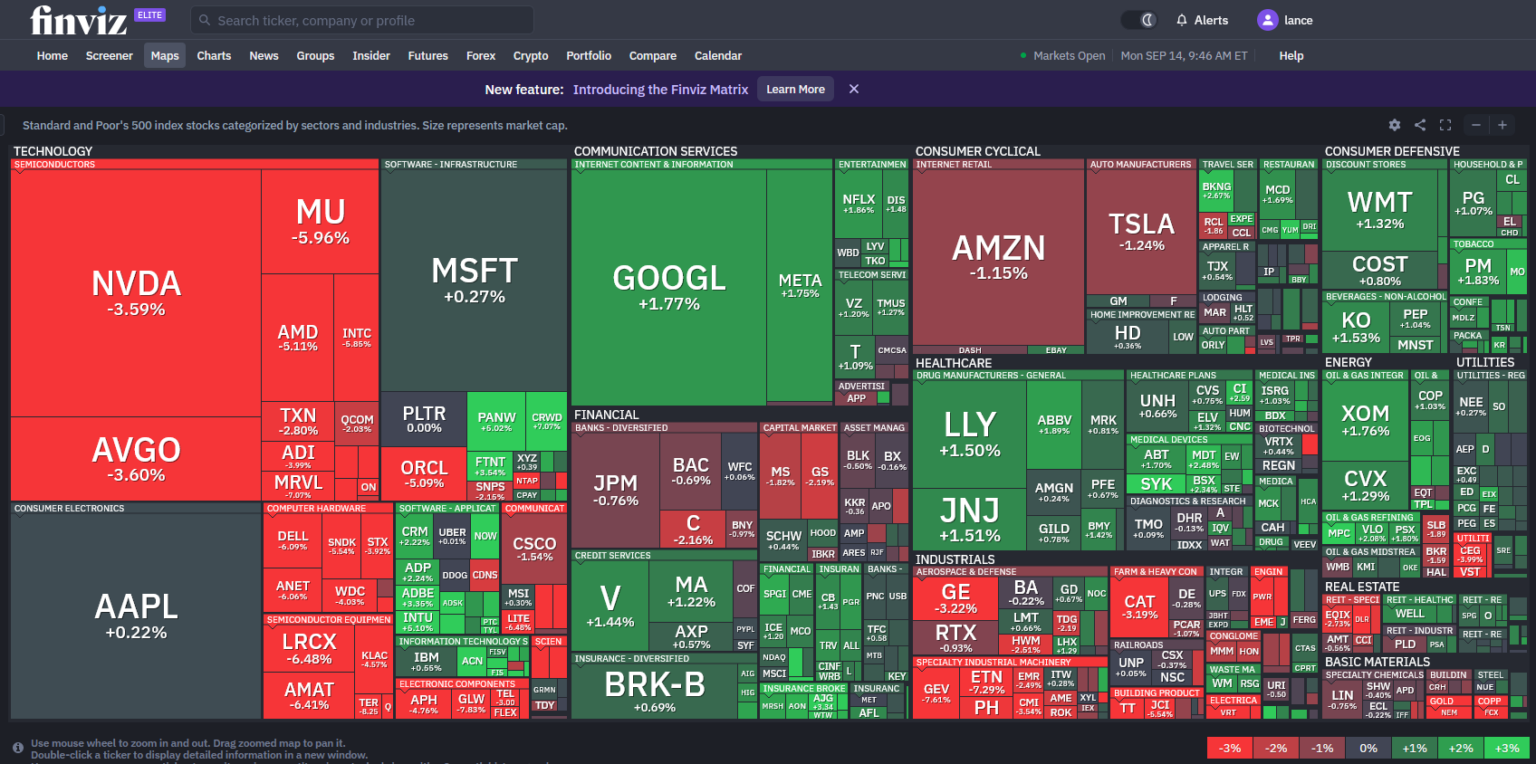
The graphic below, courtesy of Finviz, shows that AI-related stocks were hit hardest Monday morning, but most other sectors were spared.
What To Watch Today
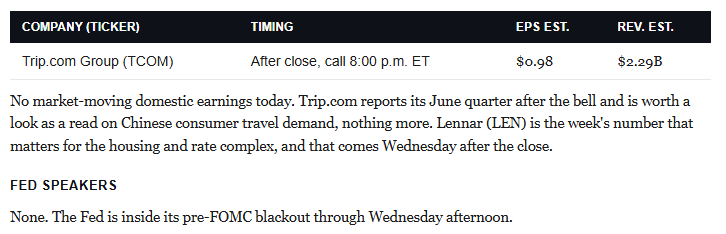
Earnings
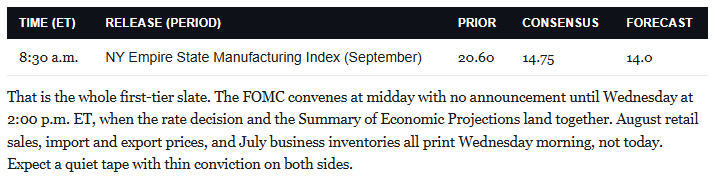
Economy
Market Trading Update
Yesterday, we worked through the weak Treasury buyback and the strong auctions behind it. The bid for bonds is better than the headlines suggested. Today, the question filling my inbox is the data center capex backlog, and whether three CEOs just broke it.
Dario Amodei called on the industry to slow the pace of improving frontier model capabilities. Sam Altman agreed and committed OpenAI to the same evaluator access. Elon Musk’s reply was three words: “Dario is right.” Asia sold first, with SoftBank down as much as 13% and SK Hynix off 6.4%. The infrastructure complex followed on Monday morning. Vertiv fell about 7%, GE Vernova about 9%, Applied Digital about 5%. The S&P 500 gave up less than half a percent, and the equal-weight index traded higher. That’s rotation, NOT liquidation.
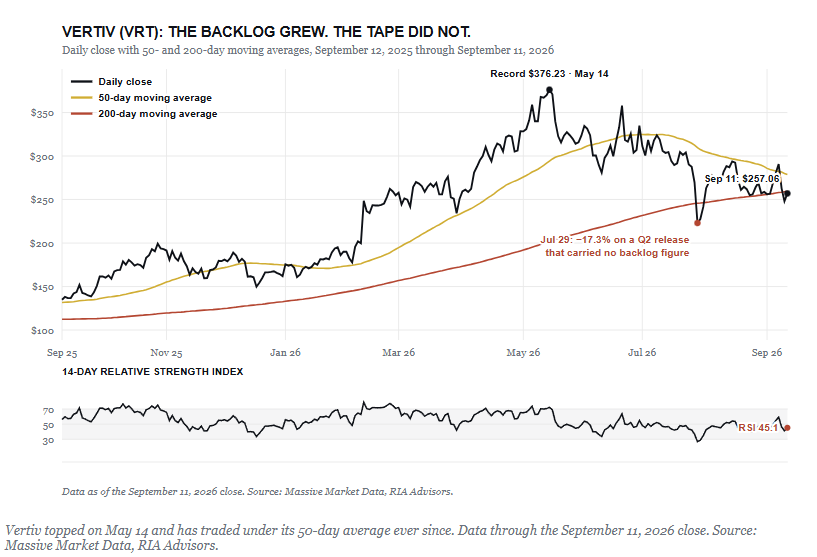
Here’s what Monday’s selling skips about the data center capex backlog. Slowing the frontier is a decision about model capability. The buildout is a decision that has already been signed, financed, and scheduled. Those are two different problems running on two different clocks. Vertiv told us in February that large orders now carry 12- to 18-month lead times, which stretches its conversion window toward 15 months, compared with a historical 9. A turbine ordered this year for a 2029 slot doesn’t get canceled because model releases span six to nine months.
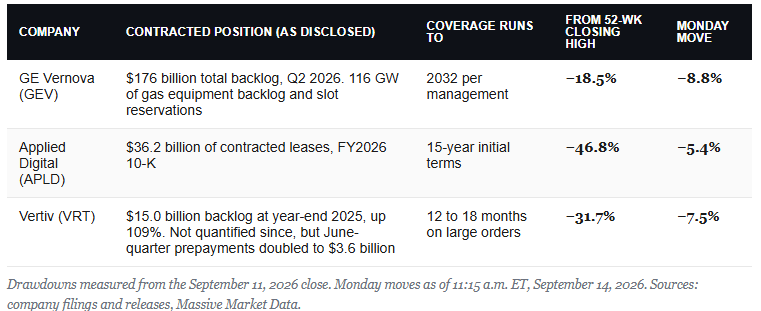
A good example is Vertiv (VRT) as noted above. The company closed 2025 with a record $15.0 billion backlog, up 109% on a 2.9x book-to-bill. The filings also confirm growth on the books. Customer prepayments doubled in the June quarter to $3.6 billion from $1.8 billion at year-end, which is cash in the door for deliveries not yet made. As shown above, the stock has been under pressure amid the prevailing narrative, but fundamentals continue to improve.
For now, the sell-off is a sentiment event, not a capex event. It only becomes a capex event the day hyperscaler budgets get cut, and none have been. Jensen Huang repeated his $3 to $4 trillion infrastructure estimate at the Goldman conference last week. Such is the gap between a narrative and a contract.
For now, we’re holding power and infrastructure exposure at target weight instead of chasing this dip. Our add point is the 200-day line, not a headline. A backlog is also a receivable. It’s only as good as the credit behind the customer, the same warning we made about CoreWeave on September 4. Own the contract, not the story. Notably, keep a watch on backlogs. If the counterparties start to pull back, then the sentiment event becomes an actual concern.
Industrials vs. Energy: The Next Big Rotation?
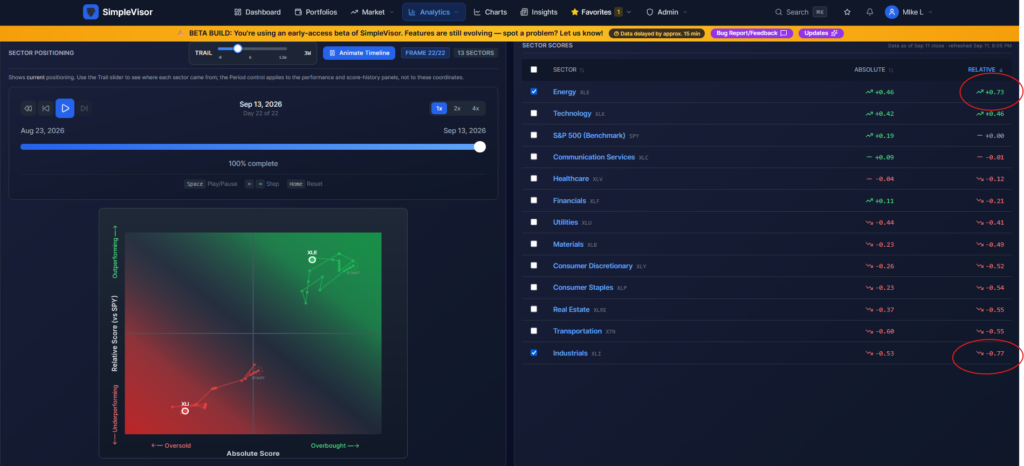
The graphic below from SimpleVisor (beta version, due for release in mid-October) shows that energy stocks are very overbought on a relative basis, while industrials are very oversold. The large divergence suggests a rotation into industrials and out of energy is likely. However, and this is important, the Iranian conflict and its impact on oil prices are driving the two sectors in opposite directions. They may continue to do so until oil prices fall appreciably. That said, industrials and other sectors more directly impacted by higher oil prices are worth following for when the “peace trade” starts.
It’s also worth noting our divergence indicator in the second graphic is starting to perk up. While this indicates weakening breadth, we may see it worsen until oil prices decline. As with industrials versus energy, the market is increasingly affected by higher oil and bond yields. Trade with caution, and start making a list of which stocks and sectors may outperform on a lasting peace agreement.

Portfolio Management: Winning The Long Game (Chapter 5)
First, stop everything you are currently doing. Before you buy a single share, you need to answer a singular question that almost nobody asks.
“What is the money actually for?”
Investing without a defined goal is just gambling with extra steps. “Retirement” isn’t a goal that is a concept. Be very specific about your dollar goals. For example:
I need $35,000 for a new car.
A 5% downpayment on a $300,000 house is $15,000.
To generate $5,000 a month in retirement, I need a lump sum of $1.3 million in bonds yielding 4.5% annually.
Being specific about your goals is crucial because your plan starts with three numbers that have nothing to do with the market.
The amount you are starting with,
The amount you need it to grow to, and
How much time do you have to get there?
From those, you can go back to the only benchmark that matters, which we covered in the last article. The rate of return your plan actually requires, earned at the lowest risk that gets you there.
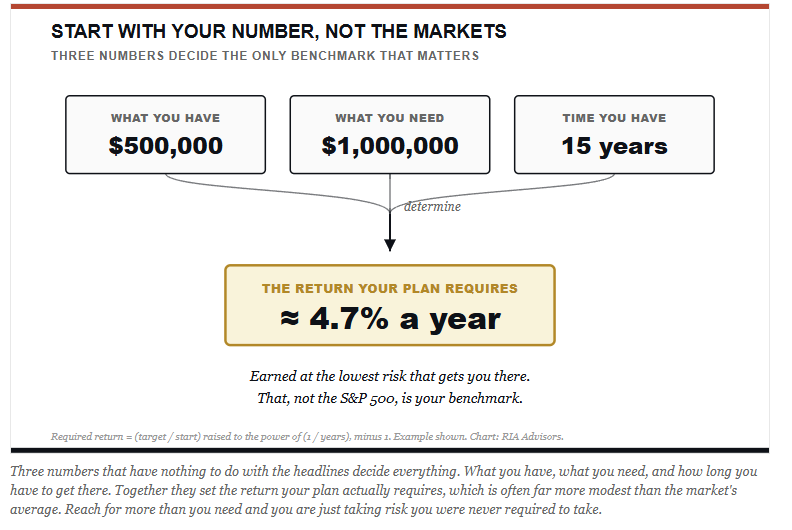
This reframing is critical to successful outcomes because it takes a nebulous concept that may seem out of reach and turns it into a concrete objective that can be broken down into smaller, more achievable ones.
Tweet of the Day


Comments
Log in or sign up to join the conversation.