Amgen's Pricing Pipeline Risk

The pharmaceutical pipeline is a probability game, and promising biology is not the same as a proven treatment.

Source: DepositPhotos

The pharmaceutical pipeline is a probability game, and promising biology is not the same as a proven treatment. Lipoprotein(a), or Lp(a), is a cholesterol carrying particle whose level is largely inherited. Drugmakers have been betting that lowering it will prevent heart attacks and strokes, creating a large potential market. Novartis' trial failure heading into the holiday weekend challenges that commercial bet, but it does not settle the question for every competing drug. For Amgen investors, the issue is how much value to assign olpasiran before its own cardiovascular results are available.

Main Note

Repricing the Pipeline Probability

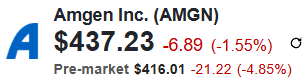
Amgen (AMGN) Quote

Verdict: The failure of a pioneer cardiovascular drug removes the assumption that targeting this specific genetic marker will easily yield a multibillion dollar franchise. This forces a rapid downward revision in peak sales expectations for Amgen.

What happened

On Friday, September 4, Novartis announced that pelacarsen missed the primary goal of its phase three Lp(a)HORIZON trial. The drug lowered Lp(a), but the study did not demonstrate a statistically significant reduction in its combined measure of cardiovascular death, non fatal heart attack, non fatal stroke, and urgent coronary procedures requiring hospitalization. The initial announcement did not disclose the percentage reduction in Lp(a) achieved in this trial.

The trial enrolled 8,323 people with established cardiovascular disease who were also receiving guideline directed care. That makes the result an important setback for pelacarsen. But the full results are needed to understand why lower Lp(a) did not produce a clear benefit on the main test. Investors should not assume that this result answers the question for every competing drug.

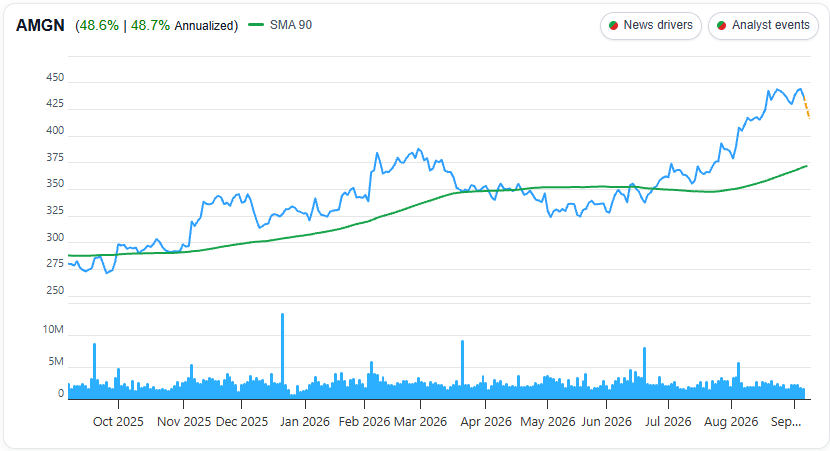
Amgen (AMGN) 1 Year Chart

Amgen (AMGN) 1 Year Chart

Why it matters

Investors value pipeline drugs partly by estimating their chances of reaching the market. A setback in one drug can lower confidence in competitors aimed at the same target, but different drugs and trial designs can produce different results. The commercial opportunity also depends on who is eventually approved for treatment, whether insurers will pay, and how widely doctors prescribe it. A large population with elevated Lp(a) is not the same as a guaranteed market.

What changed in the thesis

The market previously treated the Amgen candidate olpasiran as a highly probable blockbuster. Analysts expected this drug to help offset the looming patent cliff for older Amgen bone treatments. The baseline setup now shifts from assuming a smooth commercial launch to demanding extreme proof that the Amgen candidate can prove clinical benefit where others failed.

What the market may be missing

Depth of suppression and patient selection could still matter. Pelacarsen is an antisense drug, while Amgen's olpasiran uses small interfering RNA and lowered Lp(a) by more than 95% at higher doses in phase two. But those results came from separate trials, not a direct comparison. Both companies' outcomes trials involve patients with established cardiovascular disease, and their entry criteria and definitions of success differ. That leaves room for different results, not proof that Amgen has found the threshold that will make the treatment work.

Valuation and expectations

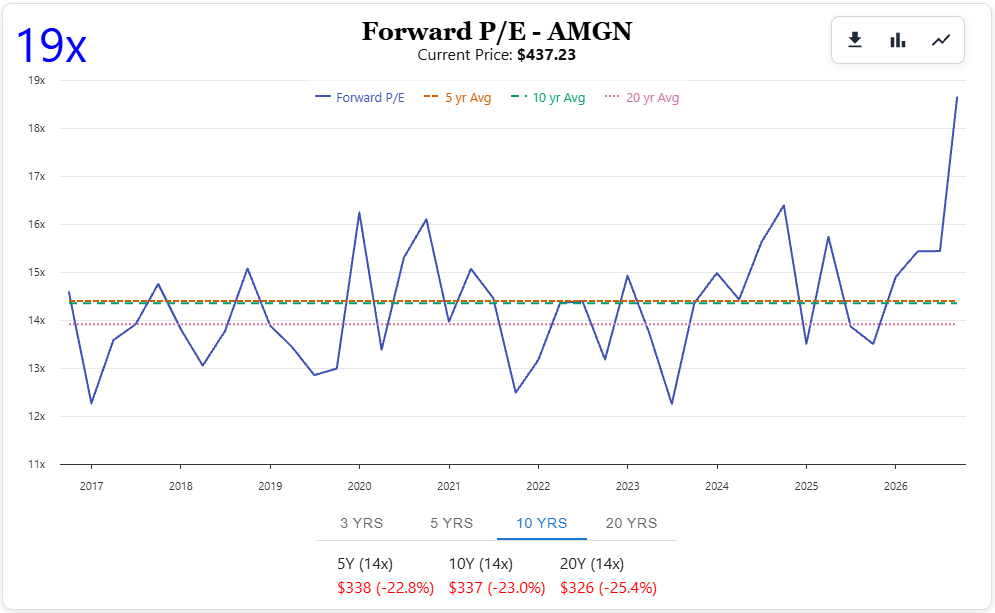
Amgen's valuation depends on which earnings number investors use. A multiple near 27 times trailing reported earnings is not the same as 27 times expected adjusted earnings. The company's latest 2026 adjusted earnings guidance is $22.30 to $23.50 a share. BMO downgraded Amgen to Market Perform following the setback, according to this morning's reporting. The question now is how much value to assign olpasiran, not whether revenue from an approved Amgen drug has disappeared. Whether the stock has become a bargain depends on how far its price falls relative to the value lost.

Amgen (AMGN) Forward PE Ratio

Amgen (AMGN) Forward PE Ratio

Bottom line

Amgen expects roughly $2.6 billion in capital spending this year, but that is companywide investment in facilities and other assets, not the cost of its olpasiran trials. The Novartis setback puts a potential future growth driver under greater scrutiny. It does not show that Amgen's existing business can no longer fund itself or that another acquisition is required. Investors need to weigh the pipeline risk against the cash generated by the drugs Amgen already sells.

Pre Market Pulse

  • Amgen was under pressure in early premarket reporting Tuesday following the Novartis trial failure.

  • Ionis, Novartis' partner on pelacarsen, also faces a setback to a potential source of future milestone and royalty income.

  • Novartis reported a separate trial setback Tuesday morning, adding another issue for investors to assess.

Why it matters this morning

Market reaction shows this is not just an isolated trial failure for one company. The swift selloff across peers indicates the market is discounting an entire therapeutic class and stripping future revenue out of long term valuation models.

Peer Read Through

Novartis (NVS)

The pelacarsen result threatens a potential future source of sales. That is a pipeline setback, not the disappearance of revenue from a drug already on the market.

Ionis Pharmaceuticals (IONS)

Ionis discovered pelacarsen and licensed it to Novartis. The setback threatens future milestone and royalty income, although Ionis had already sold 25% of its pelacarsen royalty interest to Royalty Pharma (RPRX).

Eli Lilly (LLY)

Lilly's lepodisiran is in phase three testing against the same Lp(a) target. The Novartis result raises the stakes for that program, but does not determine how Lilly's different drug and trial will perform.

Arrowhead Pharmaceuticals (ARWR)

Arrowhead sold its olpasiran royalty interest to Royalty Pharma but retains up to $485 million in remaining milestone payments from Amgen and Royalty Pharma combined. Those payments depend on future development, regulatory and commercial success.

Group takeaway

A single failure in a pioneer drug instantly alters the risk profile for every partner and competitor touching the same biological pathway.

What to Watch

  • Full data presentation for the failed HORIZON trial at the upcoming American Heart Association meeting in November, with the presentation date still to be confirmed.

  • The size of any benefit or harm, safety results, and whether encouraging findings appear in patient groups defined before the study rather than selected after seeing the results.

  • Amgen's OCEAN(a) Outcomes trial, with a current study listing pointing to estimated completion in 2028 rather than a guaranteed announcement date.

  • Progression of the competing Eli Lilly trial expected to read out in 2029.

Bottom line

Until full clinical data shows that deeper suppression directly stops heart attacks the market will continue to assign a heavy discount to all pipeline assets targeting this pathway.

STOCKS IN THIS ARTICLE

Also Mentions:

Comments