


Summary
U.S. opposition to new AI data centers has climbed to 70% among Americans under 30.
Texas is tightening data center rules rather than banning new projects.
Studies challenge claims that data centers significantly raise electricity costs or hurt home values.
The AI buildout could require between 63,000 to 140,000 additional skilled workers as data center construction approaches $70 billion per month.
Something strange has been happening in America lately. The Wall Street Journal says this is the summer when the U.S. became “a nation of Luddites.” The Economist calls it “the Summer of Ludd.”
Luddites, in case you’re unfamiliar, are historically what we’ve called people who stand in the way of progress and innovation, who want to turn the clock back to a “better time.”
The word comes to us from 18th-century England, near the start of the Industrial Revolution. Followers of Ned Ludd, a fictional weaving apprentice, destroyed textile machinery, mills and factories to protest the advancement of automation.
But the violence didn’t stop anything. Parliament made machine-breaking a capital crime. Ringleaders were hanged or shipped off to Australia. Not a single job was saved. As the Economist put it, the Luddites survive in our memory more for their theatricality than for their economic relevance.
I think of that when I read about the growing backlash to data centers.
Why Young People Are Turning Against the AI Buildout
Public perception of data centers right now is not the best, to put it mildly. The Annenberg Public Policy Center at the University of Pennsylvania ran a survey this summer and found that 61% of American adults oppose new data center construction in their area. That’s 12 points up from the spring.
Annenberg says it’s the largest shift they’ve measured on any question about artificial intelligence (AI).
And the results don’t fall along partisan line, either. Democrats oppose at 69%, Republicans at 54%, Independents at 53%. Support for new local data centers has fallen to 14%.
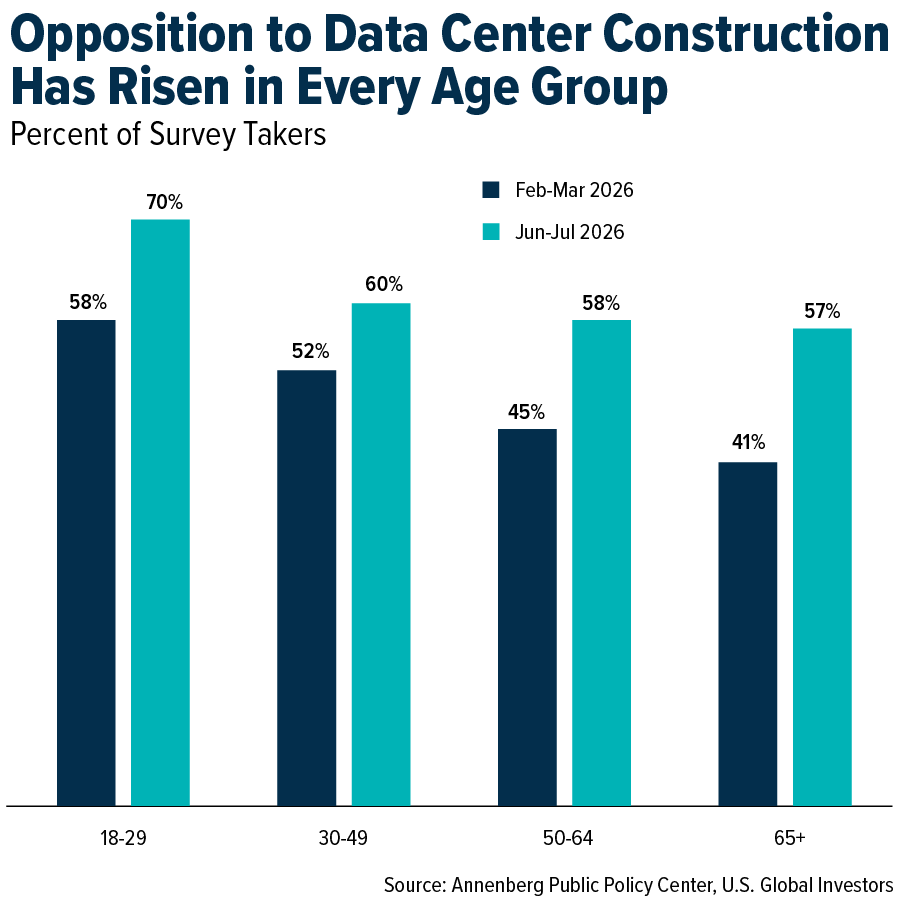
Look at the age breakdown in the chart below. Opposition is highest among Americans under 30, at 70%, and lowest among those 65 and older, at 57%. Normally it’s young people who embrace new technology while their grandparents might resist it. This time, the trend is flipped.
Texas Is Listening
Like other states, my adopted state of Texas is listening to the pushback. Governor Greg Abbott hasn’t banned new data center construction, but he’s issued a series of directives requiring new projects to bring their own power, supply and reuse their own water, add generation to the grid rather than simply draw from it, stay out of residential neighborhoods and give up state economic incentives. He’s also ordered the Public Utility Commission and ERCOT, the group that operates the state’s grid, to audit every project sitting in the queue.
Compare that to the rest of the country, where more than 500 outright data center bans are now on the books.
I believe the blanket bans are an overreaction, and I support what Governor Abbott is doing. That includes ending the incentives and subsidies.
The Electricity Story Everyone Gets Wrong
The inconvenient truth is that what most people believe about data centers does not, simply put, hold up.
Let’s start with electricity. The widely held belief is that data centers will jack up everyone’s bills. On the contrary, a recent study found that data centers actually caused average U.S. retail electricity rates to fall modestly between 2015 and 2024. The logic is straightforward: power systems carry enormous fixed costs, and when you add a large customer with steady, around-the-clock demand, you can spread those costs across more sales.
USAFacts ran a separate study and found no statistically significant relationship between how much data center capacity a state has and how much residential rates changed there. Texas and Virginia, the two biggest data center states in the country, saw rates rise less than the average state.
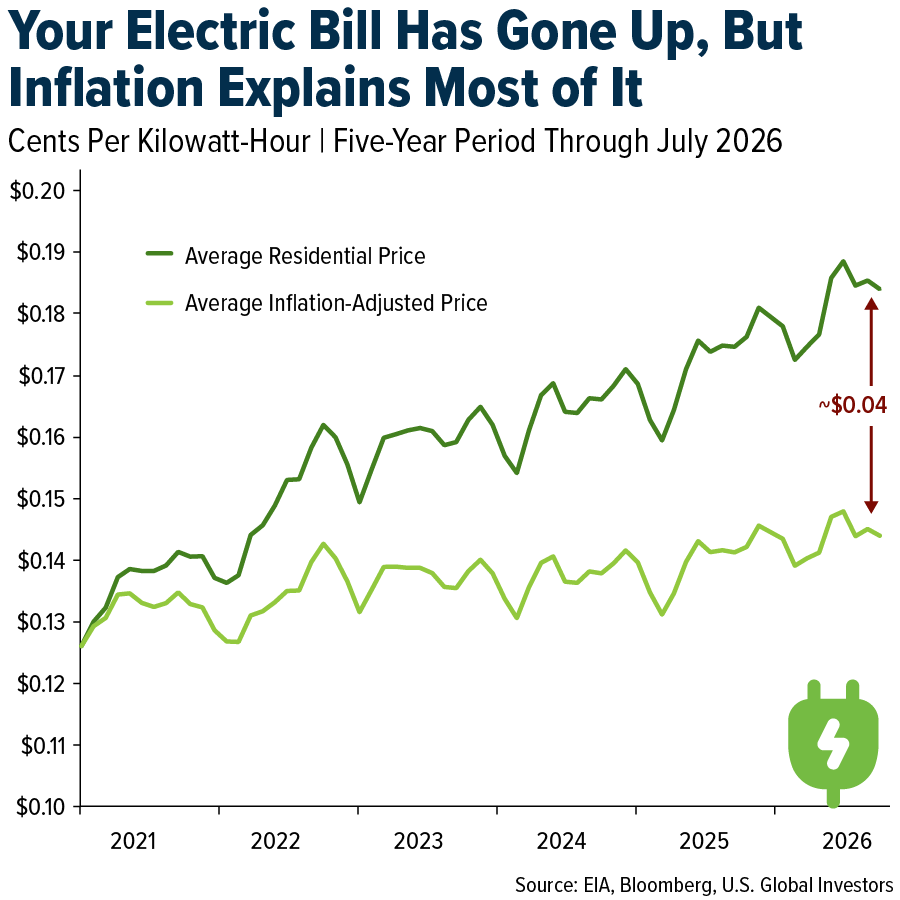
So why does everyone feel as though energy prices are climbing? Well, because they are. Between 2021 and 2025, residential electricity prices rose 27% in nominal terms. But when you adjust for inflation, prices increased only 7%.
The bill went up, but the U.S. dollar went down harder.
Follow the Money to Loudoun County
The water complaint is even weaker. If you combined all the water that data centers in the U.S. use, it’d be less than half a percent of national freshwater. Our golf courses use roughly 30 times more.
What about home values? Realtor.com matched 43 ZIP codes that received a large data center against comparable neighborhoods that didn’t get one. They found that prices moved together, with no meaningful difference in either direction.
Jobs and income? A recent academic study found that data center activation raised local employment 3.5%, total wages 5.0%, business establishments 4.7% and median household income 1.9%.
Then there’s Loudon County, Virigina, which has been running this experiment for two decades. Taxes on the computer equipment inside data centers are expected to throw off about $1.3 billion next year, roughly 40% of the county’s entire tax revenue. Loudoun has slashed residential property taxes every year for 10 years, eliminated the vehicle license fee and funded schools, roads, libraries and fire and rescue out of the proceeds.
The Buildout Needs Tens of Thousands of New Workers
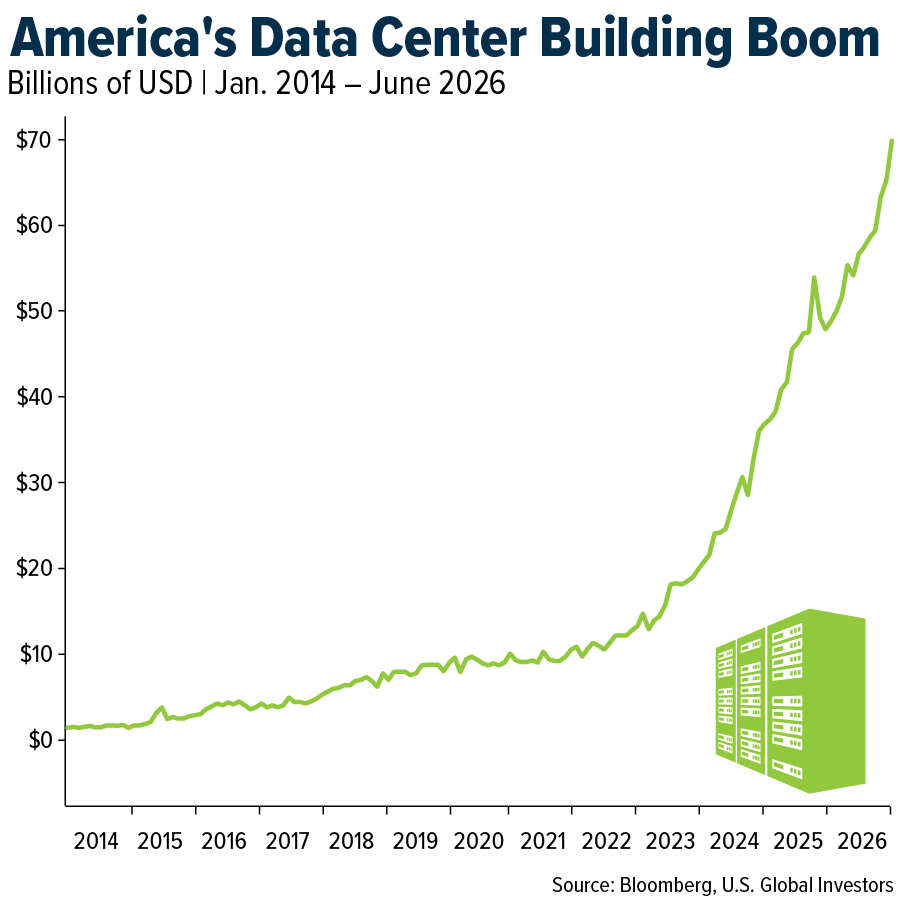
Private data center construction ran flat at around $10 billion a year for most of the last decade. It’s now approaching $70 billion… per month. That curve is what county zoning boards are voting on, whether they realize it or not.
And the growth doesn’t stay inside the tech sector. The Federal Reserve’s July Beige Book reported rising demand for primary metals and machinery, driven by defense contractors and data center builders.
That brings me back to the young people in the first chart.
The Center for Strategic and International Studies (CSIS) estimates this buildout will need somewhere between 63,000 and 140,000 additional skilled trade workers. Think electricians, engineers, technicians and more. Jobs that pay well above local averages and do not require a four-year degree or six figures of student debt.
Seventy percent of Gen Z believes AI will hurt employment. Watching what’s happening to entry-level, white-collar work, it’s hard to call that irrational.
But the thing they’re protesting outside city halls is one of the few things that will hire them right now.
The original Luddites learned the hard way that the looms and factories came anyway. They always do. The question they never seemed to ask themselves is who would be standing next to and operating the machines when they arrived.


Comments
Log in or sign up to join the conversation.