


Alphabet (GOOGL) reported second-quarter revenue of $119.8 billion, up 24% year over year and ahead of the roughly $116.9 billion expected. Google Cloud grew 82%. Operating income rose 30%. The shares fell.
That combination is worth explaining, because the reason the market disliked this quarter appears nowhere in the income statement.
The earnings per share figure is not what it looks like
Alphabet reported net income of $112.1 billion and diluted earnings per share of $9.11.
Revenue for the quarter was $119.8 billion. No company converts 94% of revenue into net income, and Alphabet did not either. The figure was lifted by roughly $98.0 billion of other income from gains on equity securities, a mark-to-market adjustment on holdings rather than cash generated by operating the business.
This distinction matters because that gain can reverse next quarter without anything changing in the underlying company. Anyone citing $9.11 as evidence of operating strength is citing an accounting outcome.
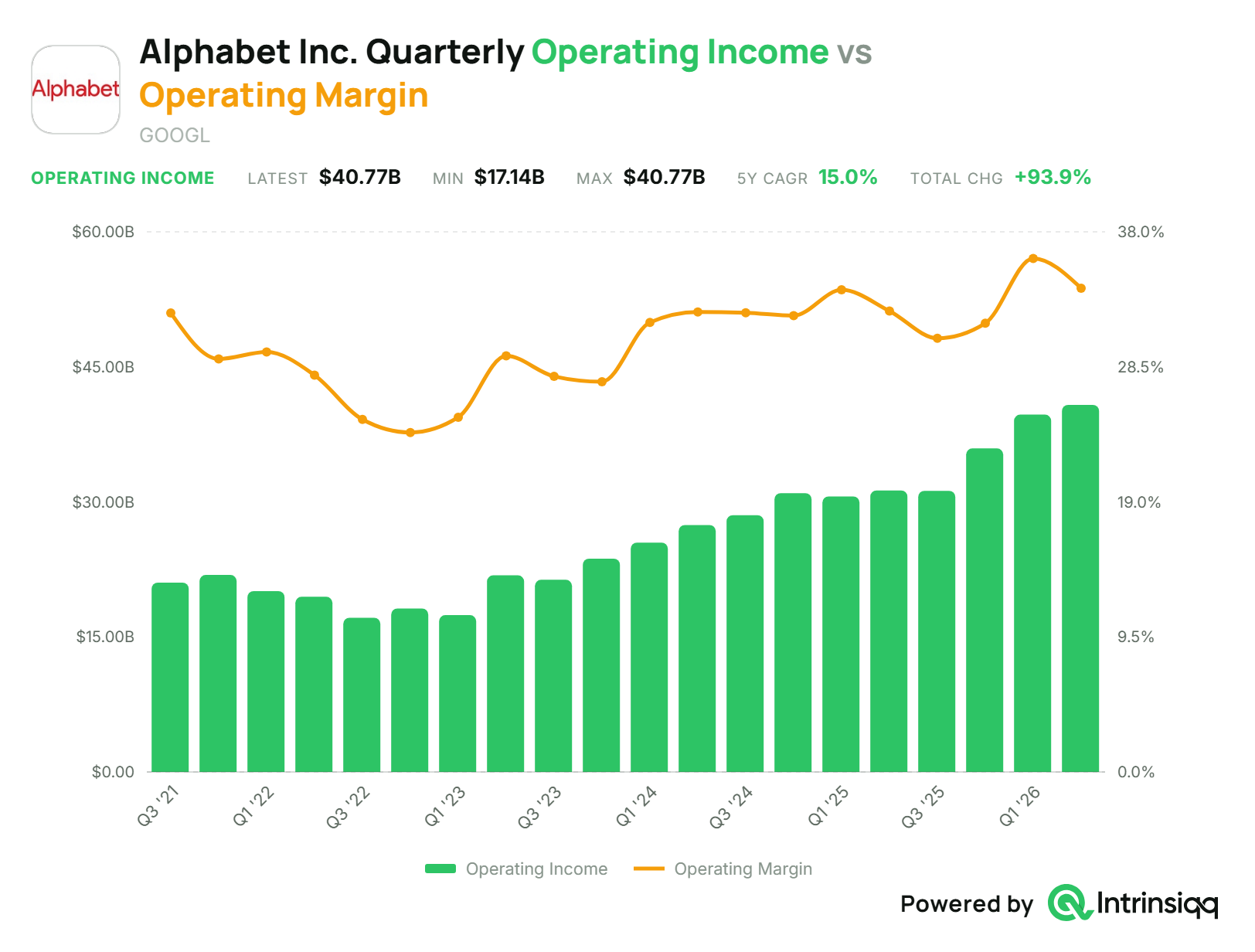
The figure that describes the business is operating income: $40.8 billion, up 30%, at a 34% operating margin. Less dramatic, and considerably more useful.
Cloud stopped being a growth story and became a profitable one
Google Cloud revenue reached $24.8 billion, up 82%.
Growth was never really the open question for Cloud. Profitability was. For years it was a strategically necessary segment that consumed capital.
Cloud operating margin more than tripled to 35.6%. At that level it is no longer a business being subsidised by search advertising; it is roughly as profitable as the parent company. That is the most significant change in this report, and it received less attention than the growth rate.
Backlog grew by more than $50 billion sequentially, to $514 billion. Backlog is contracted future revenue, which makes it a forward indicator rather than a result. It suggests customers are signing multi-year commitments for AI infrastructure rather than running pilots.
What the market actually reacted to
Capital expenditure reached a record $44.9 billion for the quarter. Full-year guidance was raised to between $195 billion and $205 billion.
Free cash flow was negative $5.9 billion.
That is the entire explanation for the selloff. One of the most profitable enterprises in the world, producing $40.8 billion of quarterly operating income, consumed more cash than it generated. Not because operations weakened, but because it is building infrastructure faster than the business produces cash.
Whether that is a problem depends on a question this quarter cannot answer: what return does the capital earn?
Return on invested capital is where this gets settled
Alphabet's trailing return on invested capital, computed from its filings before this quarter, was 16.4%. Comfortably above any reasonable estimate of its cost of capital.
This is the metric to watch, and it will move before earnings do. Capital spending enters the invested capital base immediately, while the profit it generates arrives later, if at all. A company investing into real demand shows temporarily depressed returns that recover. A company spending defensively shows returns that fall and stay down.
At roughly $200 billion of annual capital expenditure against a business earning mid-teens returns, the arithmetic is demanding. Holding that return level while adding capital on that scale requires the new infrastructure to earn at a rate comparable to everything Alphabet already owns. The 35.6% Cloud margin and the $514 billion backlog are the first substantive evidence that it might.
What would change the assessment
Three things, in order of significance.
Return on invested capital drifting toward single digits while capital expenditure remains elevated. That pattern would indicate defensive rather than productive spending.
Cloud operating margin reversing. The tripling to 35.6% is the strongest datapoint in this report and also the newest, which makes it the least established.
Free cash flow remaining negative across several quarters without backlog continuing to grow. Negative cash flow alongside rising contracted revenue is investment. Negative cash flow alongside flat backlog is something else.
The summary
Operationally this was a strong quarter: revenue accelerating at considerable scale, a cloud business that has become genuinely profitable, and contracted future revenue growing faster than reported revenue. The market sold the shares because Alphabet is asking shareholders to finance an infrastructure commitment whose returns will not be legible for years.
Both readings are defensible. What is not defensible is treating $9.11 of earnings per share as though the business produced it.
None of this addresses whether the shares are attractively priced. Business quality and price are separate questions, and only the first is examined here.

Comments
Log in or sign up to join the conversation.