
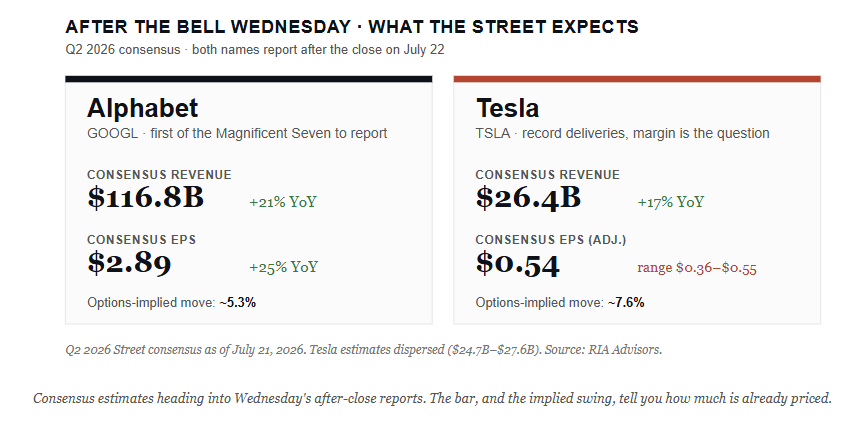
Alphabet reports earnings after today’s close, and Intel follows tomorrow. Together, they provide a first clue as to whether AI-related spending and investment continue at the brisk pace of the prior quarters.
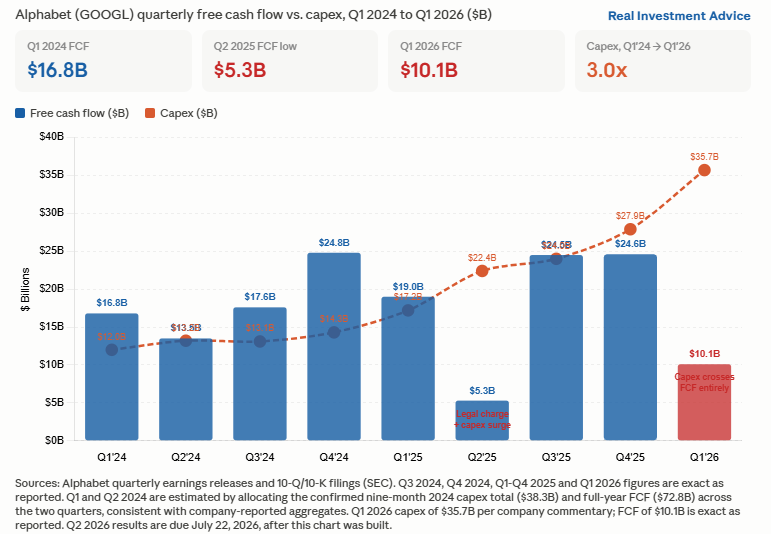
Alphabet represents the demand side for AI models. Google’s Cloud backlog nearly doubled sequentially last quarter to a record $462 billion, growing 63% year over year, the fastest pace among major cloud providers. That backlog is one important reason Alphabet and the other hyperscalers continue to allocate hundreds of billions of dollars to build out data centers. The problem, however, with their massive spending is declining free cash flow. Alphabet raised 2026 capex guidance to $180 to $190 billion and told investors 2027 spending will “significantly increase,” despite free cash flow declining 47% year over year in the first quarter to just $10.1 billion (shown below). Watch whether Google Cloud’s margin expansion continues and for any changes to capex guidance.
Intel represents the supply side of AI investment. Data center and AI revenue grew 22% last quarter as demand for its products increases and chip efficiency improves. Watch revenue and forward guidance for signs on whether AI investments from the largest companies continue to expand rapidly or if declining free cash flow is slowing capex investments.
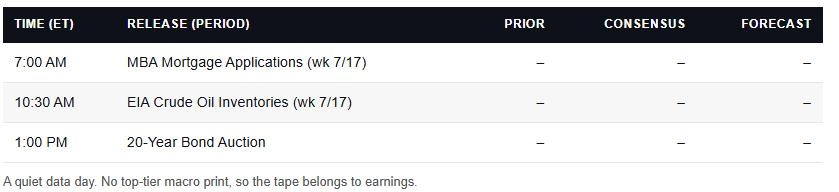
What To Watch Today
Earnings
Economy
Fed Speakers
None scheduled. The FOMC is in its pre-meeting blackout ahead of the July 28 to 29 meeting, so there are no Fed voices to move the tape this week.
Market Trading Update
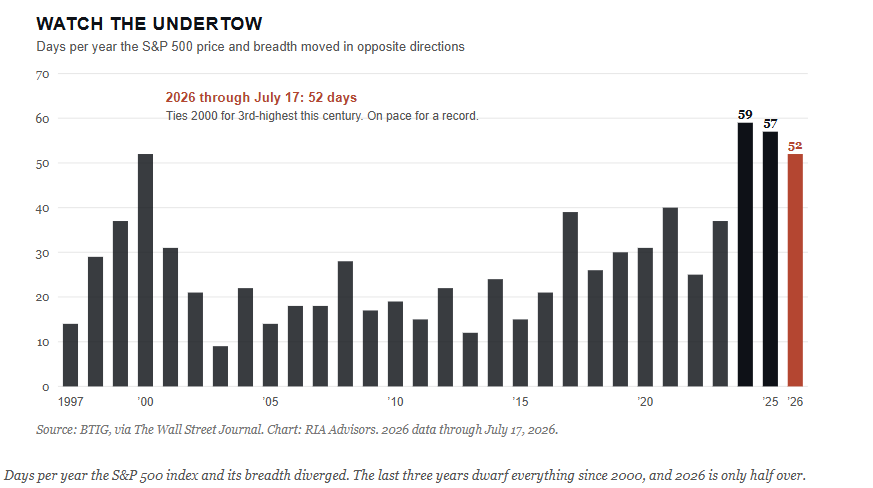
In our recent commentary, we walked through the momentum meltdown ripping through the chips and the high-beta names. Today, that story finally has a name. Spencer Jakab of the Wall Street Journal calls it bad breadth, and the label fits.
His metaphor is a duck. On the surface, the market glides along, calm and unbothered. Underneath, investors are paddling furiously. The VIX sits at 17.5, below its long-term average, so the index looks placid. The S&P 500 itself trades near 7,485, a stone’s throw from its record, which is exactly the point. The headline masks the wreckage underneath. Look at single-stock volatility and the picture flips. The VIXEQ measure sits above 50, and the gap between the two just hit a record, according to Citadel Securities strategist Scott Rubner. Traders aren’t bracing for a crash. They’re worried about specific names, mostly the AI momentum crowd.
The simpler tell is cleaner still. BTIG’s Jonathan Krinsky counts 52 sessions this year in which the S&P 500 closed one way while most of its members went the other way. That already ties the tumultuous 2000 for the third-highest count this century, and July isn’t over. 2026 will almost certainly break the record. You can see the full history in the chart below.
This is Bob Farrell’s Rule #7 in real time.
“Markets are strongest when broad and weakest when they narrow to a handful of leaders.”
Divergence can mark a healthy leadership handoff. It can also preview trouble. BTIG’s own read is the uncomfortable one. When these relationships normalize, it is likely to come from everything catching DOWN to the recent pullback in AI names, not from AI names catching back up to everything else.
The tape underneath supports the worry. Software turned toxic earlier this year. Chips flipped from a market engine to a bear trend inside a few days. The Magnificent Seven are lagging, and Oracle closed at a multiyear low on Monday, down roughly 50% from its early-June high. Tuesday’s bounce, with the semis up more than 3%, doesn’t erase any of that. Sharp reflexive rallies are a feature of downtrends, not proof of a bottom.
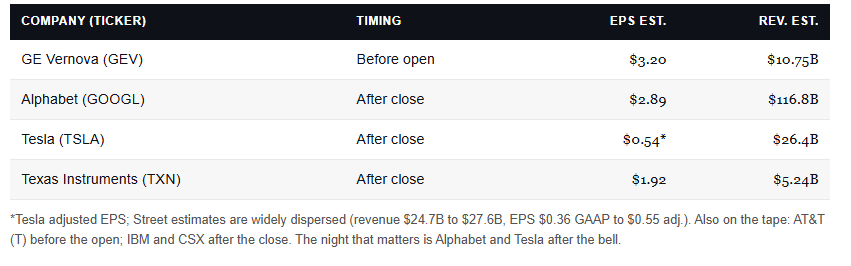
Tonight raises the stakes. With the Fed in blackout into next week’s meeting and no marquee data on the tape, the multiple is on its own. Alphabet and Tesla both report after the close, and the estimates below frame the bar. Those two prints will tell us whether the mega-cap bid holds or joins the catch-down.
So we are treating this as a market to rebalance, NOT to chase. In the equity models, we have trimmed the most extended AI and semiconductor winners back toward target weight, lifted quality, and kept dry powder for better entries. Manage risk at the line, and let the breadth confirm the next leg before you commit fresh capital to it.
Nike
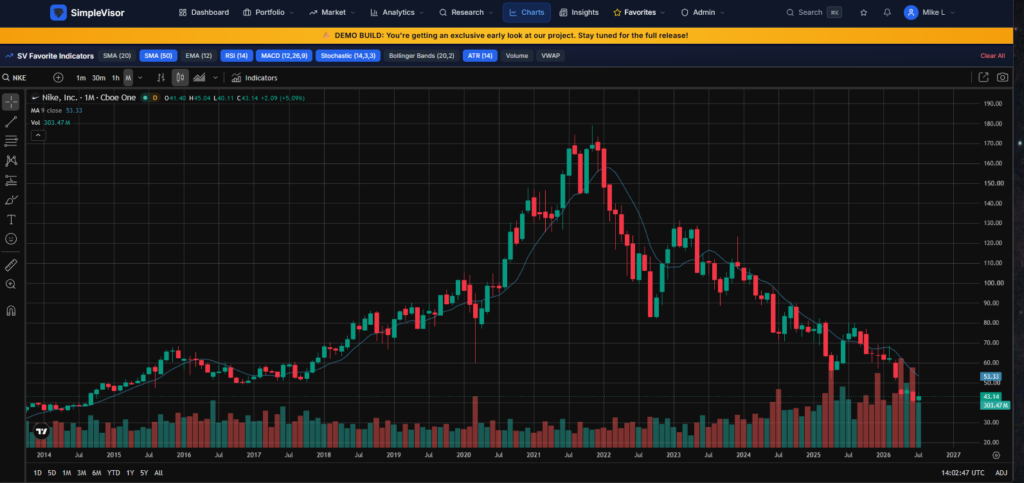
Nike has lost roughly 65% of its value since its November 2021 peak. With the stock trading near a decade low, and full-year revenues of $46.4 billion essentially flat on a reported basis, the question is whether Nike stock is an opportunity or a trap. To help answer the question, we provide a SWOT analysis below.
Strengths
Nike remains the world’s most recognizable athletic brand with unmatched global distribution. Its dividend has grown an average of 11% annually over the past decade and remains well covered by earnings and cash flow. Nike’s new CEO Elliott Hill is trying to execute a turnaround. This includes returning to wholesale and sport-focused marketing. Wholesale revenues grew 4% in Q4, an early signal his efforts may be working.
Weaknesses
Nike Direct revenues fell 7% in Q4 and 9% on a currency-neutral basis. Its gross margin compressed 1.3% to 40.2% in Q3 as discounting to clear excess inventory continues to pressure profitability. Revenue from China remains a persistent drag.
Opportunities
EPS is forecast to grow 60% over the next three years as the turnaround takes effect. The 2026 FIFA World Cup gave Nike a rare global marketing moment with 12 national team sponsorships. The average analyst price target of $59.58 implies nearly 40% upside.
Threats
Newcomers like On Holding and Hoka are taking market share in the premium performance footwear sector. Tariff uncertainty creates ongoing margin risk. Furthermore, there is speculation that Nike could be removed from the Dow Jones Industrial Average, a symbolic blow that would trigger passive fund selling.
At $41, Nike is priced for continued failure. The question is whether Hill’s turnaround is fast enough to outrun the competition, which is gaining ground every quarter.
The graph below is from our “soon-to-be-released” SimpleVisor AI.
Tweet of the Day


Comments
Log in or sign up to join the conversation.