


Before getting into links, a few comments on recent events:
Alan Greenspan was clearly one of the greatest Fed chairs, perhaps the greatest. But I evaluate his tenure a bit differently than many other pundits. Here are a few contrarian views:
While Greenspan did a great job producing stable NGDP growth during his tenure (1987-2006), there is no reason to believe that he would have done better than Bernanke during 2008, indeed his public comments about monetary policy during 2008-09 suggest that he was just as off base as the Fed.
On the other hand, Greenspan gets way too much blame for the 2008 financial crisis, which was not caused by “deregulation”, whatever that means. Indeed the regulators were pressing banks to do more high risk lending. If you want more regulation, does that mean you wanted the regulators to press banks harder to make subprime loans? Or are you assuming disinterested, omniscient regulators? The financial crisis was caused by a combination of moral hazard (FDIC and Too-Big-To-Fail) plus tight money. Greenspan’s biggest mistake in this area was the 1998 LTCM rescue, which slightly worsened moral hazard.
Don’t think of 1987-2006 as the “Greenspan era”, think of it as the “NeoKeynesian consensus era.” It wasn’t just the Fed, almost all the major central banks figured out how to do inflation targeting using a Taylor principle-type approach, and this largely explains why other developed countries had the same sort of inflation targeting success as America during this period.
In 1996, Greenspan spoke of “irrational exuberance” in the stock market. Years later, that warning was viewed as a prescient call, even though he was pretty clearly wrong. Stocks were not overvalued in 1996. This is just one of many examples of how human thinking is biased toward finding “bubbles” where they do not in fact exist.
Greenspan’s strongest attribute was his willingness to take seriously the information contained in asset prices.
Posts by Marcus Nunes, Lars Christensen, and Stephen Kirchner have good discussions of Greenspan’s legacy.
As a Milwaukee Bucks fan I cannot help commenting on the recent trade of Giannis Antetokounmpo to the Miami Heat. Casual fans have begun underrating Giannis in a couple ways. First, he gets blamed for the recent decline of the Bucks, which is actually due to the fact that 10 years of horrible drafting, bad trades, and bad injury luck produced a team lacking in talent. Second, people overestimate how often he’s injured. He only completely missed one playoff due to injury, plus a few isolated playoff games in other years, including the title year (2021.) In his 13 regular seasons, last year was the first time Giannis missed a lot of games, and that was partly due to the team holding him out when healthy in order to tank. He is an injury risk due to his age, size and style of play, but his injury history is not that bad. The amazing 2021 recovery from a severe knee injury right before the finals shows that he’s a quick healer. The betting market agrees with me—pushing Miami up to #5 in title odds (ahead of Denver), and disagrees with casual fans who view him as overrated. He’s clearly still a top 5 player, closer to #1 than #6. This will be the standard view by late November. (Boston understood, offering Jaylen Brown plus two firsts for Giannis.)
Last year, I discussed the fact that mixed race players were increasingly common in the NBA. I noticed that 5 of the top 13 picks in this year’s draft had one black parent and one white parent, including Milwaukee’s two picks (at #10 and #13.)
And now for my links:
The media won’t report this:
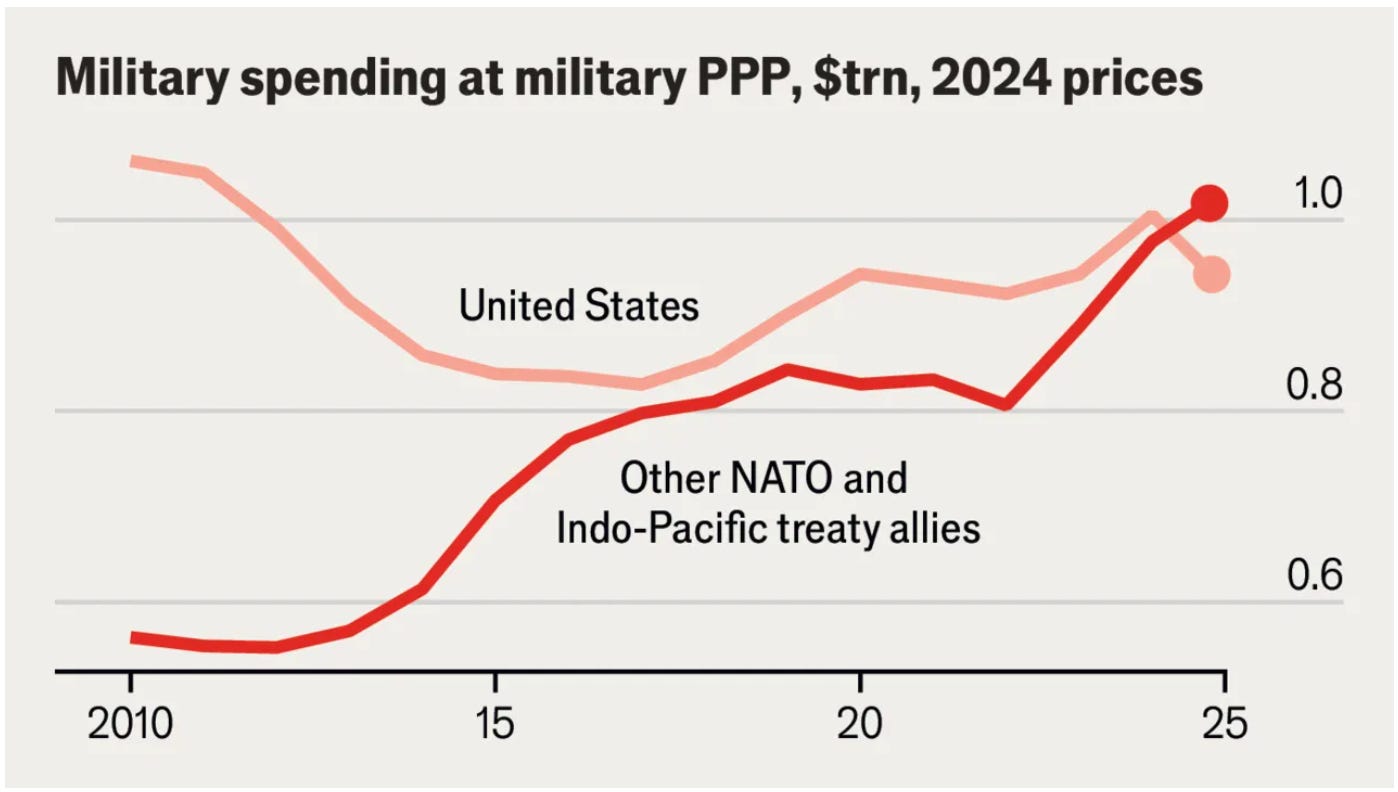
Oops, the Economist is part of the media, so I guess the media will report it.
Andrew McCarthy has a good piece on how to think about abuse of power. Hard to excerpt, but the key point is that illegal acts aren’t necessarily impeachable, and impeachable offenses aren’t necessarily illegal.
The US isn’t the only country shooting itself in the foot. Here’s Bloomberg:
China is restricting overseas travel for top AI professionals in private firms, requiring them to get approval from relevant authorities before embarking on overseas travel.
The government is targeting talent within the AI sphere, including startup founders, researchers, and executives, and adding individuals to the list based on assessments of their critical importance to the country.
The restrictions risk undermining the ability of AI firms in China to recruit and retain talent, and may force engineers with global ambitions to choose between staying home or going abroad earlier in their careers.
What sort of society would actually allow freedom of choice?
Walk into three different bars in Tokyo, and you may have three completely different experiences: one bar thick with cigarette smoke, one with a sealed glass smoking room humming in the corner, and one entirely smoke-free.
Within regulatory boundaries, the choice often lies with both the owner and the customer: Proprietors decide what kind of space they want to run, and patrons decide which environment they prefer.
When I’ve suggested that the US adopt this sort of system, I’m invariably told that it “won’t work”.
Words of wisdom from Matt Yglesias:
I wish labor would reflect more on the reality that almost all of the growth in the United States is happening in right-to-work states.
Some of that is because businesses prefer to invest in right-to-work states. But that’s not all of it. If it were the case that union-friendly labor laws had just devastated the economies of the Pacific Coast and the Northeast, then those states would be cheap. But demand to live in New York and New Jersey and Connecticut and Massachusetts and Maryland and California remains robust. If it were easier to build houses and apartments in those states, more people would live in them. If more people lived in them, a non-zero number of jobs would move with them. More jobs in states with union-friendly labor laws would create more opportunities to organize.
It would also mean much healthier pension situations for the large public-sector unions in those states.
The Bloomberg headline below caught my eye:
US Airlines See Robust Demand Even as Consumer Confidence Falls
Headline should read: US Airlines See Robust Demand Even as Surveyed Consumer Confidence Falls. I see no evidence that actual consumer confidence is falling—shoppers certainly are not acting as if they lack confidence.
Noah Smith reports that Claude is a neoliberal:
AI investor and founder Arram Sabeti recently asked Claude what policies it would enact in order to “fix everything” in America. . . . Claude’s answers were:
1.YIMBYism (upzoning, pro-housing deregulation)
Land Value Tax
Permitting/NEPA reform
Carbon tax and dividend
Repeal the Jones Act
Paying people to donate kidneys
High-skilled immigration
Reciprocal FDA approval agreements between rich countries
Reduce occupational licensing
Ranked-choice voting
This is pretty much just a list of neoliberal hobbyhorses.
A few comments. First, I entirely agree with Claude. Second, at least some of those views (selling kidneys, carbon tax/dividend, etc.) are unpopular.
Have you ever traveled to a strange foreign country where you know nothing about the culture? That’s what happens to everyone if you live long enough. In my email box I saw this headline and subhead from The Free Press:
Tough Love: Will I Get Canceled for Dating a Freshman?
A 22-year-old wants to ask out his 18-year-old classmate but fears campus backlash: ‘They’d label it predatory, and I’d be staring down the barrel of cancellation.’ Our advice columnist weighs in.
I did not read the article. I’d rather go to my grave not knowing what this is all about.
So blue states seem less suicidal:
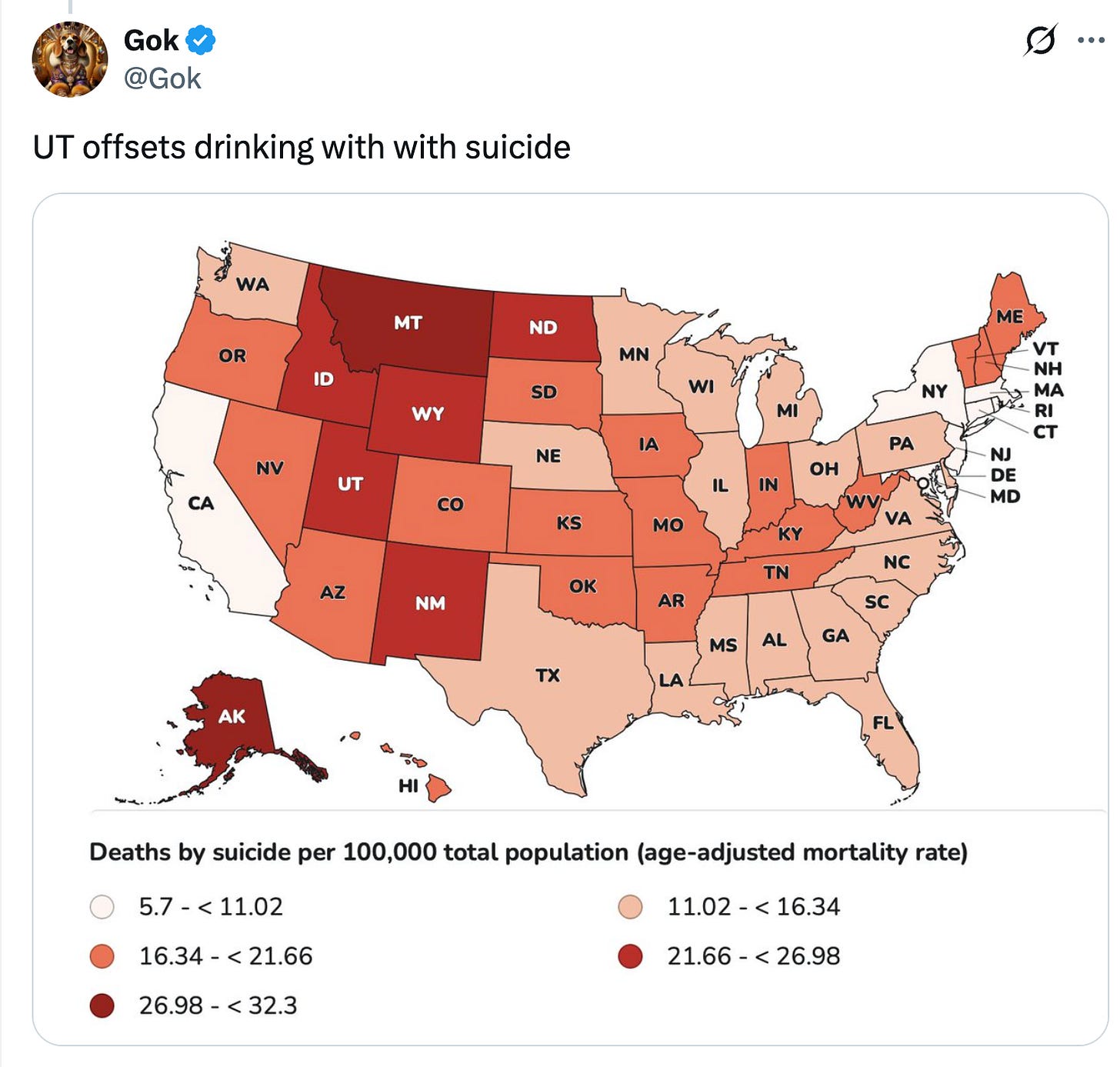
And yet studies suggest that leftists are less happy. The left reminds me a bit of this quip from Annie Hall:
Life is full of loneliness, and misery, and suffering, and unhappiness, and it's all over much too quickly.
If Matt Yglesias is correct, then he and I comprise fully one third of all humans who have read Capital in the Twenty-First Century, cover to cover:
If you are one of the six people who actually read Thomas Piketty’s “Capital in the Twenty-First Century,” then you’ll know that the primary concern he raises in the book is specifically about this heir question.
Of course Piketty is French, and if a European Bill Gates tried to give $100 billion to charities fighting disease and poverty in Africa, instead of giving the money to his spoiled kids, they’d probably put him in jail. Speaking of which, this item in The Economist caught my attention:
Employment in the sector rose about 6% in 2024, the last year measured, according to Confindustria Nautica, an Italian yachting-industry association. It may yet stay afloat: one broker notes that America, the biggest market, is growing in spite of the oil crisis. Since last July, Uncle Sam considers vessels majority-owned by American firms tax deductible.
Tax deductible? Long time readers know that I have an unhealthy obsession with the idea of using a progressive consumption tax to shrink the size of superyachts by 25%. But even if I’m wrong, should superyacht buyers pay a 0% tax rate on purchases made with before tax income while rowboat purchasers must pay an 8% sales tax with purchases made using after-tax income?
Here’s The Economist:
This symbiosis between life insurers, reinsurers and private-asset managers (which these days often own or work closely with the other two) is dubbed the “Bermuda triangle”, after the Caribbean jurisdiction where it has blossomed.
I suppose “Bermuda” does sound a bit Caribbean. How about renaming the island Prospero, to avoid confusion? Rich countries should have rich sounding names (think Luxembourg and the UAE), and of course there’s a theory that The Tempest was loosely based on a shipwreck in Bermuda.
Or perhaps East Carolina?
12. This tweet caught my eye:
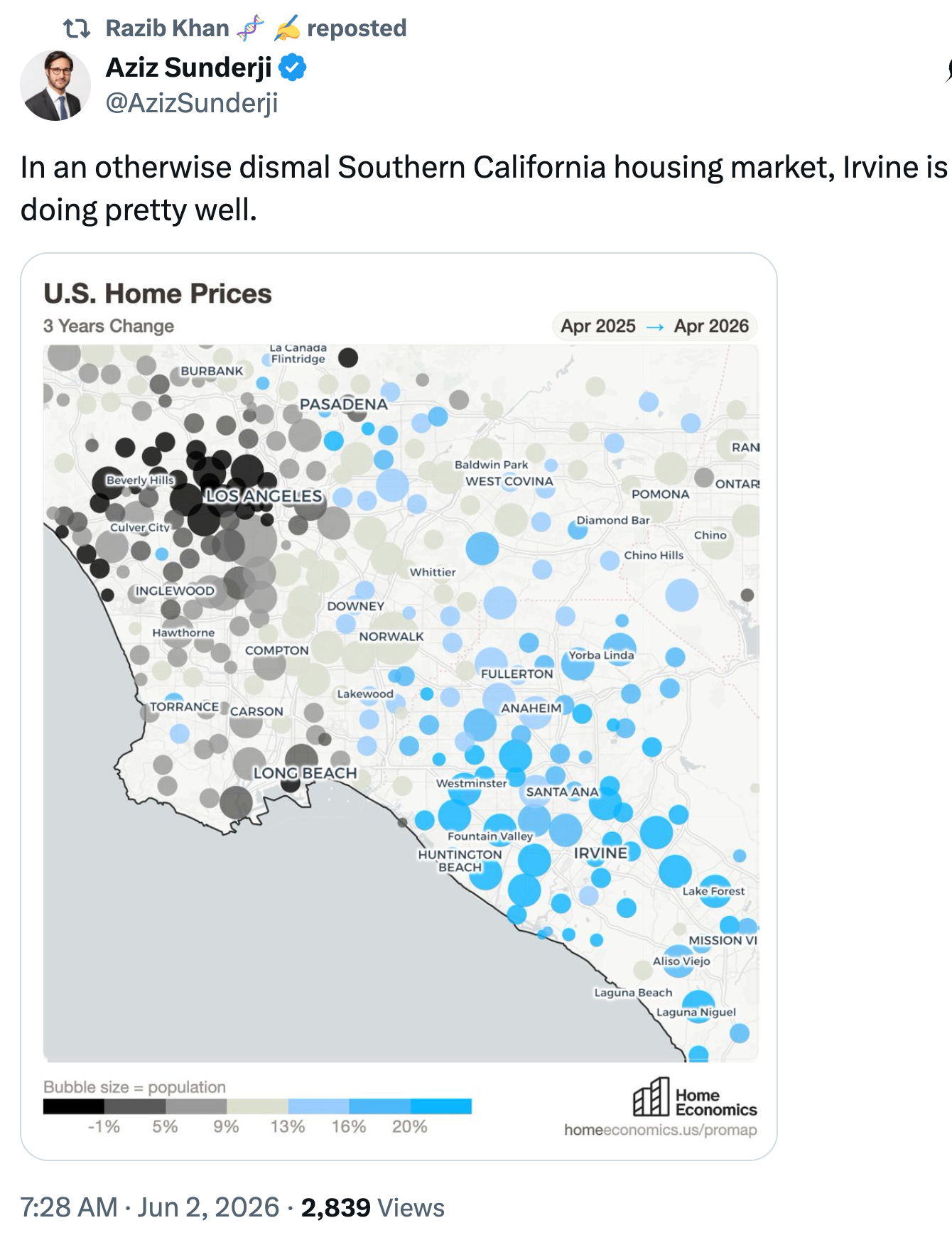
It’s worth mentioning that Orange County (southeastern area on the map) is far better governed than LA County. You notice the difference immediately when crossing into LA County (Long Beach) on the 405.
Utopia is living in a politically purple part of coastal California. (Unfortunately, the OC is more boring than LA—not for young people.)
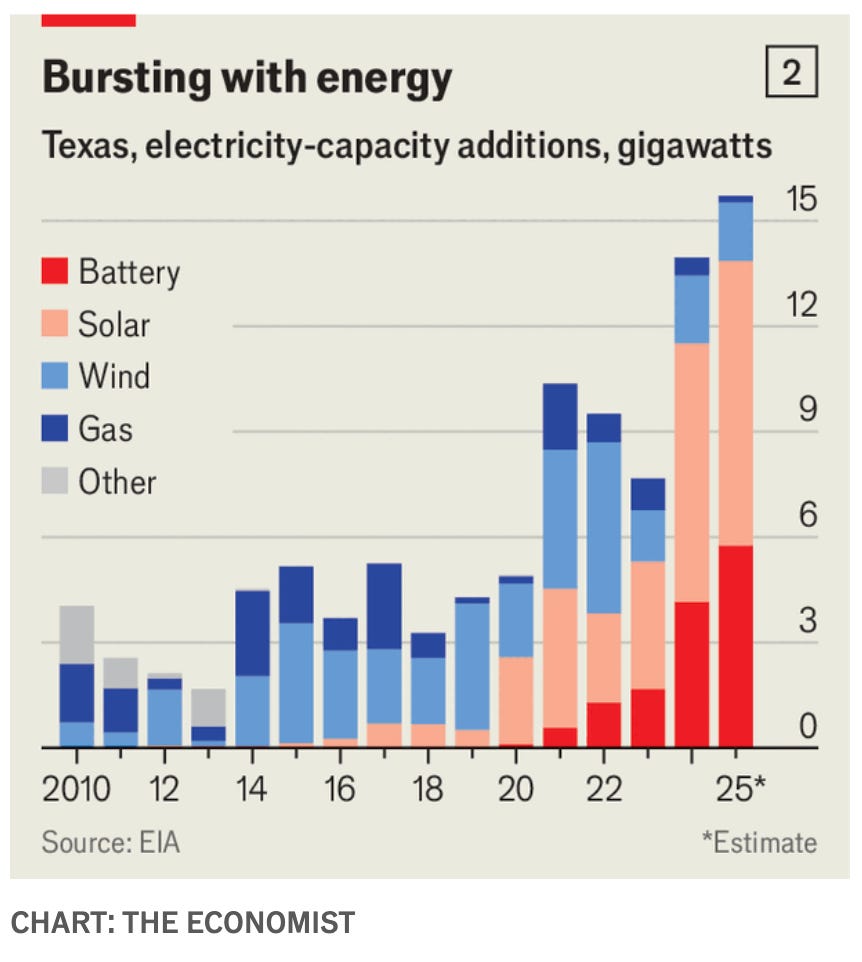
The Economist has an eye-opening graph, especially given that Texas is a conservative oil and gas state:
A new paper by Xiwen Bai, Jesús Fernández-Villaverde, Yiliang Li, and Francesco Zanetti has this abstract:
We study how global supply chain disruptions affect monetary policy transmission. Post-pandemic evidence indicates surging transportation costs, goods-market imbalances, and rising prices. We develop a model in which logistical bottlenecks (upstream slack coexisting with downstream shortages) steepen the aggregate supply curve. This convexity amplifies price responses to monetary policy while dampening output effects. Threshold VAR and Local Projection estimates are consistent with this mechanism: during disruptions, contractionary policy reduces prices more at smaller output cost, easing the stabilization trade-off.
This makes sense, although I’d focus on the role of labor markets. The fact that there was a labor shortage in 2022-23 made it easier to bring down inflation with a more contractionary monetary policy. If a labor market goes from normal to weak you tend to get a recession. Going from overheated to normal doesn’t necessarily trigger a recession.
Matt Yglesias has a good analysis of the horseshoe theory of politics:
One is temperamental. Most people who work in politics have a kind of mainstream disposition. They probably have a few opinions that are way outside the consensus, but those opinions aren’t strongly held or aren’t about things that they feel passionately about. Their general approach to life is to try to make incremental progress on relatively mainstream issues. Extremists aren’t like that — they have an oppositional attitude toward authority and end up having that in common with each other.
Another is negative polarization. There are two kinds of people who really, deeply, and profoundly hate Hillary Clinton, Barack Obama, Chuck Schumer, and Hakeem Jeffries: Republicans, and people on the far-left. This ends up being something that they have in common with each other. Pair a far-leftist up with someone from the far-right who hates mainstream Republican Party leaders and they end up having enemies in common, which is a good way to start making friends.
A third is ideological. There is a “liberal center” to American politics that believes, fundamentally, in a positive-sum cooperative world. Then there are illiberal zero-sum tendencies floating around that tend to sort themselves on the basis of whether they blame foreigners for everything or whether they blame rich people for everything, but they have that zero-sumness in common. And of course many things — like trade — implicate both foreigners and rich people.
We frequently read about China’s massive military build-up and Europe’s pathetically low levels of spending. Thus, you may be surprised to learn that China’s military spending has fallen below 2% of GDP at a time when the EU’s military spending is up to 2.1% of GDP, and is still rising.
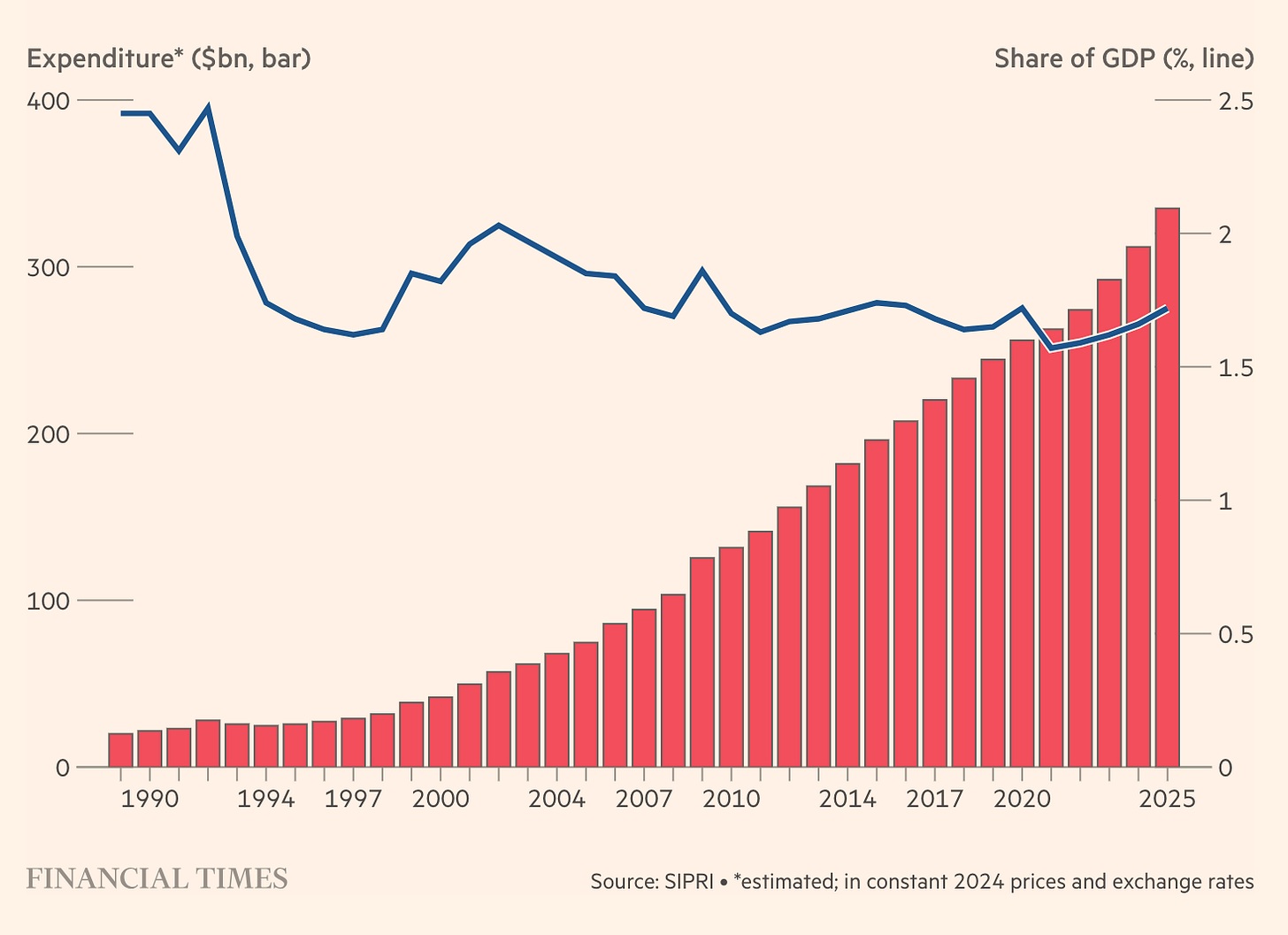
The two regions have roughly equal size economies, although China’s is larger in PPP terms.
Very good news from the FT:
Swiss voters have rejected a proposal to cap the country’s population at 10mn people, delivering a surprise defeat to a rightwing initiative that had appeared neck and neck in opinion polls until just days before the vote.
Projections on Sunday showed the initiative losing by roughly 54 per cent to 46 per cent, a significantly stronger result for opponents than suggested by recent polls, which had indicated a tight race in the final days of the campaign.
The proposal, backed by the rightwing Swiss People’s Party (SVP), would have made Switzerland the first country to impose a formal cap on its population. It sought to limit the number of residents to 10mn, from about 9.1mn today, and would have required the government to take measures to curb population growth once the population reached 9.5mn.
Iran War analysis from Noah Smith:
Before the war, Iran didn’t control the strait, simply because it didn’t realize it could. Drone technology had advanced to the point where Iran was able to shut down Hormuz, but Iran didn’t know that until the U.S. attack forced it to try the risky and desperate move of actually shutting down the strait. The gambit paid off spectacularly, and now Iran knows that modern drone weaponry gives it an advantage it didn’t have in previous decades. So it controls Hormuz.
It’s kind of wild to step back and consider how good of a position Iran’s leaders are in now, compared to the situation before the war. Iran had lost most of its proxy armies in the Middle East — Hezbollah, Assad, most of Hamas. The regime had been rocked by massive nationwide protests, which it only managed to quell by murdering tens of thousands of innocent Iranian citizens. The country’s economy was slowly dying. Now the leaders are firmly entrenched in power, their economy will be revived, and they find themselves the masters of Hormuz for the first time.
. . . A final silver lining is that the U.S. may step back from the Middle East in general, as I’ve long been urging.
And from Matt Yglesias, you can’t make this up.
Jessica Riedl has an excellent piece explaining why AI is unlikely to solve our budget problems:
Unfortunately, like all the other "easy solutions" to budget deficits, AI is highly unlikely to produce the trillions of dollars in annual fiscal savings necessary to avert the hard decisions. Betting America's fiscal future on AI is wishful thinking.
The job impact of AI is overrated:
Two main economic concepts apply to the rise of AI in the legal industry: the lump of labor fallacy and the Jevons paradox.
The lump of labor fallacy is the mistaken belief that there is a fixed amount of work to be done in the economy. Under this view, if AI eliminates a category of tasks, the people who did those tasks are simply left without work. History tells a different story. Many of the ten most common jobs from the early 20th century no longer exist in any recognizable form. Yet employment has expanded dramatically. Many of the jobs that exist now, including roles like AI data scientist or prompt engineer, didn’t exist then because the conditions that created them hadn’t yet arrived. Every major technological shift ultimately results in a larger total number of jobs, even when it disrupts specific roles.
Meanwhile, the Jevons paradox states that when something becomes cheaper and more efficient to use, total consumption of it tends to increase, not decrease. The original example involved coal. As steam engines became more efficient, requiring less coal to operate, there was a widespread expectation that coal consumption would decrease. Instead, it multiplied. Cheaper engines led to more engines being used in more places.
No idea what this means, but FWIW:

Works in Progress is full of great articles. One of them describes Spain’s successful urbanism (until recently):
For the price of one mile of the New York’s Second Avenue Subway extension, Spanish builders covered the entire 35-mile 1995–1999 expansion of the Madrid Metro.
Adrian Wooldridge on Swedish reforms:
A succession of neoliberal governments re-engineered the model from top to bottom. Sweden reduced its public spending as a proportion of GDP, cut the top marginal tax rate radically and dismantled taxes on property, gifts, wealth and inheritance. It introduced a universal system of school vouchers, invited private schools to compete with public, allowed private companies to provide state-funded health services and care for the elderly and donned the golden straitjacket of fiscal orthodoxy, keeping a downward pressure on debt and deficit, and swapping a retirement system with defined benefits for one with defined contributions while making automatic adjustments for longer life expectancy. All more Milton Friedman than Bernie Sanders.
A sentence I never expected to read:
Corporate officials who “falsely represent” their business as gay face up to a year in county jail.
Oscar Wilde would have had something clever to say about that.
From the FT:
Russia has accused the US of abandoning efforts to broker an end to the war in Ukraine after Donald Trump appeared to be shifting again in favour of Kyiv.
Russian foreign minister Sergei Lavrov on Tuesday said the US was “seemingly stepping back from the role of an objective mediator” in the war and had “forgotten” about Trump’s own statements last year inching towards Moscow’s position.
Instead, Trump was “hugely impressed and enthusiastic” about Ukraine’s recent campaign of long-range strikes on targets deep inside Russia at last week’s G7 summit, said two people briefed on the private discussions among the leaders. Trump at that summit also agreed to increase sanctions on Russian energy.
Trump values strength and the Ukraine is getting stronger. Ethics? Not so much.
Most people I speak with believe that saving Social Security will require a combination of tax increases and benefit cuts. It would seem that those “most people” come from a rather unrepresentative group, perhaps 5% of the population:
It is not just Washington inertia that makes reforms tough. In polling conducted by YouGov for The Economist, 71% of respondents believe Social Security spending should be increased, more than for any other category of government spending. In the same poll, 45% say it should be increased a lot. The proportion who wish it to be reduced is just 5%, slightly less than the share of Americans who believe that covid-19 vaccinations were used to microchip the population.
Only 5%? Now suppose you asked people if they favored raising taxes. How many would say yes? Suppose you asked people how many favored allowing Social Security to go bankrupt. How many would say yes? Would the three options add to 100%?
Or is a better interpretation of the data that there is no such a thing as public opinion.
Why is Matt Yglesias my favorite center left pundit? In back-to-back tweets he nails the essence of what’s going on. First this:
Chicago’s left already staged a successful insurgency, but the incumbent left-wing mayor who led the successful insurgency is an unpopular failure so people don’t talk about him anymore.
Question is whether the reformist counterinsurgency will spread from SF to the Windy City.
And then this:
There’s been an interesting trajectory since Bernie’s 2015 era pitch that “democratic socialism” meant “policy like Denmark” to the current situation where left policy proposals look nothing like actual Danish tax policy.
We’ve gone from “be more like Denmark” to “be more like Venezuela”. At the same time, the right has gone from “be more like Switzerland” to “be more like Hungary”.
I generally agree with “The Unpopulist”, but not this time:
The Unfortunate Necessity of Court Packing to Stop America’s Authoritarian Drift
Court packing is authoritarianism.
I refuse to insult the Turkish people by calling their country “Türkiye”. Only banana republics insist on foreigners calling their country by the local name. It’s a sign of weakness and insecurity. You don’t see residents of places like Germany, Spain and China insisting that we call their country Deutschland, España and Zhōngguó.
Just one more reason (out of dozens) why JD Vance should never be president.
What would you say if someone invited you to this Orange County restaurant?

No . . . ?


Comments
Log in or sign up to join the conversation.