

Nasdaq 100 futures rose 1.3% on Monday, October 19, after a steep sell-off in US AI stocks and the wider technology sector, while S&P 500 futures gained 0.8%. The bounce offers some relief, but futures gains do not establish that the selling has run its course: inflation worries, financing concerns and questions about returns on AI investment remain unresolved.
The previous clear test in the primary market record came on Thursday, October 15. The Dow Jones Industrial Average climbed 1.1%, or 550 points; the S&P 500 added 0.3%, and the Nasdaq Composite rose 0.1%, following declines of 1.9% and 1.1% in the Nasdaq and S&P 500 a day earlier. That earlier session was the indexes’ worst since July.
The sequence puts the central question in focus: did investors reassess the AI trade, or did they rotate temporarily toward sectors less exposed to its financing and valuation pressures? The October 15 close supports the latter interpretation more clearly than a broad recovery; Monday’s futures move is a separate, early signal, not confirmation of a reversal.
For equity holders, the distinction matters because the funding stress facing AI stocks sits alongside an inflation backdrop that could keep borrowing costs elevated. The rebound is therefore being tested against both company-level returns and the price of capital.
Sector Rotation Left US AI Stocks Shares Under Pressure
On October 15, gains in the major indexes did not reflect uniform strength in technology. CoreWeave (CRWV) closed 6% higher after falling more than 15% the previous day amid concerns about the Nvidia-backed company’s debt. Other AI-linked shares remained weak. Dell Technologies (DELL) and Hewlett Packard Enterprise (HPE) were among the S&P 500’s worst performers for a second consecutive session.
The pressure extended to semiconductors and mega-cap technology. The iShares Semiconductor ETF (SOXX) was down roughly 1% after dropping 4.5% on Wednesday. Nvidia (NVDA) fell nearly 2% following a 3% decline the previous session. The Roundhill Magnificent Seven ETF (MAGS), which tracks seven major technology companies, ended down 0.3%.
By contrast, consumer and healthcare stocks helped lift the indexes. Nike (NKE) rose 6%, and Sherwin-Williams (SHW), Home Depot (HD), Walmart (WMT) and McDonald’s (MCD) also advanced. The S&P 500 healthcare sector gained about 2.5%, while energy and information technology fell 1.6% and 1.1%, respectively.
That divergence is the meaningful signal for market concentration: a positive index close can mask continued losses in the shares that drove much of the AI rally. The day’s gains point to a shift in leadership rather than proof that investors had restored confidence in the AI buildout. Crowded AI positioning makes that distinction relevant to retail investors who hold concentrated technology exposure directly or through broad indexes.
Inflation and Earnings Keep the Rebound on Trial
Hot macro data keeps the rebound on trial. September’s Producer Price Index rose 1.3% month over month and 6.3% year over year, up from 0.4% and 5.4% in August, while retail sales rose 0.8%, twice expectations, and weekly jobless claims came in at 199,000.
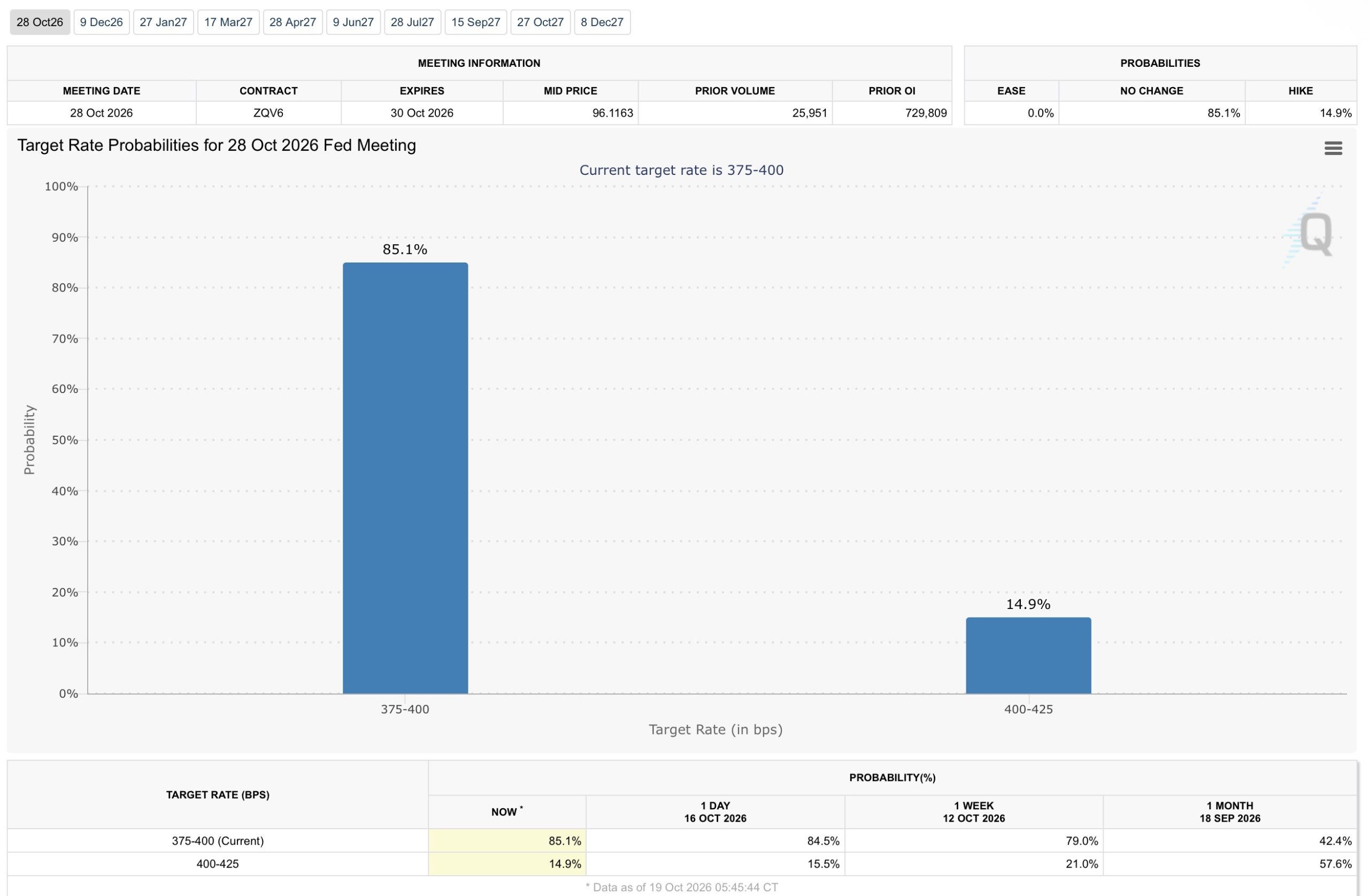
CME FedWatch put the chance of a rate increase at 29% for the next meeting and of at least a quarter-point rise in December at 88%, and the 10-year Treasury yield stood near 5.09% after touching 5.33%.
Earnings are the next test, with Netflix (NFLX) on Tuesday and Tesla (TSLA), Meta (META) and IBM (IBM) on Wednesday, and investors want evidence that US AI stocks’ demand turns into revenue, not just larger budgets. A stock bounce like CoreWeave’s does not show that financing worries have eased, so index strength is not yet an all-clear for AI exposure.

Comments
Log in or sign up to join the conversation.