


On Thursday, November 26, Ethereum’s core developers agreed to take the Ethereum Glamsterdam upgrade to its final public test on December 15, keeping a disputed gas rule exactly as written. The test runs on Hoodi, the network developers use as a dress rehearsal for mainnet.
It comes seven weeks later than planned. An October test was called off after a security firm warned that the new charges could change how programs already running on Ethereum behave. Developers now point to a mainnet launch in late January or early February, though no date is fixed yet.
ETH barely moved on the news. It trades at $1,730, down 42% since January 1. The Fear & Greed index sits at 12, deep in extreme fear, and traders have heard plenty of upgrade stories before.
So does a hard fork still move the ETH price?
Why Was the Ethereum Glamsterdam Test Delayed Until December 15?
The Gas Rule That Delayed the Test
The call summary on Ethereum Magicians records a “rough consensus” among execution teams to ship the current spec unchanged. The fight was over EIP-8037, a rule that adds a separate charge on anything that creates new permanent data on Ethereum, such as a new account or storage slot.
The goal is to stop the “state,” the database every node has to keep, from growing without limit. The price is steep. Creating a new contract today has a flat base cost of 32,000 gas. Under EIP-8037, the storage charge alone would be 183,600 gas, before regular fees.
That change is what worried auditors. ChainSecurity replayed a year of real Ethereum activity and found about 200 problems across bridges, wallets, exchanges, staking services and oracles. Most can be fixed with a setting, but 24 need code upgrades. Ethereum Foundation developer Marius van der Wijden estimates that up to 15,000 of Ethereum’s roughly 90 million contracts could be exposed.
A last-minute plan to simplify how the charges are tracked was turned down. Teams have until December 15 to report serious problems and until January 10 for the rest. Client releases for node operators are due early next week.
What Other Changes Will the Ethereum Glamsterdam Upgrade Bring?
The gas rule grabbed the headlines, but the Ethereum Glamsterdam list in EIP-7773 is long. Two changes matter most for how the network runs.
The first is enshrined proposer-builder separation, or ePBS (EIP-7732). Today, validators who propose blocks mostly buy them from specialist builders. Outside relays sit in the middle of that deal. ePBS moves it into Ethereum’s own rules, cutting out the middlemen that most blocks now depend on.
The second is block-level access lists (EIP-7928). A block will list up front which accounts and storage it touches, so nodes can load data and check transactions in parallel instead of one by one. That is groundwork for raising Ethereum’s capacity later.
Smaller items will please wallets and exchanges. Plain ETH transfers will emit a log, making them easier to track, and the maximum contract size goes up. The Sepolia testnet already switched to Glamsterdam on October 6.
ETH Price After the Last Five Ethereum Upgrades
An upgrade like Ethereum Glamsterdam sounds like good news for the price. The record is more mixed. We measured ETH’s move from the open on each mainnet upgrade day to the close 30 days later and compared it with bitcoin over the same window.
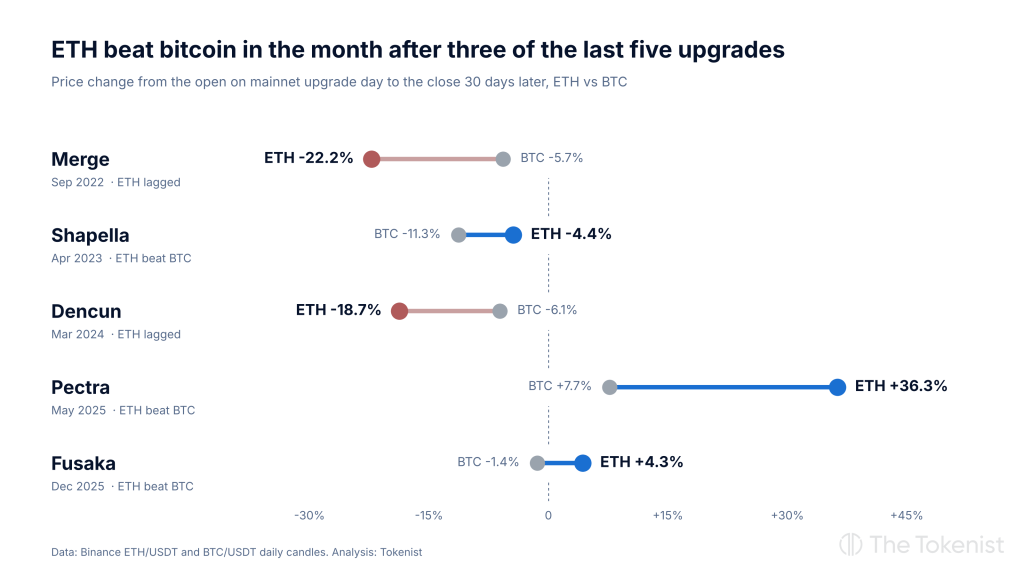
ETH beat bitcoin in the month after three of the five upgrades. The best run came after Pectra in May 2025, when ETH jumped 36% in 30 days while bitcoin added 8%. Shapella, which unlocked staked ETH in April 2023, and Fusaka last December also came out ahead.
The two misses were the most hyped launches. ETH fell 22% in the month after the Merge in September 2022, while bitcoin lost 6%. Dencun followed a 59% run-up in the month before it went live, and ETH then gave back 19%.
Five upgrades is a small sample, and each one met a different market. Still, the record argues against selling the news by reflex. Pectra is the closest match to today: ETH went into it near $1,800 after a long slide, and the price now sits just below that.
ETH Price Analysis: $1,540 Is the Floor to Watch
ETH trades at $1,730, below its 50-day exponential moving average (EMA), an average that gives recent prices more weight, at $2,066. The 200-day EMA sits higher, at $2,226.
Resistance: $1,850, a level ETH traded around in February and August and lost again in mid-November. Above that sits $2,000, the round number that held as a floor in April and turned ETH back in July.
Support: $1,540, the zone that held in late June and again on November 21, when ETH dipped to $1,538. Below that sits the 2026 low of $1,505 from June 6.
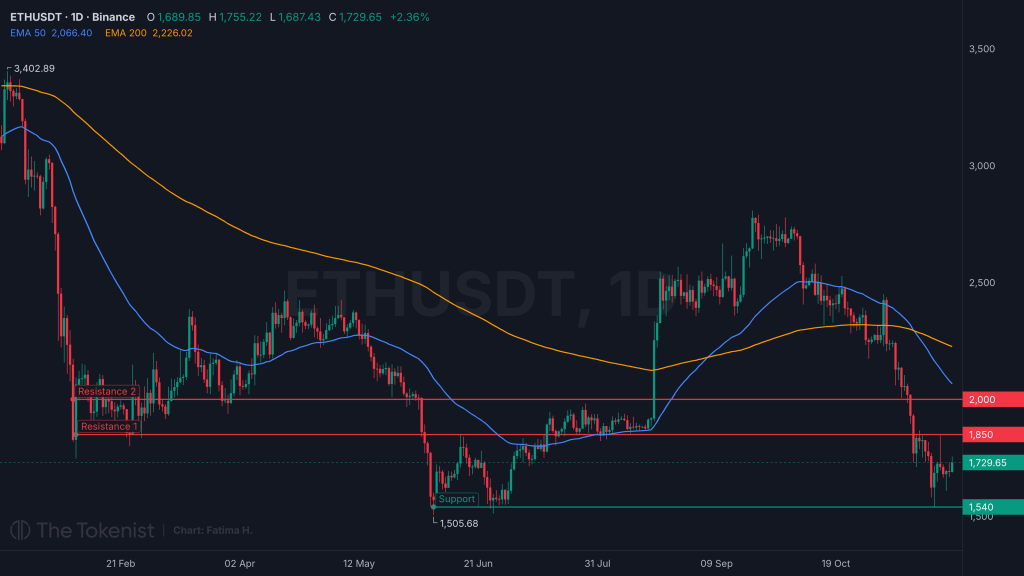
ETHUSDT 1D chart. Source: TradingView
Scenario | Condition | Where it could lead |
|---|---|---|
Advance | A daily close above $1,850 | $2,000, the July ceiling |
Pause | Price holds between $1,540 and $1,850 | A range into the December 15 Hoodi test |
Retreat | A daily close below $1,540 | $1,505, the 2026 low |
The Ethereum Glamsterdam test on December 15 is the next real date for ETH. If Hoodi runs cleanly, developers can set a mainnet date in January, and the Pectra comparison will get its first real check.



Comments
Log in or sign up to join the conversation.