

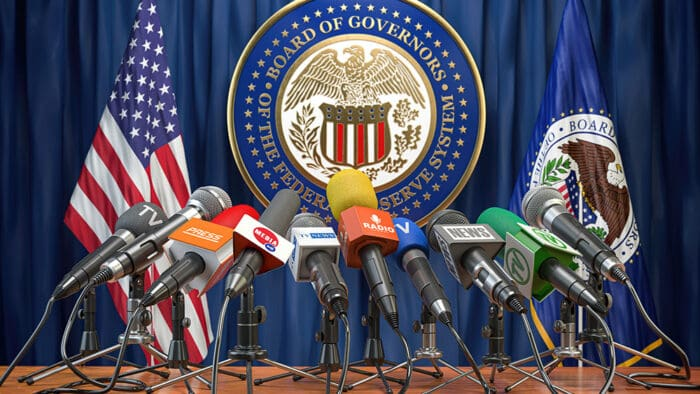
Financial markets had seemingly ground to a halt this morning as traders waited for Federal Reserve Chair Kevin Warsh’s highly anticipated address to the Kansas City Fed’s Jackson Hole Economic Symposium. Considering that a portion of the speech was devoted to the notion of a less communicative Fed, the half-hour length took some listeners by surprise. The immediate outcomes were: a 7-basis-point rise in 2-year yields, reflecting higher rate-hike odds; a flattish long end of the Treasury curve; and a “you may resume your regularly scheduled rally” response from stock traders.
While all financial markets pay close attention to central bankers, fixed-income investors are especially tethered to their utterances. Short-term rates move higher and lower based on perceptions about the likelihood of central bank activity. The rise in short-term yields tells us that the bond market is re-solidifying the prospect of rate hikes. Expectations for a 25-basis point hike at the September meeting rose from 31% to 50% on IBKR Prediction Markets and from 35% to 57% according to CME FedWatch, using Fed Funds futures. That said, the first hike still isn’t fully priced in until December. This has been my opinion for some time because I don’t think Warsh wants to take flak for hiking before the midterm elections. Perhaps more importantly, a second hike is now fully priced in the middle of 2027. Hence, we see higher short-term rates.
Long bond yields are relatively stable, but the cause is trickier to discern. Because long-term rates are heavily influenced by inflationary expectations, it is difficult to say whether the main influence for today’s relatively stable 10- and 30-year yields is Warsh’s inflation-fighting rhetoric or traders’ reticence to challenge Treasury Secretary Bessent’s buyback. Unfortunately, the Chair did not address the pressing question of whether the Treasury’s actions are countering the Fed’s desire for price stability. (By the way, literally as I was typing this, the Japanese yen weakened to 160 vs. the dollar for the first time since the Treasury intervened to prop up the yen on July 31st.)
Meanwhile, stocks seemed to be saying, “You’re now free to resume your regularly scheduled rally.” Today’s initial upward move was quite a bit more balanced than yesterday’s, which can be summed up mainly as “forget about this rotation thing, we’re back to buying tech.” In recent weeks, we have seen many investors favoring a wider range of stocks, including more value-oriented basic industries and consumer-related shares. Yesterday, with relatively few exceptions, it was tech and only tech. This was evidenced by 197 more decliners than advancers among the S&P 500 (SPX) yesterday and by the fact that only one sector – technology – gained in SPX yesterday. (As I type this, SPX advances are leading declines by 35 and about half the SPX sectors are higher.)
I just finished an interview with a foreign journalist who asked some pointed questions about Federal Reserve credibility. He understandably wondered whether a Fed Chair who talks tough about fighting inflation risks squandering valuable credibility via inaction, especially if the FOMC waits until December for its first move. If the stasis is indeed politically motivated, it is fair to wonder whether the committee is missing a valuable opportunity to assert its independence, especially when the Treasury’s pseudo-“Operation Twist” seems to be at odds with Warsh’s rhetoric. For obvious reasons, Warsh made no mention of that key question today.
During the time I spent speaking to the media, stocks began to fade. SPX was about 20 points higher when I started writing today; now it’s down by nearly the same amount; and 2-year rates are now up by more than 10 basis points instead of 7. The adage “don’t short a dull tape” often applies on a summer Friday with few catalysts. Warsh’s speech was the third key catalyst of the week, after the PCE report and Nvidia (NVDA) earnings. For the bond market, at least, today’s speech was a very important catalyst. For markets as a whole, two out of three proved very consequential.
Comments
Log in or sign up to join the conversation.