

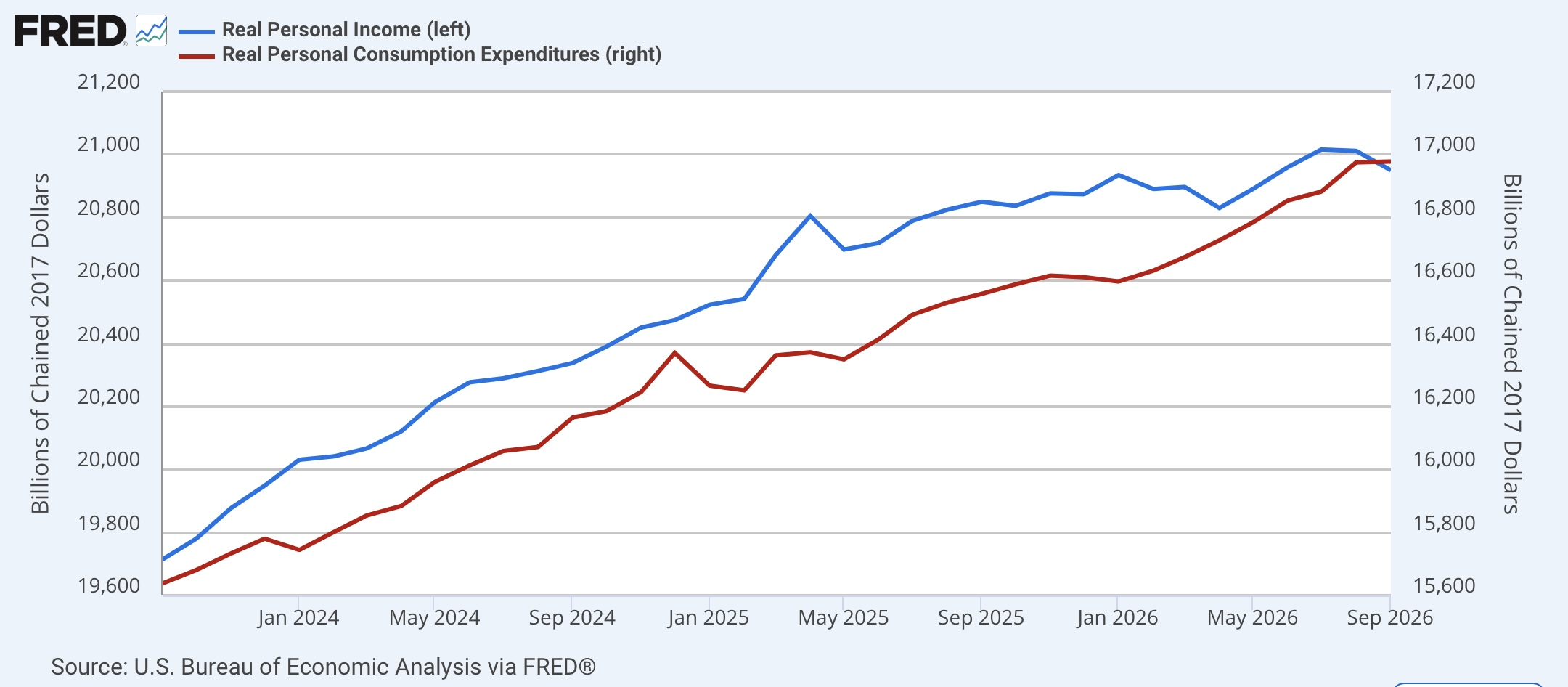
As promised, let’s take a look at the second of this morning’s three significant data updates. As I typically note, along with the employment report, real income and spending are probably the most important monthly reports as to the health of the average American household. Earlier this year there had been a real split between the income and spending sides of that ledger, with the former looking recessionary and the latter very positive. Last month the negatives on the income side were revised away, due to incorporating the more comprehensive measures found in the QCEW (through the first quarter of this year) and income tax payments (through Q3).
This month the softness reasserted itself somewhat, as real incomes declined, while real spending was unchanged. Here’s the more detailed look.
Nominally income rose 0.2% in September, and nominal spending increased 0.5%. But after adjusting for the price deflator, which rose 0.5% as well, real income (blue) declined -0.3% and real spending was unchanged:
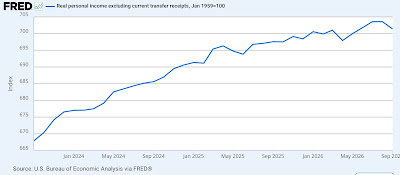
Real income less government transfers payments is one of the important coincidental indicators the NBER looks at in determining if the economy is expanding or in recession. Since even without government transfers real income was down, needless to say so was this metric as well, also by -0.3% for the month, although it too was higher 0.5% YoY:
Here is what both real incomes and spending look like YoY since the pandemic:
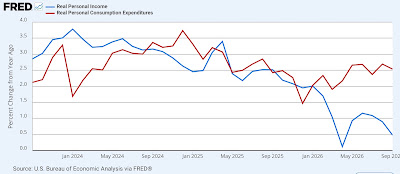
The former is up 0.5% YoY, which is weakly positive, while the latter is up 2.5%, a normal expansionary positive number.
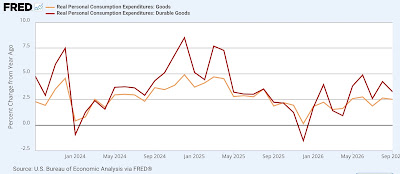
As I’ve noted many times in the past, real spending on services frequently rises all the way through recessions. The leading indicator is real spending on goods (gold). Further, real spending on durable goods (red) historically tends to peak even before goods spending as a whole. In September real spending on goods declined -0.3%, and real spending on durable goods declined a sharp -0.8%
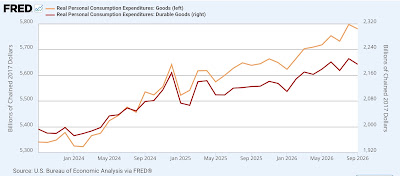
But both remain higher YoY, the former by 2.5%, and the latter by 3.2%:
The difference between income and spending is saving. In September, the saving rate declined -0.2% to 3.6%. This is low historically, but not as low as the era of the housing bubble and in 2022:
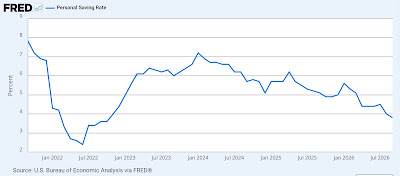
Typically, as expansions go on, consumers become more and more risk-taking about spending, and the saving rate declines. An increase in the saving rate in the presence of price pressures is one of the signs of an imminent recession. Needless to say, whatever they are telling pollsters, in the aggregate consumers remain quite confident about spending, likely tilted towards those with AI-based stock market gains.
Finally, this morning’s report also enables the update of real manufacturing and trade sales, one of the other important coincident markers used by the NBER to date recessions. These lag by one month. They were also flat in August, but their uptrend remains intact:
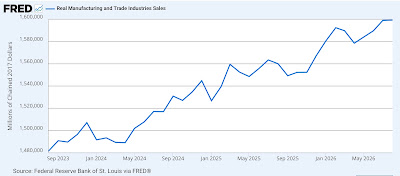
They are higher 2.5% YoY.
This was a slightly negative report. Real incomes declined, real spending was unchanged, and the goods component of that spending declined. Consumers in the aggregate dug into their savings to continue that spending. But the overall positive trend in these numbers remains intact. For me to change that opinion would require real spending on at least goods or durable goods to turn negative.



Comments
Log in or sign up to join the conversation.