

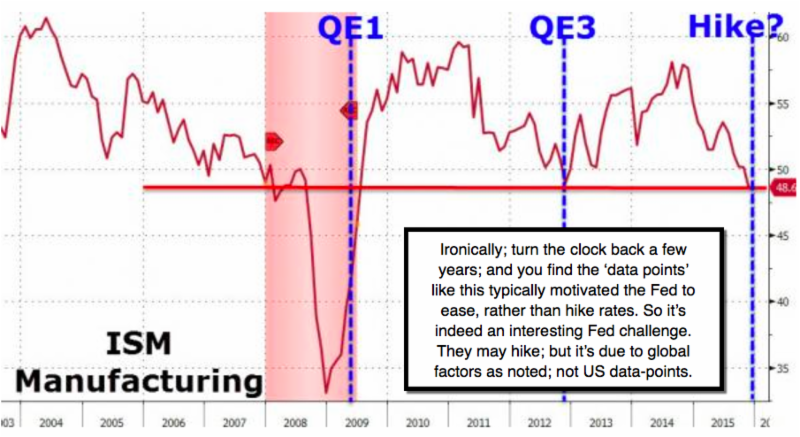
A relentless barrage of soft data-points - should be the highlight of forecasts for next year, not just the never-ending debate about whether they justify 'cover' for the Fed to firm rates. The ISM was the worst number since 2009; helping of course rally the rate-curve belly if you will. What that says 'in theory' supports a 'pass' on rate moves, and a more 'dovish' posture by the Fed. Some see that in a 'bullish' frame of reference, but that's last year's game and this is something to be concerned about for reasons beyond what the Fed does or again defers. The ISM number if not out-of-sync with other data; while final demand appears to be firm (to wit: auto-sales, but that is because of low rates, and presumably with long-lease or purchase terms, pulls from future demand).
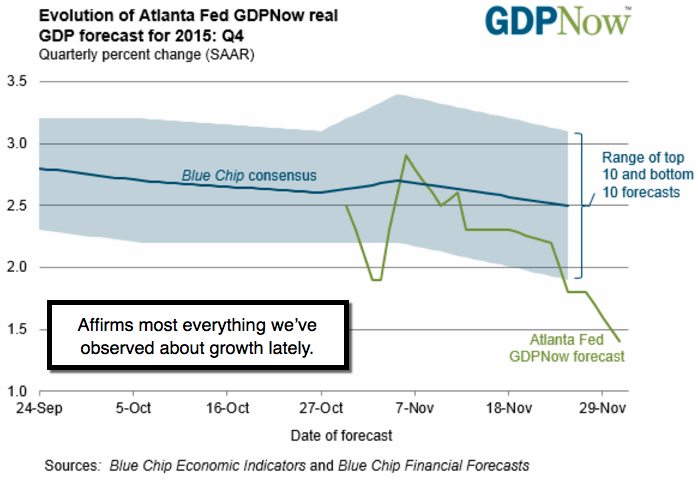
The economy is 'not dying'; although it's struggling in manufacturing overall for sure. The Atlanta 'Now' Fed data has been lowered again; and we actually are not sour about 'slow growth', as that's the best climate for the long-term. But we have markets and industries (especially commodities and energy) structured on a faster pace of recovery (it's not just slack Chinese demand) and expectations of higher 'CapEx. Combating that is today's 'Business Roundtable' CEO survey; which might just be the most important release of the week. Why? Because 'CEO Confidence'in fact imploded; with regard to this Quarter and at least early 2016. That's very significant, as one might presume 'Capital Expenditures' and hiring won't really take-off in an environment of low executive confidence.
One might conclude from that a presumption about 'more' buybacks in 2016; a prospect for some of course. But the downside of that (especially as investors increasingly recognize many executives engaged in insider-selling during what was perceived to be rising demand during buybacks which elevated earnings, or masked failure of top-line and bottom-line results that otherwise existed. It's essentially (where a company didn't have really great profitability) a 'default' of growing a business, and might be seen as disadvantageous to shareholders; the opposite of what most presumed short-term as share price often firmed. I could be cynical and ponder how any CEO of a firm, struggling in a bifurcated economy, could have a positive outlook when nothing has been done to 'really' grapple with the needed manufacturing renaissance, and as each passing year sees more people having to enroll in healthcare costing more than estimates (I doubt that surprised many, as some plans were almost bait and switch after the first year), which sort of sucks every last dollar they out of their pockets, leaving fewer to possibly spend on retail stuff mostly from China; or to be returned after the holidays. Yes, cynical, but probably not an unrealistic middle-class take.

In sum: how to view the Fed and Data Driven decisions. First more matters as we're in a War with 'radical Islam' (not just Islamic State); the 'threat matrix' is a bit less-known that almost at any other geopolitical time; and perhaps we get to a point where 'reasonable growth' is welcomed; but you still have low CapEx; a consumer that is pressed by high healthcare and other basic expenditures; as a corporate world is hard-pressed to justify any sort of major expansions.

Then there is a wild-card politically. No; not whether or not it's Donald Trump or any of the other Republican candidates as standard bearers; but rather a wild card of what happens if it's not Hillary Clinton running for the Democrats. Most view (he says so) Bernie Sanders as less pro-business; and Hillary acceptable (meaning she'd not be terribly draconian as far as business and markets; while tending to be fiscally dovish they suspect). But what if a rather nonpartisan FBI probe actually moved along in a way that nullified her candidacy? Just saying it as a 'wild card', but imagine how markets might respond to that.

Bottom-line: we'll not assume a lump of ('clean') coal in Christmas stockings; but you'll likely not get a strong Jobs number on Friday; and lower payroll data; at a time of year that if soft that implies even softer early in the new year. Thus if you get a 'year-end' rally, it could be from a lower level to a lower high; hence very little is happening to encourage investments. Other than the lower yields at this point haven't reflected the flattening; though the 2-year implies that.

If the Fed does raise rates some think the Dollar sells-off; we disagree and see it higher; though it's a crowded-trade so you can get shakeouts as we've seen a couple times in the year just past (identified while staying bullish DX overall). At the same time we feel the same about the Euro; rallies within overall continuing downtrend; as outlined since about 1.40 Euro; discussing a move to parity. Whether the economy is truly fragile (hence Fed sensitivity and the credibility argument prevails either way; if they move and we find that a recession began in July other than auto's, well, they'll be eating crow to bump rates, but we have felt their concerns are macro; beyond domestic concerns. However that's really not their mandate, so investors are confused expecting a more myopic view by our central bank.
Daily action - there are several factors to basically account for Tuesday's firm turnaround (it was up and sharply down initially on ISM data by the way); most are subjective, and a return to 'hope' for a 'bad news is good news' revival time.
We think the latter, the idea that the Fed won't hike based on miserable data on most parts of the economy and jobs, is the key one that was in-play today; as a fairly lethargic rebound found legs only after Pres. Evans of the Chicago Fed, in his bias, called for dovish policy and no rate hike yet. We believe the Fed focus is more macro than domestic; but macro isn't so strong overseas; so anything is possible. The Fed will lose credibility either way if the economy declines after a 'skip' on rate change, or if it declines after a 'hike' in rates. That latter gets lots more blame of course by the Street, which generally prefers the Fed do nothing now, but became resigned to the prospect; mostly to calm investment jitters.

You also have Draghi's pledge to be more proactive (yet again); and their ECB meeting comes first. So does Chair Yellen's Economic Club address tomorrow. Any of this can underpin the move; make shorts nervous; or unwind the rally as well; especially if Yellen comes-forth to defend the plan to 'normalize' monetary policy; as we presume they know they missed the ideal window to do so; and it is dangerous to leave themselves with no 'cushion'; but also dangerous if they hike rates and the effect is more serious than benign for the markets.
We continue to view the market as an accident (again) waiting to happen; as a lot of crosscurrents dominate; but a lot of selling, not just buying, is in the wings over the weeks ahead. That may be especially as we move into early 2016 and especially among some hedge funds, that might even dissolve or reduce client acceptances and return some if not all money. Any number of managed asset portfolios are either flat-to-down for the year; and hedgers are typically paid for performance, which they generally don't have this year. If they believe they will in the future, then they should persist, because they aren't expected to vanish if the going gets tough; but to maintain relationships for many years.

Many of the bigger or better-established funds should be disappointed but view it like sports where you don't expect to win every season, nor get a bonus if you didn't win the Superbowl. Probably poor analogy, but perhaps it seems odd to see these guys (some of them) throw in the towel, rather than shift their asset focus. Perhaps some see the same market scenario; flat prospects; overdone credit market plays; continued submerging markets in Asia, and more difficulty in being profitable in down markets ahead (yes ahead); particularly as the short side can get crowded too (as we've seen with each of these snappy rebounds; especially as they usually have little sustainability).
The frustration may actually morph into something else next year; because this was a year of 'distribution', and largely artificial stamina bolstered by buybacks, as I've discussed. For a year ending in '5' that's before an Election, it was really mediocre. Bulls & Bears alike are fairly worn-out from fighting this; almost like a war in the Middle East, where you retreat from the battlefield only to recognize a little later, that wasn't the wisest choice. Stay and defend, as the next battle may be successful; and if one leaves the playing fields, it's much tougher for an Army to be fielded again; almost from scratch.

Yes that's an analogy to not just Iraq of course (where errors were made going in and getting out; not to mention a Shia regime that wanted us out and Iranian agents in), but to long-side bulls that hung-in, but found lots of 2015 air-pockets while if they were short, those stocks got periodically run in. When pundits tend to praise this market, they rarely mention that over 55% of all stocks are 10% or lots more down from their 200-day highs (just the last half year or so) and often lots more from the start of the year. They typically won't focus on the rotation as was needed to keep the Indexes alive, or a 'narrow universe' (under 10 stocks) at a given time that received the focus of institutions to 'bring 'em back alive' on each dip that threatened to break primary trend support points.
Also, remember, that when a leveraged Index player finds the S&P down 10%, he is down probably 40-50%; because they are using more than 20% margin. It follows that a 20% or more decline would potentially be a wipe-out; hence they will fight as best they can to prevent that from happening. We are way overdue for a 20% peak-to-trough decline by the way; and long-term distribution usually precedes a significant 'accident' to the market; not plateau for new bull market.

Comments
Log in or sign up to join the conversation.