

Now that the Supreme Court has ruled that tariffs are illegal, the remaining question concerns whether it was worthwhile. Is the U.S. economy better off for having imposed tariffs? A year into Trump’s breakup of the international trading environment, the U.S. finds itself no better off, and in some respect worse off . Tariffs were imposed in one instance to lessen and ultimately repair U.S. trade imbalances, especially with China. And, in another instance, tariffs were placed to protect specific industries from international competition, such as steel and aluminum. Yet ,in a third instance, tariffs were imposed, in the case of Canada, under the false claim that Canada is a major source of the importation of fentanyl.
Although the Trump administration, at times, had different agenda items regarding the US trade picture, the administration it argued that there were three objectives:
To narrow the trade deficit globally, and specifically with China;
To encourage encourage overseas investors to relocate operations into the U.S., and accordingly,
To shift supply chains towards more industrial development within the U.S.
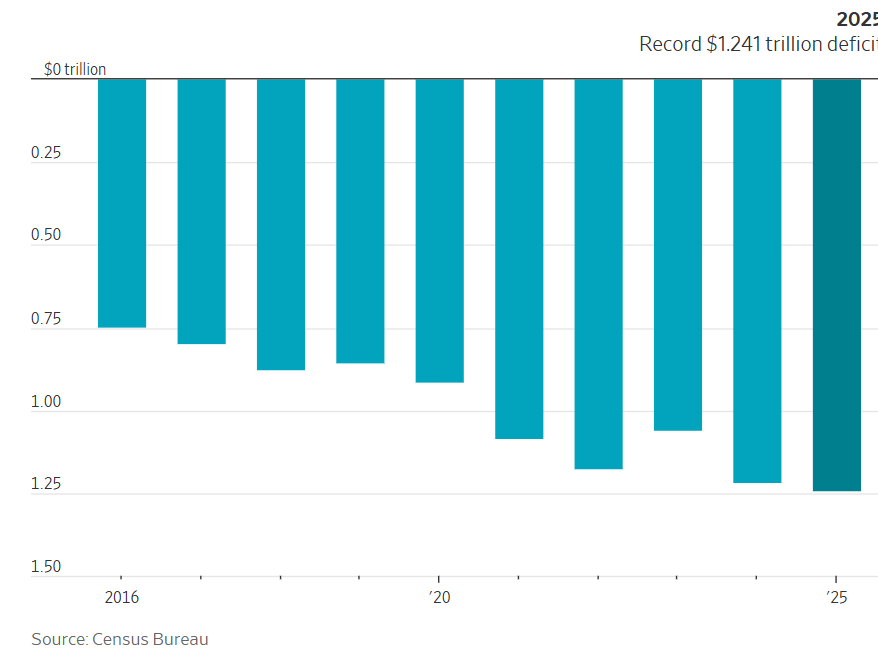
Last year, U.S consumers and businesses went on a buying spree internationally in anticipation of the application of tariffs. Once that was completed, US consumers continued to purchase more offshore, resulting in the largest deficit in goods on record, over US,$ 1.24 trillion. These results are consistent with a steady increase in the deficit for more than a decade. Nothing changed with respect to the extent and the direction of the U.S. deficit in traded goods.
U.S. Balance in Goods Trade
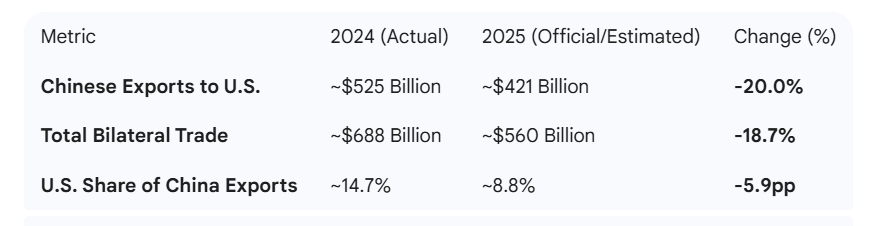
With respect to China, the administration started out by imposing a broadbased set of tariffs ,as high as 145%, in early 2025, ultimately lowering to them to 15-20% range, Trump tariffs were on top of those put into place by the Biden Administration in 2018 and, in total, China is subject to tariffs that are 25% or slightly higher. U.S. trade policy had a significant effect on lowering Chinese imports by $100 billion, and there is a certain degree of decoupling between the two nations. China, on the other hand, generated new markets, replacing the loss of U.S. business, and recorded a record $1.25 trillion trade surplus in 2025.
U.S. China Bilateral Trade
Source: Census Bureau
Trump’s administration can claim success in the use of tariffs to reduce its deficits in trade with China. However, U.S. trade deficits with Asian nations worsened as Vietnam and India hit record highs with the U.S. In many cases, Chinese companies shifted their supply chains and transferred products through neighbouring countries in an effort to avoid the high tariffs.
In sum, U.S. tariffs never achieved their goal of reducing trade deficits or altering supply chains more towards domestic producers. Granted, to a limited extent there was a decoupling between China and the U.S., but Chinese ability to find alternative markets left no scars on the Chinese manufacturing sector. The amount of decoupling remains small, and bilateral trade puts China just behind Mexico and Canada as the U.S. most important trading partner.
Trump, initially, boasted that the foreign suppliers would bear the cost of tariffs. A recent study by the Federal Reserve documented that 90% of the cost of higher tariffs is borne by consumers and producers in the U.S. Other Fed studies point to a higher unemployment rate and a new higher level of prices have followed the imposition of tariffs. These findings above all else call into question the value of protectionist policies that ultimately make the consumer worse off.
So, the Supreme Court decision really begs the question : was it worth turning the world’s trading environment upside down in pursuit of MAGA? U.S. trade deficits continue to increase, U.S. consumers are now feeling pain from higher prices, and the promise of re-shoring back has yet to begin.



Comments
Log in or sign up to join the conversation.