
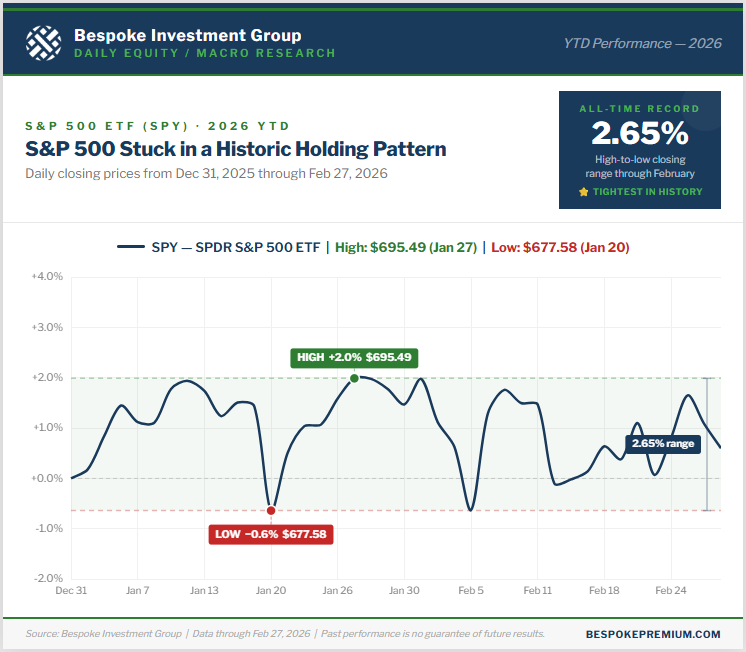
Given the massive geopolitical events that have taken place this weekend, no one knows what will happen once the dust settles from tomorrow's trading action. We do know, however, that 2026 has so far seen the tightest range on record for the S&P 500 through the first two months of the year.
Just 2.65% separates the S&P 500 ETF's (SPY) highest and lowest close so far this year. That's its tightest year-to-date high/low spread ever through February, and the same record holds for the actual S&P 500 index throughout its history.
Needless to say, the "market" as measured by the large-cap S&P 500 is a coiled spring heading into March's trading.
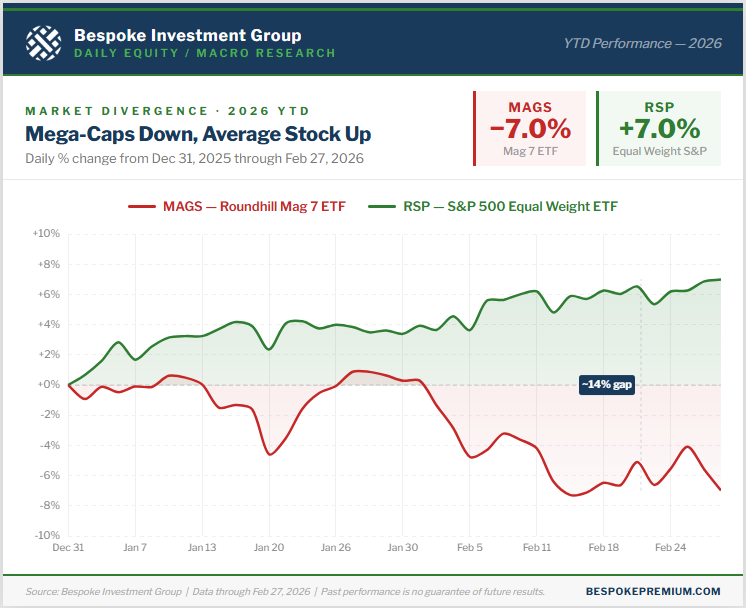
While the cap-weighted S&P 500 has been flat as a pancake this year, the average stock in the index is actually up 7%. This means the largest stocks in the index, the mega-caps, have underperformed. The Roundhill Mag 7 ETF (MAGS) is made up of Alphabet, Amazon, Apple, Meta, Microsoft, NVIDIA, and Tesla. So far this year, MAGS is down 7%.
Below is a look at the huge 14-percentage point year-to-date performance gap between the S&P 500 Equal Weight ETF (RSP) and the MAGS ETF:
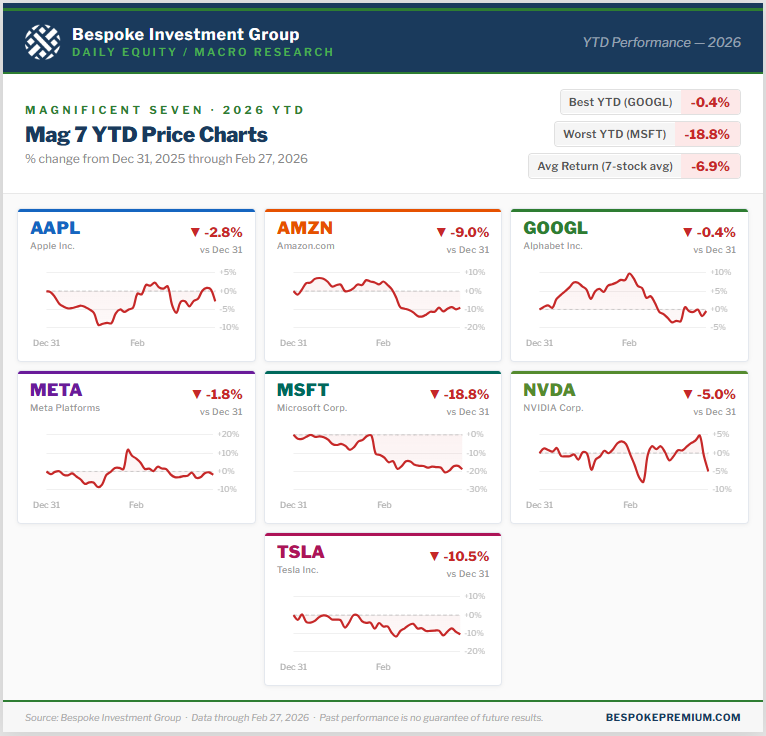
As we get set for March, not one of the Mag 7 stocks is up on the year. As shown below, Alphabet has been the best performer of the group this year with a small decline of 0.4%. On the flip side, Microsoft is down the most with a decline of 18.8%.
With such big concentration at the top of the S&P 500, investors have been worried that weakness in the mega-cap cohort would inevitably take down the rest of the market. During the recent Mag 7 sell-off, the rest of the market has stepped up enough to essentially keep the major cap-weighted indices flat.


Comments
Log in or sign up to join the conversation.