

A 'desperate secondary test' just above the January 20 lows preceding our expected 'reflex rebound', and ensuing decline from February's start, is really the core message to convey about Monday's market turnaround try. It's dicey; has little prospects for success, and is discussed (and projected from technical perspectives) to be part of the pattern 'process' outlined for weeks.
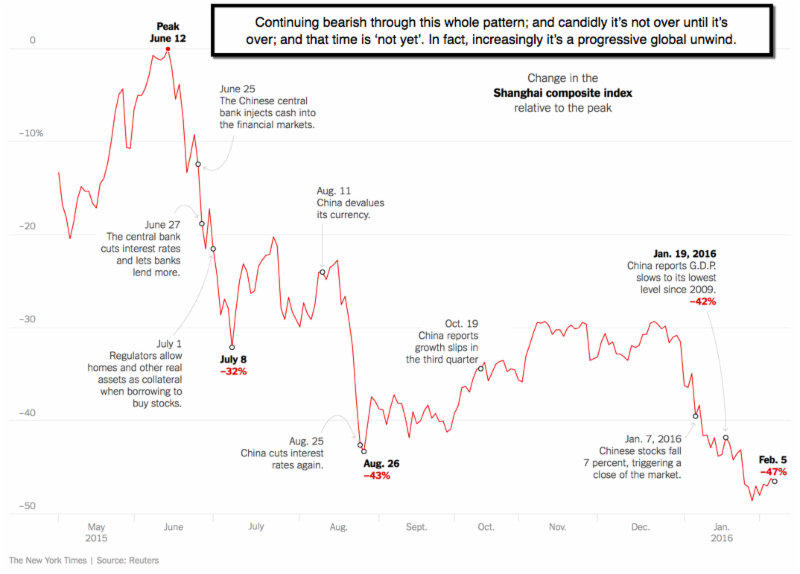
The reason I begin with this is unusual: despite the obvious nature of trying to hold above the preceding low (and thus seeking to avert a penetration into what I call 'no-man's land' that lies below), the pundits are either rationalizing a turn as bargain-hunting (little of that); or short-covering (lots of that); or based on oil being strong (sort of, but lots more challenges, dividend cuts and defaults loom both here and abroad); or somehow a rebound in Financials (that was solely a function of late-day post-European market close statements by Deutsche Bank (DB), the institution at the heart of Europe's banking fears, saying they have sufficient liquidity to meet a Coupon payment in April).
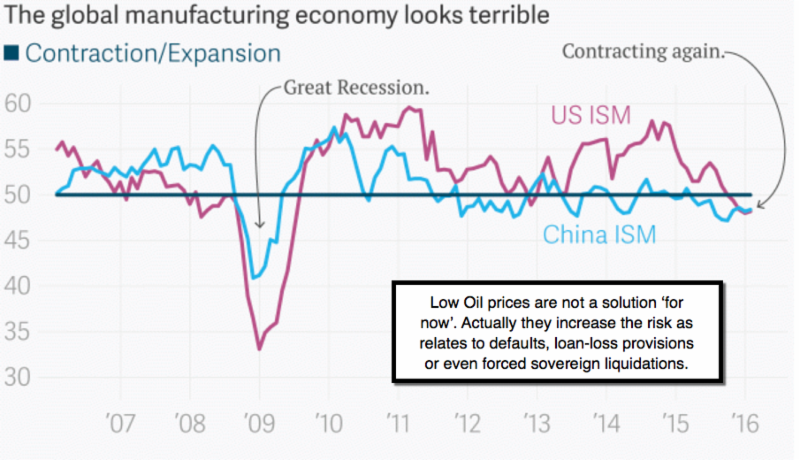
This matters, because 'some' would act 'as if' the market simply turned around (it tried but was goosed-along by DB), because investors saw bargains. That's nonsense, though there's no argument the lower things go the lower the risks. I should also say that while others are suggesting we 'may' enter a recession in the future, I contend we are in one roughly since indicated in July of 2015. That makes me 'more' optimistic about getting this 'Bear Market' over with earlier if you think about it, than many suggest. Here I'm referring to 'lead times' during which a market sees distribution (all last year) and then the lag for a recognition formally of a recession (closer to the end historically). Because at that point the stock market starts anticipating the recovery that follows.

What's different? Well hopefully it's not different 'this time'. But we have limited Fed stimulus capacity (unless it's at the expense of the American people being more heavily taxed); we have China in a funk (we can only hope they figure out something to stabilize their bleak growth and jobs picture; or societal discord is a real risk there... and perhaps Hong Kong would actually regain independence if push came to shove.... it could all get interesting); and Japan sort of spinning.
So if it's 'different', it would be because the unwinding is potentially enormous; at the same time the ability of central banks to do much is limited; and the very coordination of 'globalism' puts everyone pretty much in the same soup; leaving few capable of rescuing the many. That's where you get deflation risk beyond of course the kind of disinflation/deflation we've had more recently.

What you don't get is rising demand for commodities or very much for oil unless oddly enough the Dollar breaks much harder, and Canada stabilizes (Canada is a banking risk few are focusing on, but perhaps should take a look at with some concern). I know businessmen in Canada are quite concerned about the status of their commodity-based (mostly oil, timber and mining) economy. Less so for Ontario and Quebec; very much so for Alberta, Manitoba, and even Vancouver which has benefited so much (high property prices) from Asian capital inflows.

Technically - it will not surprise me at all if the US market breaks (yes I don't expect Monday's late rally to hold even if Europe opens firmer with reduced risk of a 'bank run'; a story that made the rounds earlier today in Germany mostly); with allowance at midweek for a snap-back related to Chair Yellen's testimony.
Again the 'secondary test' aspect relates to the lows of January and August. Of course if these come out (and they should, whether right away or subsequently if they manage to hang together for a couple days or into Yellen); algo signals at that point trigger more selling. Before that so do margin calls and so on. It's likely to be erratic; and nobody would be surprised at more relief rallies; as the crowd that won't talk about it, knows the risks in 'no-man's-land'.

Again, while I'm excited about eventual bargains; you don't have the kind of big percentage cuts (foretold here in the absurd pricing in FANG and other stocks), even with rebounds in Oils or some dividend-paying industrial's (careful about a dividend payer as often that may not be a safe dividend), without a series of up and down swings at worst, or a selling climax (crash like) at best. (I say 'best' of course as a washout usually leads to a big rally; not the ragged kind of action.)
In sum: what we've had has been 'orderly' and 'systematic'; just the 'process' I frequently refer to the evolution as. That's why the VIX is still sub-30; and it's a reason why 'they' (meaning fee-based money managers) haven't panicked. It's worth mentioning that sometimes they can't. And about that I recall one of my comments last Summer, about 'risks of ETF's'. Yes investors are diversified in a group; but it tends to cause balancing or almost equivalent moves up or down, for the components in a given ETF. So when you see a 'bank basket' move or wonder why a bank that has few problems moves lower with the group; that it's a part of an ETF may be the reason. Not making a big point here; just noting a few 'modern portfolio' aspects that can prolong the misery or even the depth of decline, by virtue of these 'constructs' they created to attract investor money.

If they 'really' (so far it's going as we warned) unwind this; by no means does it hold the S&P 1700's, much less the 1800's (just below here), over time. It's not essential that it all drops on a dime, but it still should in time. Few agreed with us all through last year; few dispute the issue now; few are sufficiently sidelined (much less short and profiting from the drop or at least hedging other losses in a portion of their retirement or other long-side portfolios they're barely involved with); and all that means this may have lots more slack in it as we've suggested many times. So again, doesn't matter if the ultimate low is 1750; 1450 or 950 (? did I say 950; no I just gave a number; I said nothing as far as where it stops).
It matters that we've assessed the distribution of last year; the hard break just in-front of this year (as a process of the preceding desperate 'hail Mary' failure), and we look forward to trading our way to a hopefully sustainable low 'one day'. This is not that day. Rally or not; for now still short at March S&P 2065.
Comments
Log in or sign up to join the conversation.