

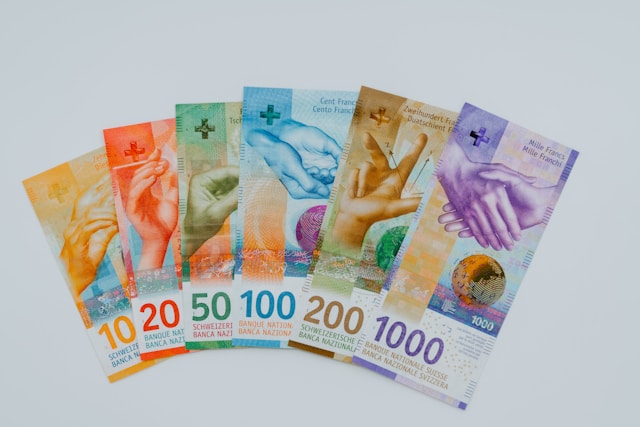
USDCHF is trading around 0.8088 at the moment of writing, pulling back from the one-year high near 0.8139 touched on June 24 as the dollar's bid weakens. Even so, the franc remains roughly 6.3% weaker against the dollar than the lows touched in January 2026
Despite this year's wobble, the franc remains one of the world's genuinely strong currencies: at its June meeting the SNB held its policy rate at 0% for a fourth straight meeting, with inflation drifting up only modestly, from 0.1% in February to 0.6% in May, and staying firmly inside the 0–2% comfort zone. That combination — a strong currency alongside near-zero rates — is worth pausing on, because it inverts what textbook interest-rate parity would suggest. The franc holds its value not because of yield, but because of what it represents: Switzerland's political stability, current account surpluses, deep capital markets, and its status as the default destination for capital fleeing risk elsewhere. Low rates are possible precisely because the franc's structural strength already does much of the disinflationary work, keeping imported prices — around 22% of the CPI basket — in check even as energy costs rise.
This is where Switzerland's FX policy diverges sharply from Japan's.The BOJ has spent years fighting yen weakness, intervening to prop the currency up as ultra-low rates and capital outflows dragged it down. The SNB faces the opposite problem: its low rates coexist with a currency that tends to appreciate too much, especially in moments of global stress, which is disinflationary or even deflationary for Switzerland and squeezes its export sector. That's why SNB intervention, when it happens, points the other way — selling francs to cap excessive appreciation, not buying them to support the currency. The SNB's own language now frames this as conditional and "if necessary" rather than systematic, reserved for episodes of rapid, excessive strengthening that could threaten price stability, as seen in the early-2026 flight-to-safety period.
TECHNICAL ANALYSIS
USDCHF was trading around the 0.92 area at the beginning of 2025 — roughly 11 big figures higher than current levels — and if we go further back in time, say to 2023, the pair was trading close to parity. This highlights the strength of the Swiss franc, although here we will focus more on the short-term picture, using a chart that covers the last 14 months of trading.
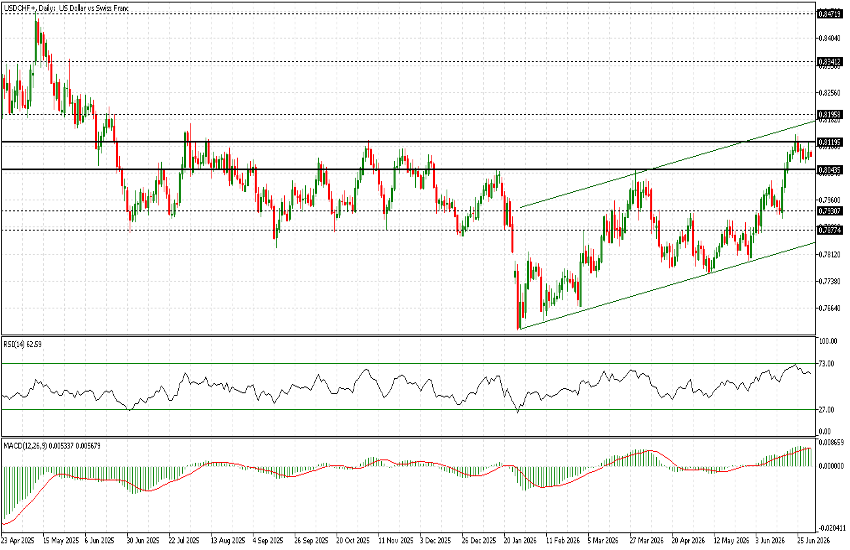
January 27 marked the strongest level reached by the Swiss franc this year, with USD/CHF hitting a low of 0.7604. From there, the pair began its recovery, a rally that can be contained within an upward channel whose upper boundary currently comes in around the 0.8180 area. The same region (around 0.82) also represents a resistance zone dating back to the March-May 2025 trading period, although it is secondary to the area where the pair is trading now. Indeed, the 0.8040-0.8120 range is a clear and significant resistance zone that has been tested multiple times throughout 2025.
This is an area where the current rally could potentially stall. However, we believe there is still room for further upside: technical indicators remain constructive and are still far from overbought territory. Should the current trading range gradually be cleared to the upside, the next noteworthy resistance level above 0.82 comes in around 0.8340, followed — much further out and admittedly prematurely at this stage — by the 0.8470 area.
To avoid being excessively biased to the upside, we also focus on potential support levels on the downside, particularly 0.7930 and, even more importantly, 0.7875. However, this is not our base-case scenario and, in our view, likely not the base case of the SNB at this stage either.

Comments
Log in or sign up to join the conversation.