

(Click on image to enlarge)
The Briefing
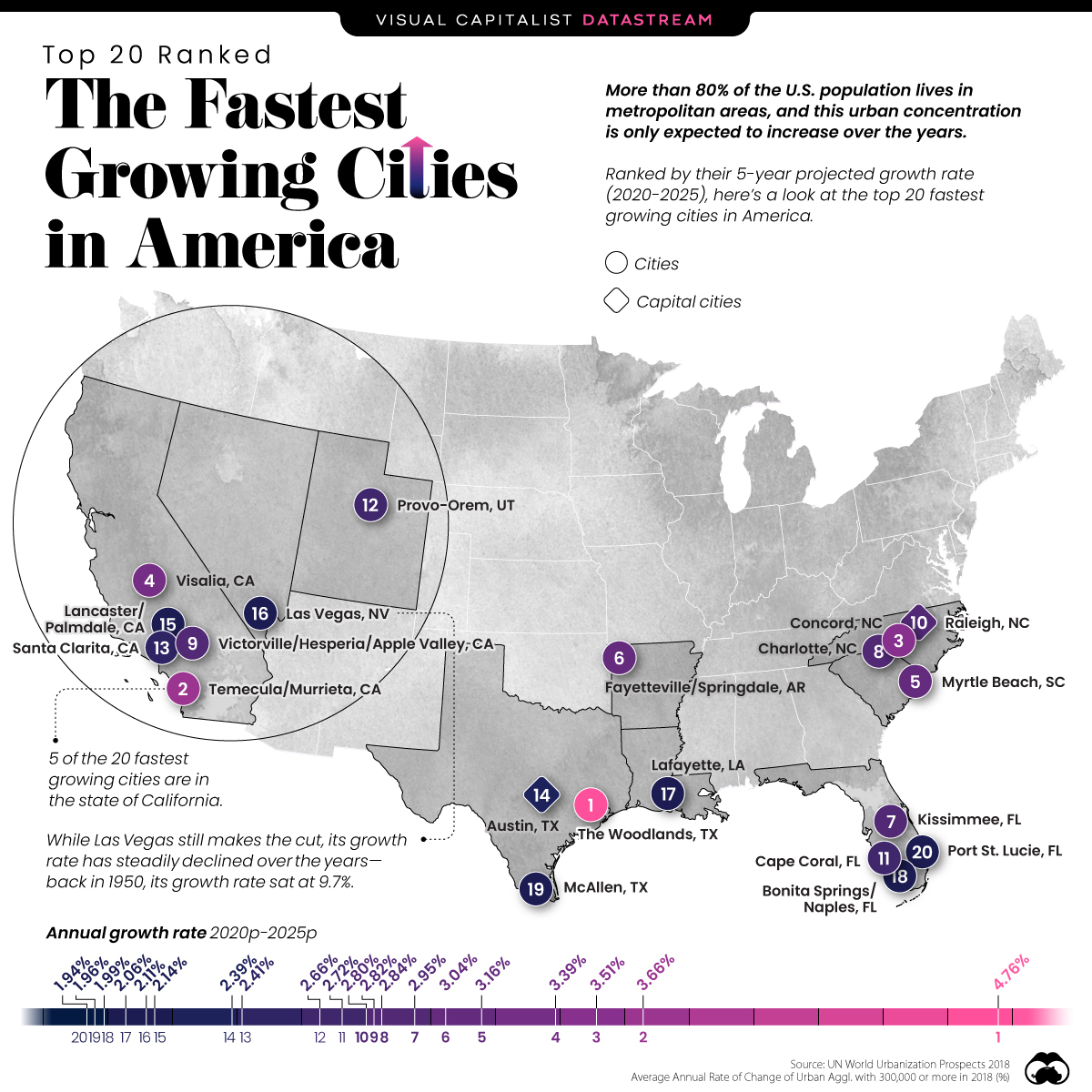
- Five of the 20 fastest-growing cities are in California
- However, California’s population growth as a whole has become stagnant over the last few years
- Between 2020-2025, the fastest-growing U.S. city is expected to be The Woodlands, TX
Ranked: The Fastest Growing Cities in the U.S.
The world has become increasingly more urbanized, especially in America. Despite being one of the largest countries on the planet, over 80% of the U.S. population currently is concentrated in key metropolitan areas, and this urban concentration is only expected to increase in the coming years.
Which U.S. cities are leading this growth?
Here are the fastest-growing urban areas in the U.S. with over 300,000 residents, based on their projected annual growth rate from 2020 to 2025.
| Rank | City | State | Avg. Growth Rate ('20-'25p) |
|---|---|---|---|
| 1 | The Woodlands | Texas | 4.76% |
| 2 | Temecula-Murrieta | California | 3.66% |
| 3 | Concord | North Carolina | 3.51% |
| 4 | Visalia | California | 3.39% |
| 5 | Myrtle Beach | South Carolina | 3.16% |
| 6 | Fayetteville-Springdale | Arkansas | 3.04% |
| 7 | Kissimmee | Florida | 2.95% |
| 8 | Charlotte | North Carolina | 2.84% |
| 9 | Victorville-Hesperia-Apple Valley | California | 2.82% |
| 10 | Raleigh | North Carolina | 2.80% |
| Rank | City | State | Avg. Growth Rate ('20-'25p) |
|---|---|---|---|
| 11 | Cape Coral | Florida | 2.72% |
| 12 | Provo-Orem | Utah | 2.66% |
| 13 | Santa Clarita | California | 2.41% |
| 14 | Austin | Texas | 2.39% |
| 15 | Lancaster-Palmdale | California | 2.14% |
| 16 | Las Vegas | Nevada | 2.11% |
| 17 | Lafayette | Louisiana | 2.06% |
| 18 | Bonita Springs-Naples | Florida | 1.99% |
| 19 | McAllen | Texas | 1.96% |
| 20 | Port St. Lucie | Florida | 1.94% |
Coming in as America’s fastest-growing city is The Woodlands, Texas. This Houston-adjacent community is projecting an extreme population increase, reflecting the rapid population growth of the state of Texas.
According to 2020 Census data, Texas is America’s third fastest-growing state, with a population of over 29 million—that’s more than the entire population of Australia.
The second fastest-growing city is Temecula-Murrieta, California, which lies in the center of the triangle formed by Los Angeles, San Diego, and Palm Springs. Despite the fact that five of the 20 fastest-growing cities are in California, the Golden State’s overall population has been somewhat stagnant in recent years. In 2018, California’s population growth rate dipped to 0.47%—its slowest growth rate on record.
The Main Factors that Impact City Growth
What contributes to a city’s population growth? According to academic research conducted by Gilles Duranton and Diego Puga, there are several key drivers that impact urban growth:
- Transportation and housing supply: Restrictions on housing supply, along with poor transportation options or limited roads, tend to hinder urban growth.
- Amenities: This includes “natural” amenities, such as the weather—one of the most reliable predictors of city growth. Warmer temperatures in January and cooler temperatures in July are both strongly correlated with urban growth.
- Agglomeration effects: An educated city is more likely to be an entrepreneurial city, which attracts new firms and helps foster growth for existing firms. As a result, its population naturally increases.
Duranton and Puga stress that municipal and city governments likely play a role in a city’s population growth too—however, more research on the topic is needed to confirm their hypothesis.


Comments
Log in or sign up to join the conversation.