
Government Sponsored Enterprises QE

I fully support President Trump's desire to fire Jerome Powell for gross incompetence. The irony here is that Trump wants him gone for not reducing rates quickly enough. Whereas, I think he should be canned for being the biggest money printer in the history of the Fed. The sad truth is the US government has become insolvent, and the economy and markets can no longer function properly unless our central bank is a consistent purchaser and owner of Treasury and mortgage-related bonds. The government spent and borrowed too much money, and now it's too late for the Fed to let markets dictate the price of debt. So, our fate is depression or hyperinflation, probably both at different times.
Smart people learn from their mistakes. Governments, however, tend to double down on their errors. For a great example, one would have hoped that our government now understands that manipulating mortgage rates below what the free market warrants leads to a significant disconnect between home prices and incomes.
This is why our Administration's latest efforts to launch a new quantitative easing (QE) program for the mortgage-backed securities (MBS) market is particularly insane.
The Government Sponsored Enterprises, Fannie Mae and Freddie Mac, exist to buy mortgages from banks. The government has just instructed these GSEs to buy $200B of MBS to further force down rates on new mortgages. This "GSE QE" is supposed to free up bank balance sheets so they can increase mortgage lending. It is crucial to mention that the GSE's were enacted by Congress for the purpose of providing a steady and affordable supply of mortgage funds, particularly for FHA-insured mortgages. These loans benefit families of low and moderate incomes, and therefore, they are of the riskier variety.
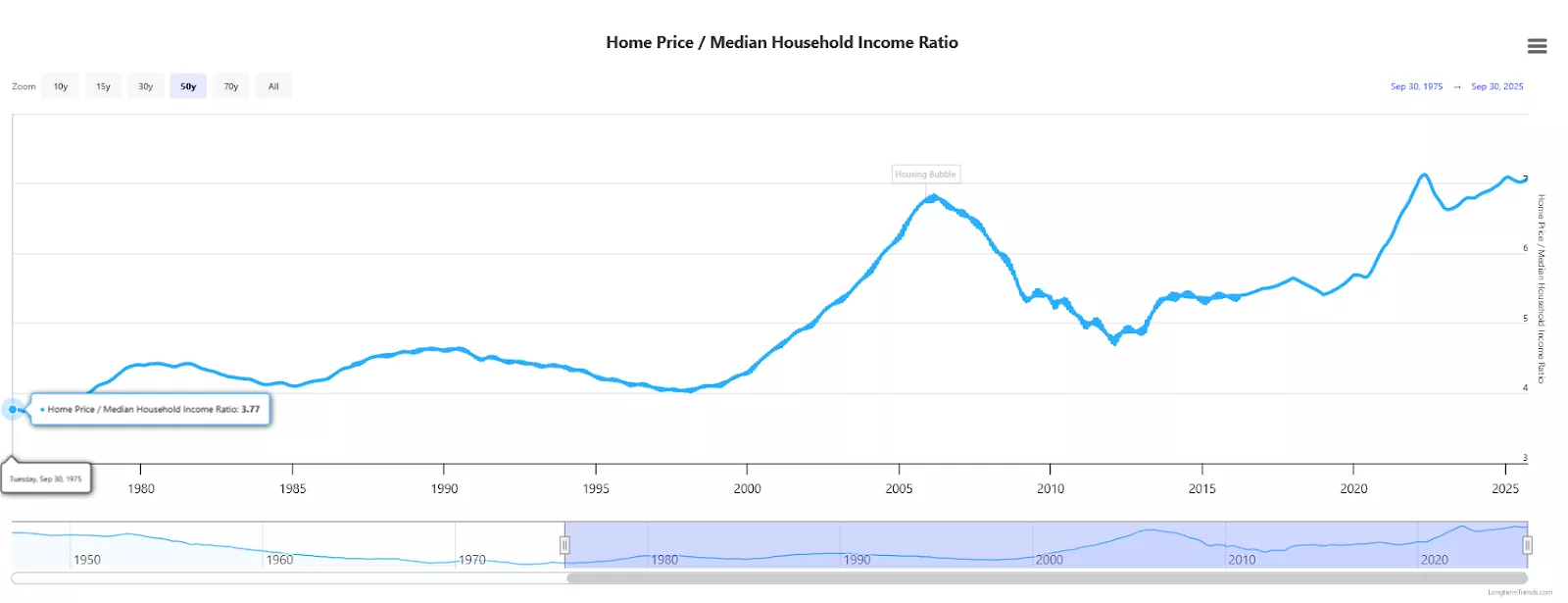
Hence, the solution offered by the government to rectify the unaffordability crisis of housing, which was caused in the first place by the Fed's artificial manipulation of mortgage rates to record lows, is to force the GSE's to buy more MBS! Buying mortgage bonds pushes bond prices up and interest rates down, which in turn sends home prices even higher. The problem with housing is that prices are far higher than what consumers' incomes can support. In fact, the home price to income ratio is at a record high. Home prices have risen by more than 115% since 2008 and skyrocketed by 50% from 2020-2022.
Here is a chart from Longtermtrends.com showing the affordability, or more accurately, the unaffordability of homes. The past 50 years of central bank and government manipulations of markets have caused the home price-to-income ratio to surge from 3.6 to well over 7.0.
(Click on image to enlarge)
Fed Chair Jerome Powell is fond of saying this at the end of every FOMC press conference: "Everything we do is in service to our public mission. At the Fed, we will do everything we can to achieve our maximum-employment and price-stability goals."If price stability was their goal they missed the target by light years.In reality, the Fed’s public mission has been to print trillions of dollars of high-powered money to manipulate interest rates lower, so that banks make fortunes while the living standards of the middle class are eviscerated.
The real solution to the affordability crisis and frozen real estate market is to allow interest rates to rise, which will cause home values to fall more in line with incomes. However, with real estate bonds being a big part of bank balance sheets, the Fed cannot let that happen. Sadly, government's answer to every hiccup in markets and the economy since at least the year 2000 has been to monetize the problems away.
This tragic function will continue until inflation begins to run intractable and the bond market breaks, which is surely our destiny. The US has annual deficits of nearly $2 trillion during times of relative peace and prosperity, and is pushing a $40 trillion National debt, much of which must be rolled over each year due to our proclivity to fund that debt with T-bills. There will be very little public or private demand for US sovereign debt (outside of our central bank), once inflation rates begin to rise higher than the yield Treasury rates offer. Investors may soon become convinced that our government will have to become the sole purchaser of US debt.
Japan has already suffered this fate. The Bank of Japan (BOJ) was the sole purchaser of Japanese Government Bonds (JGBs)—holding sovereign yields at zero percent from 2016 to 2022. Japan's rate-pegging regime seemed to be working for a while. However, interest rates are now surging in Japan, as rising inflation finally forced the BOJ to abandon its rate-repression scheme and was forced to allow bond yields to rise.
What makes the situation much worse in the US than Japan is that the Yen has never been the world's reserve currency; the USD has been since 1944. Investors in US Treasuries, both foreign and domestic, will sell what they own and sell short what they do not, once inflation really begins to surge. As our reserve currency privilege continues to erode, expect the bond market to crash alongside the USD.
That is why, in the long run, we should have a portfolio allocation that is short both the USD and the bond market, and long base metals, precious metals, and energy. This macroeconomic condition is known as stagflation, which promises to be the most intense and chaotic in US history.
More By This Author:
The Miran DotFull Steam Towards Intractable Stagflation
Fire The Entire Fed, Not Just Lisa Cook
Michael Pento is the President and Founder of Pento Portfolio Strategies and Author of the book more



Comments


