


Image Source: Pixabay
The EUR/USD rises during the North American session, following the release of mixed inflation figures in the United States (US) and US President Donald Trump’s threats to sue the Fed Chair Jerome Powell. At the time of writing, the pair edges up 0.50% at 1.1673.
Market mood remains positive with US stocks boosted by mixed readings on the Consumer Price Index (CPI). Although headline inflation was unchanged, underlying numbers exceeded estimates, though it was ignored by market participants, who had priced in over 90% chances of a rate cut by the Federal Reserve.
Following the figures, Trump slammed the Fed Chair Jerome Powell for being “TOO LATE” to cut rates and threatened to pursue a lawsuit against him, over the Fed building renovations.
In the meantime, a slew of Federal Reserve officials crossed the wires, led by the Kansas City Fed President Jeffrey Schmid, who was hawkish. The Richmond Fed President Thomas Barkin adopted a more neutral stance.
At the same time as Barkin crossed the wires, on CNBC, the Fed board Trump nominee Dr. Stephen Miran crossed the wires, and said that the Fed’s independence is paramount, though he didn’t speak further, as the Senate has not approved him.
Across the pond, the latest European Union (EU) ZEW Survey of Expectations for August plunged from 36.1 to 25.1. The figures in Germany deteriorated sharply in August due to the disappointing trade agreement reached with the United States and the declining economic output in Q2. Germany’s ZEW Economic Sentiment fell from 52.7 to 34.7 in August, below forecasts of 39.8.
The US and EU economic docket will be busy on Wednesday. In the US, the Fed parade will continue as Fed Regional Presidents Thomas Barkin, Austan Goolsbee, and Raphael Bostic will cross the wires. The EU schedule will feature German and Spanish CPI on Wednesday.
Daily digest market movers: EUR/USD surges as US inflation cools down
- Mixed US inflation figures failed to sway traders toward increasing bets on a Federal Reserve rate cut at the September 16–17 meeting. The Consumer Price Index (CPI) rose 2.7% YoY in July, matching June’s pace and just below the 2.8% forecast. In contrast, Core CPI accelerated to 3.1% from 2.9% the previous month, coming in slightly above expectations of 3.0%.
- Richmond Fed President Thomas Barkin said current monetary policy is well-positioned but warned the central bank will continue to face pressures on both inflation and unemployment. Kansas City Fed President Jeffrey Schmid also backed maintaining a modestly restrictive stance for now, favoring a patient approach to rate adjustments. He noted that the muted impact of tariffs on inflation suggests policy remains appropriately calibrated.
- Stephen Miran, nominated by President Trump to the Federal Reserve Board, emphasized that the central bank’s independence is “of paramount importance,” but declined to elaborate further ahead of his Senate confirmation process. He added that inflation has been “well behaved,” particularly since Trump took office.
- The US Dollar Index (DXY), which tracks the performance of the buck’s value against a basket of its peers, is down 0.44% at 98.06, a tailwind for the EUR/USD.
- The latest economic data released in the US spurred investors' speculation that the Federal Reserve might resume its easing cycle at the upcoming September meeting. Odds for a quarter of a percentage cut are at 91%, revealed Prime Market Terminal (PMT).
- On the European Central Bank (ECB) front, the easing cycle seems to be on pause for the September meeting, with 94% odds for the ECB to keep rates unchanged, and a slim 9% chance of a 25 basis points (bps) rate cut.
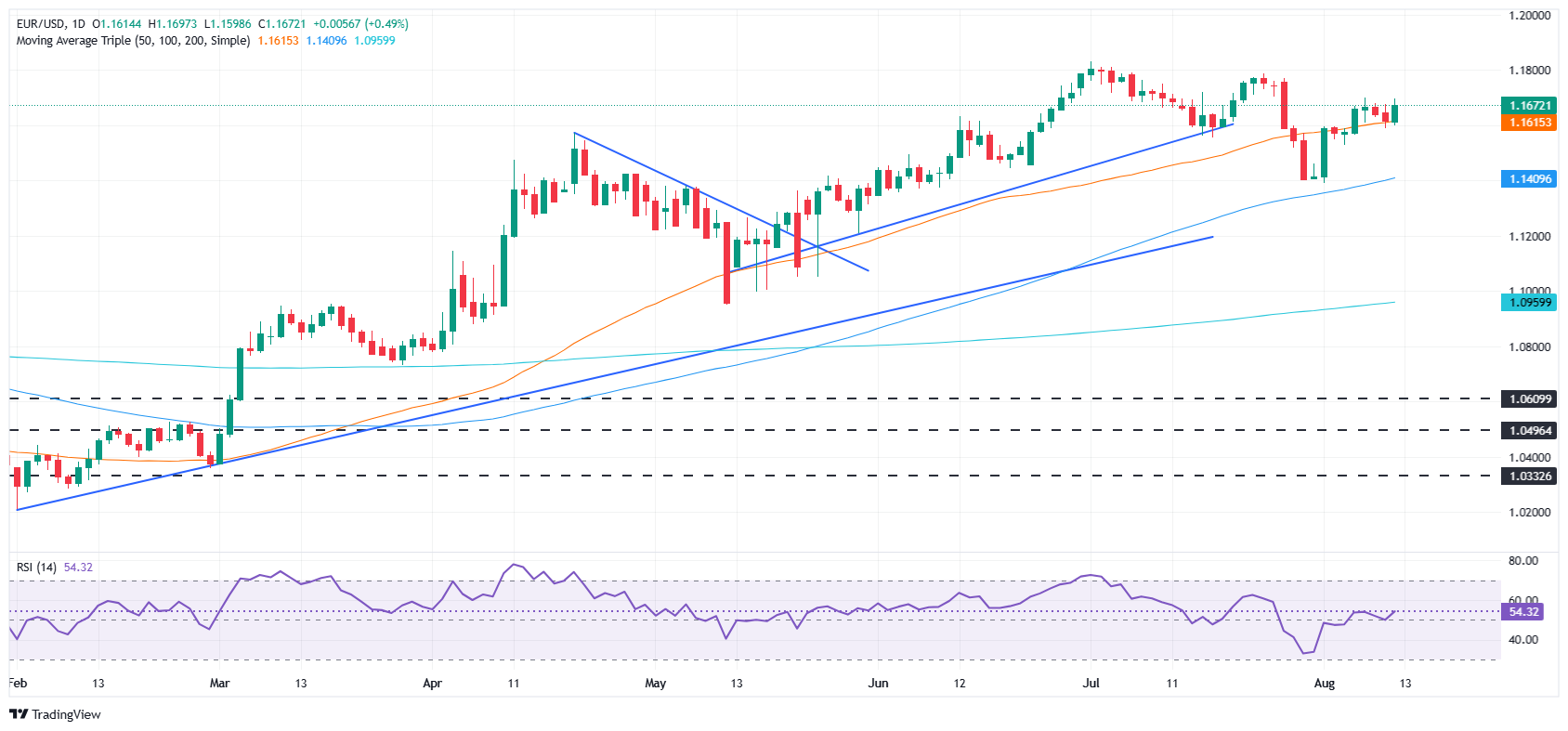
Technical outlook: EUR/USD rallies towards 1.1700 after clearing 1.1650
The EUR/USD uptrend stalled even though the pair hit a weekly peak of 1.1697, just shy of the 1.1700 figure. Momentum shows that buyers are in control, as depicted by the Relative Strength Index (RSI). However, as the index turns flat, the chances of a pullback are real.
If EUR/USD edges below 1.1650, a test of the confluence of the 20 and 50-day Simple Moving Averages (SMAs) around 1.1626/19 is on the cards. Further downside is seen once those levels are cleared, with the 1.1600 mark up next.
Conversely, if EUR/USD clears 1.1700, then the next key resistance would be 1.1750, 1.1800, and the YTD high at 1.1829.
(Click on image to enlarge)
More By This Author:
EUR/GBP Muted As UK Labor Market Steadies And EU Economic Sentiment WeakensSilver Price Analysis: Retreats Below $38.00 As US Dollar Strength Weighs On Metals
EUR/USD Dips As Traders Brace For U.S. CPI And Geopolitical Developments



Comments
Log in or sign up to join the conversation.