


Image Source: Pixabay
EUR/USD holds firm at around 1.1750, virtually flat after the latest US jobs report reinforced the chances that the Federal Reserve (Fed) could continue its easing cycle into next year. At the time of writing, the pair posted minuscule losses of 0.04%.
Euro trades flat after US payrolls confirm labor market cooling, while US Dollar stays rangebound
US Nonfarm Payrolls figures for October and November were released earlier on Tuesday and revealed an already known picture of a weakening labor market. The Unemployment Rate rose above the FOMC’s December projections but failed to boost the chances of a rate cut at the January 28 meeting.
The US Dollar Index (DXY), which measures the American currency against six others, is virtually flat at 98.21, a headwind for the EUR/USD advancement.
Recently, Atlanta Fed President Raphael Bostic was hawkish and said that he would have left the fed funds rate unchanged at the December meeting.
At the time of writing, the swaps market had priced in 59.8 basis points of easing by December 2026.
Meanwhile, a Wall Street Journal article revealed that US President Donald Trump is set to interview Fed Governor Christopher Waller for the Fed top job, adding his name to the list consisting of National Economic Council Director Kevin Hassett and former Fed Governor Kevin Warsh.
Across the pond, a Reuters poll revealed that economists project the European Central Bank (ECB) will remain on hold throughout 2026 as they estimate inflation to remain subdued, but the economy is expected to stay resilient.
Ahead of the week, the ECB is expected to keep rates unchanged at the December 18 meeting.
Daily market movers: Euro fails to rally despite soft US jobs data
- Atlanta Fed President Raphael Bostic noted that the jobs report was a mixed picture and that it did not change the outlook, adding that he would have prefered to leave rates unchanged at the last Fed meeting. He said that “multiple surveys” are suggesting that there are higher input costs and that firms are determined to preserve their margins by increasing prices.
- Bostic said, “Price pressures are not just coming from tariffs [and that the] Fed should not be hasty to declare victory,” adding that he sees GDP for 2026 at around 2.5%.
- The US Bureau of Labor Statistics (BLS) reported that Nonfarm Payrolls rose by 64K in November, beating expectations of 50K and marking an improvement from October’s -105K print. However, the Unemployment Rate climbed to 4.6% from 4.4%, exceeding the 4.5% projection.
- US Retail Sales were flat in October (0.0% MoM), easing from September’s 0.1% gain and missing forecasts for a 0.1% increase. Contrarily, Control-Group Sales—used to calculate the consumer spending component of GDP—recovered in the same period, rising by 0.8% after a 0.1% contraction previously.
- Negotiations toward a peace deal in Ukraine remain ongoing. The United States has offered NATO-style security guarantees to Kyiv following talks between Trump and Ukrainian President Volodymyr Zelenskyy in Berlin, a development that has provided modest support to the Euro.
Technical outlook: EUR/USD remains upward bias despite remaining subdued
(Click on image to enlarge)
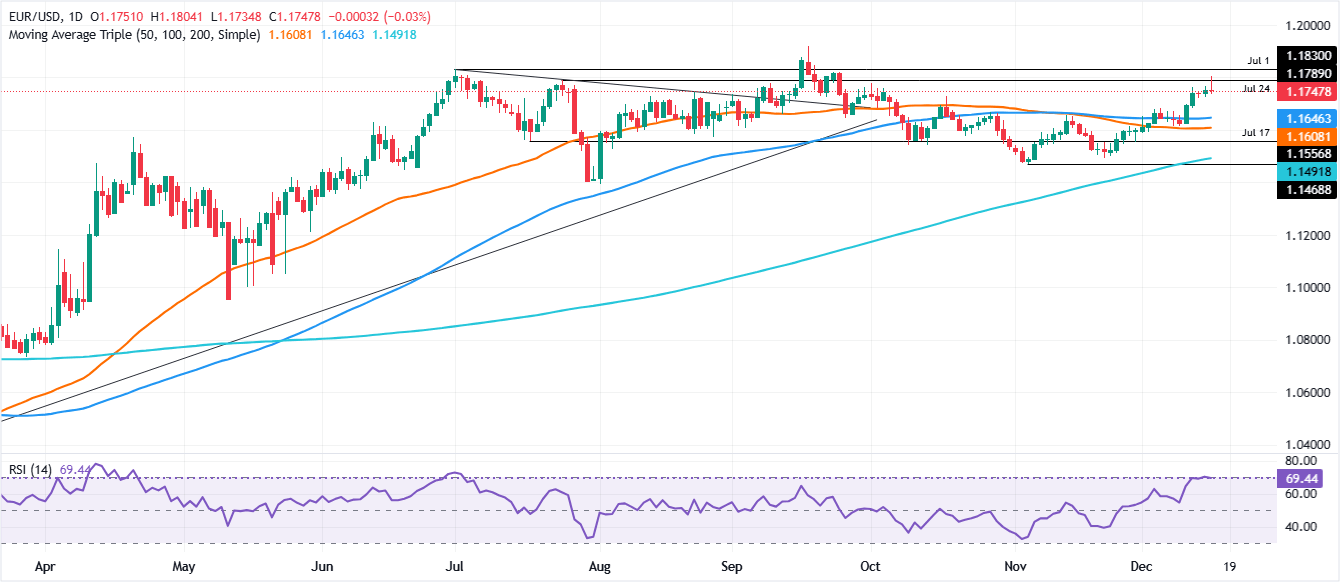
EUR/USD daily chart
EUR/USD remains neutral to upwardly biased as price action seems to form a Gravestone Doji, an indication of traders’ indecision. Bullish momentum is fading as depicted by the Relative Strength Index (RSI).
For a bullish continuation, buyers must clear 1.1800, so they could challenge the 1.1850 region and, ultimately, the yearly high at 1.1918. On the flip side, the EUR/USD falling below 1.1700 clears the path to challenge the 100-day Simple Moving Average (SMA) near 1.1645, ahead of the 1.1600 handle.
More By This Author:
Gold Eases Below $4,300 As Traders Unwind Post-NFP GainsGBP/USD Erupts As Soft US Jobs Data Crush The Dollar
EUR/USD Supported Above 1.1700 As Weaker Dollar Sets Tone Before NFP



Comments
Log in or sign up to join the conversation.