


Image Source: Unsplash
US equities sold off sharply on Tuesday as geopolitical risk surged after President Donald Trump escalated rhetoric around acquiring Greenland, including new tariff threats against close US allies. Markets reacted swiftly to the prospect of a renewed trade conflict, with investors reducing exposure to US assets amid concerns that tariffs are being used as a political tool rather than a purely economic one. Treasury yields jumped, the US Dollar (USD) weakened around 1%, and volatility spiked as risk sentiment deteriorated.
Frontline indexes decline, market withers on Greenland turmoil
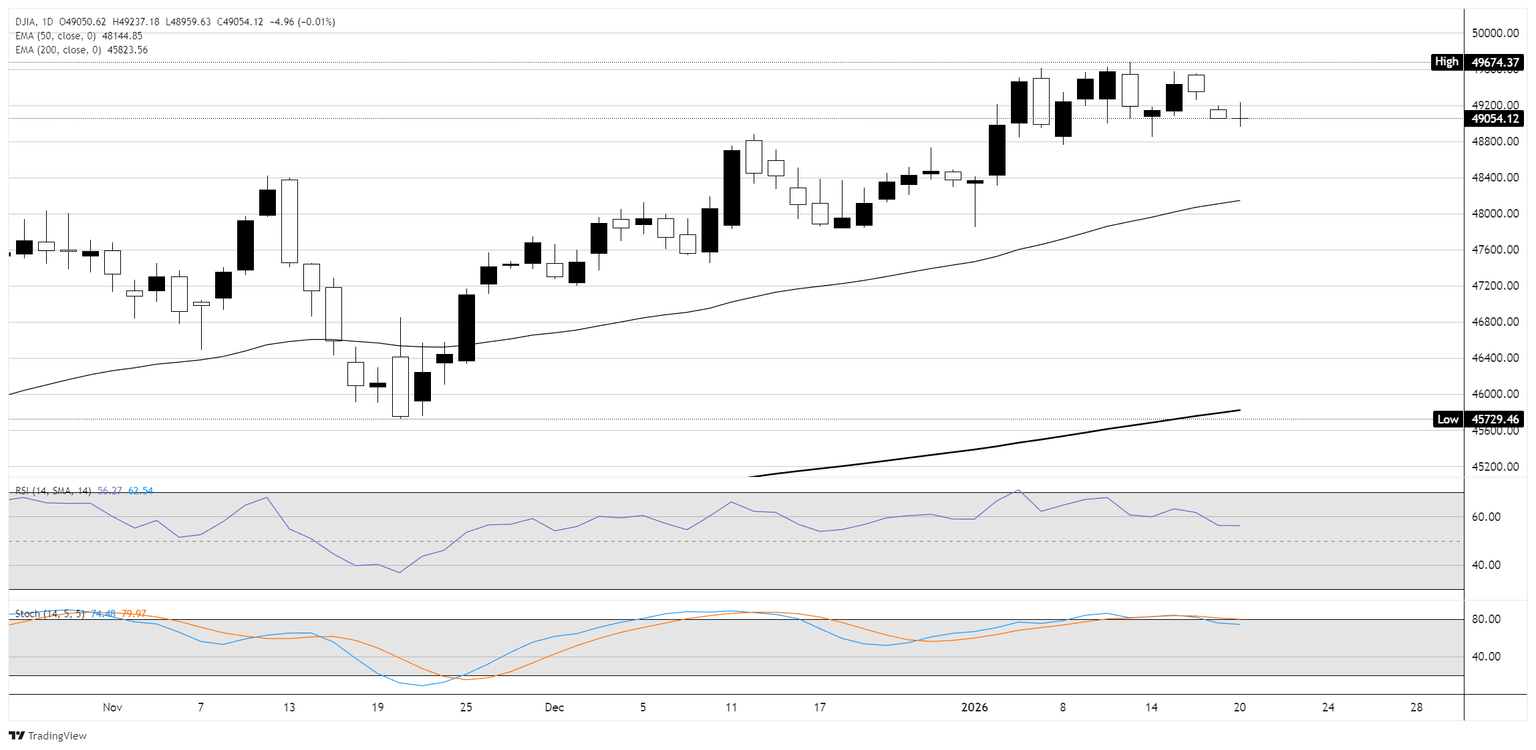
The Dow Jones Industrial Average (DJIA) fell 1.4%, while the S&P 500 and Nasdaq Composite declined 1.6% and 1.8%, respectively, pushing both indices into negative territory for the year. The VIX climbed above 20 for the first time since late November, reflecting rising uncertainty. Trump outlined plans to impose tariffs starting at 10% on imports from eight NATO countries on February 1, rising to 25% by June, and separately threatened 200% tariffs on French wine and champagne. European leaders have signaled strong opposition and are reportedly considering retaliatory measures, raising the risk of a broader escalation.
Market participants warned that equities were already priced for optimistic outcomes, leaving them vulnerable to policy shocks. Investors also grew uneasy about longer-term implications for capital flows, with concerns that persistent trade conflict could reduce foreign appetite for US assets and debt. The backdrop reinforced a global risk-off move, with the Euro strengthening against the Dollar and bonds selling off sharply. Trump is expected to address the issue with European leaders during meetings in Davos, where the topic has already drawn significant attention.
Key value segments draw fresh investing crowds
Technology stocks remained under pressure, leaving the Nasdaq trading lower on the year as several large-cap leaders continued to slide. Apple (AAPL) and Meta (META) are down roughly 8% year to date, while Microsoft (MSFT) has fallen about 6%, highlighting ongoing weakness in high valuation growth names amid rising geopolitical and policy uncertainty. Amid the broader selloff, defensive and value-oriented stocks offered pockets of stability, with Walmart (WMT) and Procter & Gamble (PG) reaching new highs, and insurance names such as Allstate (ALL) posting gains, as investors sought relative safety.
In contrast, small caps again showed relative resilience. The Russell 2000 outperformed the S&P 500 for the twelfth consecutive session, its longest such streak since 2008, and remains up more than 7% in 2026. Expectations for Federal Reserve (Fed) rate cuts, solid domestic growth data, and the index’s heavier exposure to US-focused businesses have helped insulate small caps from trade-related risks.
New Trump pick for Fed Chair expected
On the policy front, Treasury Secretary Scott Bessent said President Trump is close to nominating the next Federal Reserve chair, with a decision potentially coming as soon as next week. The process has narrowed to four candidates, adding another important macro catalyst for markets to monitor.
Dow Jones daily chart
(Click on image to enlarge)
More By This Author:
Dow Jones Industrial Average Softens On Final Trading Day Of 2025
USD/JPY Treads Water Near 156.00 As Yen Traders Grapple With Multiple Headwinds
AUD/USD Flubs Key Technical Level As Holiday Season Drains Market Volume

Comments
Log in or sign up to join the conversation.