

Clarity is the most sought-after commodity in the market, and also the rarest. Traders spend extraordinary amounts of time trying to predict what comes next—what the Federal Reserve will say, which sector will rotate, which headline will matter. Yet after fifteen years of analyzing volatility and even more time spent studying uncertainty in intelligence work, I have learned that prediction is often the weakest part of the process of using my indicator to find winning trades..
What matters is structure.
Before I traded markets, I worked in an environment where decisions could not wait for perfect information. Intelligence work forces a certain honesty on you: you make judgments knowing full well that the data is incomplete. You learn quickly that guessing is not analysis. You need a framework that interprets uncertainty the same way every time.
That lesson is the foundation of the volatility indicator I built more than a decade ago and still rely on today. The purpose is simple: when information is noisy, emotional, and contradictory, the structure remains stable. It behaves the same way regardless of headlines, sentiment, or opinion.
Volatility tells you what emotion is doing beneath the surface. Structure tells you when that emotion has reached its limit.
When investors grow anxious, volatility expands. When that anxiety exhausts itself, volatility contracts. The transition is often subtle, but it is measurable. And it appears inside individual stocks long before the broader market acknowledges it. My indicator evaluates that internal cycle. It identifies when a stock reaches an emotional extreme and when that pressure begins to unwind. That is where opportunity forms: not in the narrative that surrounds the stock, but in the structure of its behavior.
Recently, one of those patterns appeared in my service. The ITV indicator signaled that volatility in Wyndham Hotels & Resorts, Inc. (WH) had reached an extreme.
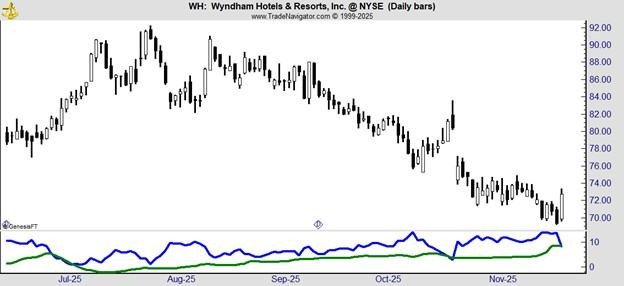
The next day, the pattern reversed and produced a quick exit signal. The move created a modest gain of about 3%, but that is the nature of structural opportunities. They are often quick and repeatable.
Former CIA analyst Richards Heuer, whose work guided generations of intelligence analysts, explained that people confronted with uncertainty often fall back on what feels familiar. They search for past situations that seem similar and assume the same outcome will follow. The problem is that familiarity is not evidence; it is simply memory dressed up as analysis.
Markets catch traders in this trap all the time. A pullback resembles a pullback from three years ago, so they treat it as if it were the same event. A rally resembles a rally from last spring, so they project the same path forward. The comparison is emotionally satisfying but analytically hollow.
A structured approach avoids that mistake. My indicator does not care which past event a pattern resembles. It measures whether volatility inside this stock is behaving the way it has behaved at past extremes. It compares structure to structure, not story to story. The past is used not because it is familiar, but because it is relevant.
This is the discipline behind every signal, and behind every trade I make.
Structure does not eliminate uncertainty, but it organizes it. And once uncertainty is organized, judgment becomes clearer. We stop reacting to the market’s noise and begin responding to its measurable rhythm. That rhythm is never perfect, but it is consistent enough to guide decisions that do not depend on predicting the future.
Clarity in trading rarely comes from foresight. It comes from a framework that treats uncertainty as a feature of the landscape, not a barrier to understanding. Volatility shows the emotional contour. Structure defines the opportunity. And discipline allows us to act on it with confidence, even when the surface of the market looks chaotic.
That is the role the indicator plays. It is not a crystal ball—it is a compass. And in markets built on uncertainty, a compass is far more valuable than a forecast.
More By This Author:
Unlock Trading Edges Hidden Inside Market ChaosThis Subtle Shift In Volatility Reveals New Opportunities
The Consistent Edge Hidden In Market Volatility


Comments
Log in or sign up to join the conversation.